
[论文解读] A Posteriori Evaluation of a Physics-Constrained Neural Ordinary Differential Equations Approach Coupled with CFD Solver for Modeling Stiff Chemical Kinetics
该论文提出了一种物理约束神经普通微分方程(PC-NODE)框架,在训练过程中通过损失函数直接施加元素质量守恒,显著提升了在模拟高 stiffness 化学动力学时的物理一致性与准确性。当与 CFD 求解器结合时,PC-NODE 在预测热化学状态方面优于纯数据驱动的 NODE 模型,并在面对未见条件时保持稳健的泛化能力,且误差累积极少。
The high computational cost associated with solving for detailed chemistry poses a significant challenge for predictive computational fluid dynamics (CFD) simulations of turbulent reacting flows. These models often require solving a system of coupled stiff ordinary differential equations (ODEs). While deep learning techniques have been experimented with to develop faster surrogate models, they often fail to integrate reliably with CFD solvers. This instability arises because deep learning methods optimize for training error without ensuring compatibility with ODE solvers, leading to accumulation of errors over time. Recently, NeuralODE-based techniques have offered a promising solution by effectively modeling chemical kinetics. In this study, we extend the NeuralODE framework for stiff chemical kinetics by incorporating mass conservation constraints directly into the loss function during training. This ensures that the total mass and the elemental mass are conserved, a critical requirement for reliable downstream integration with CFD solvers. Proof-of-concept studies are performed with physics-constrained neuralODE (PC-NODE) approach for homogeneous autoignition of hydrogen-air mixture over a range of composition and thermodynamic conditions. Our results demonstrate that this enhancement not only improves the physical consistency with respect to mass conservation criteria but also ensures better robustness. Lastly, a posteriori studies are performed wherein the trained PC-NODE model is coupled with a 3D CFD solver for computing the chemical source terms. PC-NODE is shown to be more accurate relative to the purely data-driven neuralODE approach. Moreover, PC-NODE also exhibits robustness and generalizability to unseen initial conditions from within (interpolative capability) as well as outside (extrapolative capability) the training regime.
研究动机与目标
- 解决数据驱动的代理模型在与 CFD 求解器耦合时,针对高 stiffness 化学动力学表现出的不稳定性和物理不一致性问题。
- 通过将元素质量守恒约束嵌入神经 ODE 训练过程,提升训练效率与物理保真度。
- 实现在包括分布外场景在内的多种初始条件下,对热化学状态演化进行稳健且可泛化的预测。
- 在三维 CFD 环境中,通过氢-空气自燃案例,证明物理约束方法的可行性与优越性。
提出的方法
- 在神经 ODE 训练过程中,将元素质量守恒作为正则化项引入损失函数,确保总质量和元素质量均被守恒。
- 使用神经网络参数化刚性 ODE 系统中的化学源项,这些源项在训练期间通过刚性 ODE 求解器进行积分。
- 使用详细化学机理生成的真值解进行端到端训练,最小化预测与真实热化学轨迹之间的差异。
- 将训练好的 PC-NODE 模型作为化学源项的代理模型,集成至 CONVERGE CFD 求解器中,用于三维模拟。
- 将该框架应用于不同当量比和初始温度下的氢-空气混合物均相自燃问题。
- 通过后处理 CFD 模拟验证性能,并与纯数据驱动的 NODE 模型(NO-CONS)及真值机理进行对比。
实验结果
研究问题
- RQ1在损失函数中施加元素质量守恒是否能提升神经 ODE 模型在高 stiffness 化学动力学中的物理一致性?
- RQ2与纯数据驱动的 NODE 模型相比,物理约束的 PC-NODE 模型在准确性及随时间累积误差方面表现如何?
- RQ3PC-NODE 模型在初始条件超出训练分布范围(包括外推区域)时,其泛化能力达到何种程度?
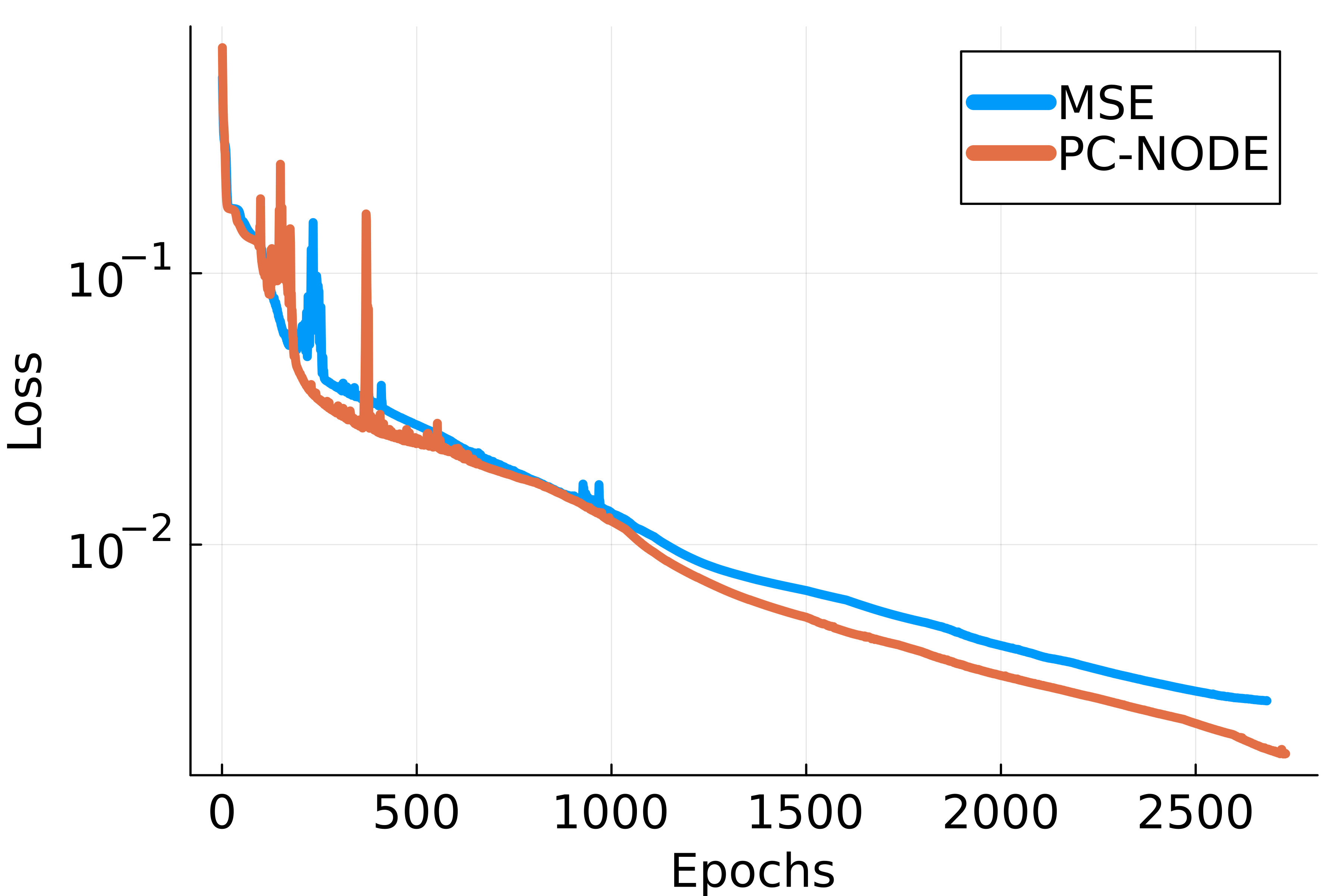
- RQ4在刚性 ODE 系统背景下,引入质量守恒约束是否能提升训练效率与收敛性?
主要发现
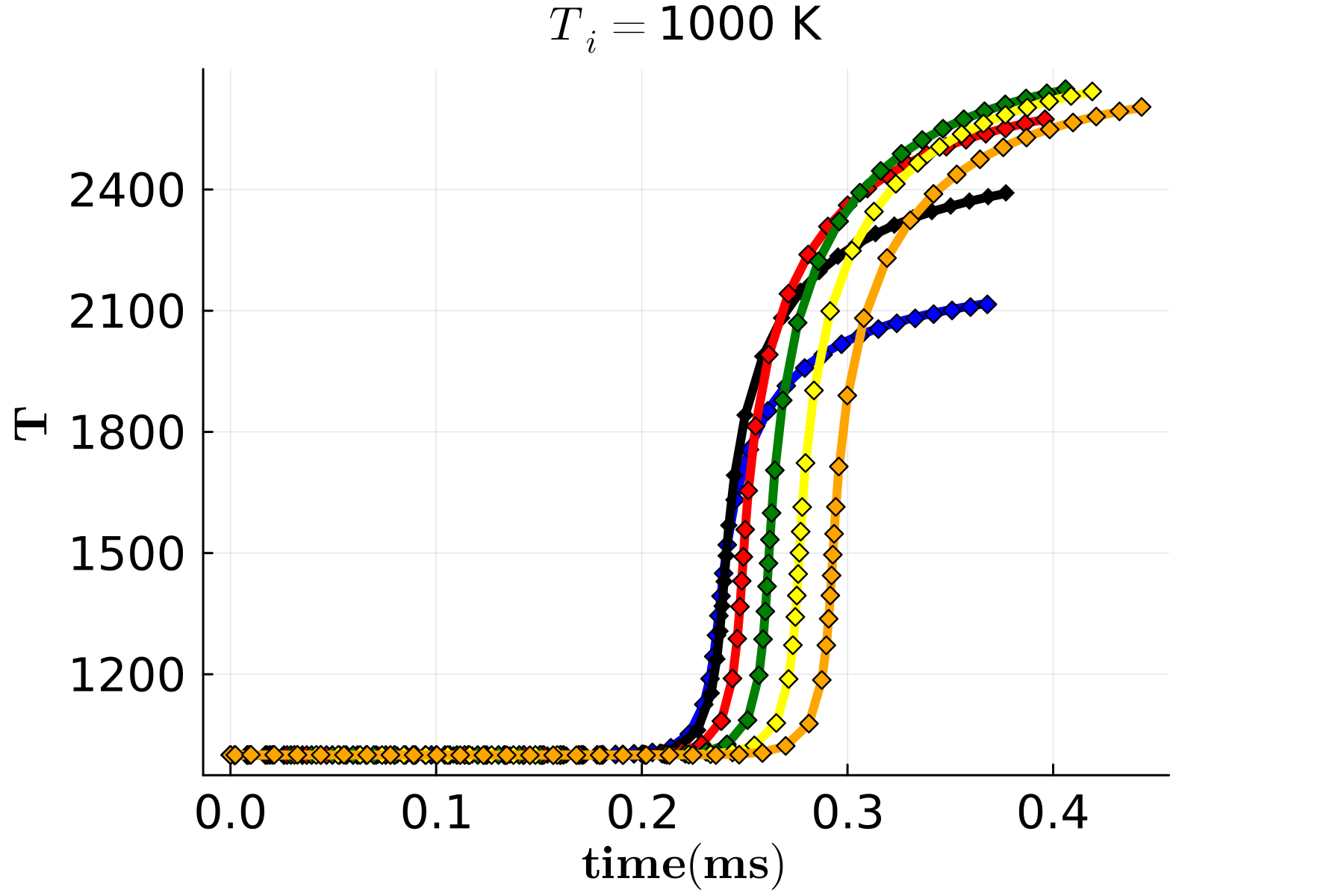
- 带有元素质量约束的 PC-NODE 模型(ELE-CONS)在温度和物种质量分数方面与真值高度一致,而无约束模型(NO-CONS)则表现出显著偏差。
- 即使在分布外条件下,PC-NODE 预测中的氢和氧元素质量分数也保持在数值容差范围内,证实了其物理一致性。
- PC-NODE 模型在初始温度为 1200 K 以及当量比 φ=0.4 和 φ=1.6 的条件下,表现出稳健的外推泛化能力,这些条件均超出其训练范围。
- 与纯数据驱动的 NODE 方法相比,PC-NODE 在热化学标量随时间演化过程中的误差显著更低。
- 由于损失函数中引入了物理定律的正则化,物理约束模型实现了更高的训练效率和更优的收敛行为。
- 当与 CONVERGE CFD 求解器耦合时,PC-NODE 保持了极低的质量守恒偏差,并在三维单元胞模拟中产生了准确且稳定的解。
更好的研究,从现在开始
从阅读论文到最终审阅,大幅缩短您的研究时间。
无需绑定信用卡
本解读由 AI 生成,并经人工编辑审核。