
[论文解读] A Quantum Algorithm for Model-Independent Searches for New Physics
本文提出一种受量子启发的检验统计量 ${\mathcal{H}}_{\text{min}}$,通过将数据残差映射到具有空间相关相互作用的伊辛自旋格点,实现对箱化对撞机数据中新物理的模型无关搜索。该方法通过利用物理信号中典型的关联性(而统计噪声中不存在)来减轻‘全局搜索效应’,在二维网格中,其受试者工作特征曲线下方面积重叠最多减少51.3%,优于传统的 $\chi^2$ 检验。
We propose a novel quantum technique to search for unmodeled anomalies in multidimensional binned collider data. We propose associating an Ising lattice spin site with each bin, with the Ising Hamiltonian suitably constructed from the observed data and a corresponding theoretical expectation. In order to capture spatially correlated anomalies in the data, we introduce spin-spin interactions between neighboring sites, as well as self-interactions. The ground state energy of the resulting Ising Hamiltonian can be used as a new test statistic, which can be computed either classically or via adiabatic quantum optimization. We demonstrate that our test statistic outperforms some of the most commonly used goodness-of-fit tests. The new approach greatly reduces the look-elsewhere effect by exploiting the typical differences between statistical noise and genuine new physics signals.
研究动机与目标
- 开发一种模型无关的拟合优度检验统计量,用于在不假设特定新物理信号的前提下,检测多维箱化对撞机数据中的未建模异常。
- 通过区分具有空间相关性的信号与无关联的统计涨落,减轻‘全局搜索效应’。
- 提出一种新颖的检验统计量 ${\mathcal{H}}_{\text{min}}$,其来源于由数据残差构建的伊辛哈密顿量的基态能量。
- 通过基态中的自旋构型分析,实现异常检测与解释的双重功能。
- 探索使用绝热量子优化在高能物理大规模应用中的可行性。
提出的方法
- 将每个数据箱对应为伊辛格点中的一个自旋位点 $s_i = \pm 1$,自旋构型表示与预期背景的偏离。
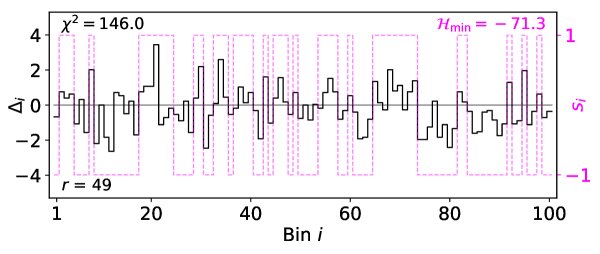
- 基于归一化残差 $\Delta_i = (o_i - e_i)/\sqrt{e_i}$ 定义伊辛哈密顿量 ${\mathcal{H}}$,包含最近邻自旋-自旋相互作用和自能相互作用。
- 将哈密顿量构建为 ${\mathcal{H}} = -\sum_i \frac{|\Delta_i|\Delta_i}{2} \cdot \frac{s_i}{2} - \frac{\lambda}{2} \sum_{i,j} w_{ij} \frac{(\Delta_i + \Delta_j)^2}{4} \cdot \frac{1 + s_i s_j}{2}$,其中 $\lambda$ 控制相互作用强度。
- 将基态能量 ${\mathcal{H}}_{\text{min}}$ 作为检验统计量:值越低,表示对背景假设的拟合越差。
- 通过模拟退火等经典方法计算 ${\mathcal{H}}_{\text{min}}$(适用于小 $N$),或通过绝热量子优化计算(适用于大 $N$)。
- 通过分析基态中的自旋构型来解释异常,识别出自旋对齐的大片区域,以指示相关偏离。
实验结果
研究问题
- RQ1能否构建一种模型无关的检验统计量,以捕捉数据残差中的空间相关性,从而提升对撞机物理中异常检测的性能?
- RQ2${\mathcal{H}}_{\text{min}}$ 检验统计量与传统的 $\chi^2$ 拟合优度检验相比,在统计功效和‘全局搜索效应’减轻方面表现如何?
- RQ3由数据残差构建的伊辛哈密顿量的基态在多大程度上能揭示可解释的结构,从而指示新物理信号?
- RQ4绝热量子优化能否为高维多箱数据集中的 ${\mathcal{H}}_{\text{min}}$ 计算提供可扩展的解决方案?
- RQ5将系统误差(通过 nuisance 参数 $\vec{\theta}$ 建模)纳入后,该检验统计量的稳健性如何受到影响?
主要发现
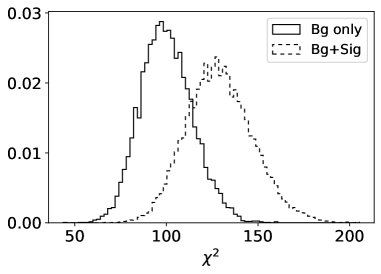
- 在16个箱的1D示例中,$\chi^2$ 检验的原假设与信号分布重叠为51.3%,而 ${\mathcal{H}}_{\text{min}}$ 降低至41.4%,表明区分能力提升。
- 在 $10\times10$ 的2D网格中,$\chi^2$ 的重叠面积为40.7%,而 ${\mathcal{H}}_{\text{min}}$ 仅为20.1%,显示出显著的性能提升。
- 图8中的ROC曲线表明,${\mathcal{H}}_{\text{min}}$ 在二维示例中始终优于 $\chi^2$ 检验和“区域”检验。
- ${\mathcal{H}}$ 哈密顿量基态中的自旋构型清晰显示出信号型偏离的大片自旋对齐区域,从而实现可解释的异常定位。
- 对于大 $N$,${\mathcal{H}}_{\text{min}}$ 的精确计算变得不可行,但绝热量子优化提供了一种有前景的可扩展替代方案。
- 经典方法如模拟退火在性能上与当前的绝热量子优化器相当,使其在近期应用中具有可行性。
更好的研究,从现在开始
从阅读论文到最终审阅,大幅缩短您的研究时间。
无需绑定信用卡
本解读由 AI 生成,并经人工编辑审核。