
[论文解读] A Robust Study of High-Redshift Galaxies: Unsupervised Machine Learning for Characterising morphology with JWST up to z ~ 8
本研究提出一种基于詹姆斯·韦布空间望远镜/近红外相机(JWST/NIRCam)图像的无监督机器学习框架,利用变分自编码器从6,869个高红移星系(z > 2)中提取固有形态特征,识别出11种独特且具有物理意义的形态类别。该方法消除了观测偏差,揭示了随着红移增加球状星系比例下降的趋势,并表明传统目视分类无法捕捉早期宇宙形态的复杂性,因此主张采用更精细、基于数据的分类体系。
Galaxy morphologies provide valuable insights into their formation processes, tracing the spatial distribution of ongoing star formation and encoding signatures of dynamical interactions. While such information has been extensively investigated at low redshift, it is crucial to develop a robust system for characterising galaxy morphologies at earlier cosmic epochs. Relying solely on the nomenclature established for low-redshift galaxies risks introducing biases that hinder our understanding of this new regime. In this paper, we employ variational auto-encoders to perform feature extraction on galaxies at z $>$ 2 using JWST/NIRCam data. Our sample comprises 6869 galaxies at z $>$ 2, including 255 galaxies z $>$ 5, which have been detected in both the CANDELS/HST fields and CEERS/JWST, ensuring reliable measurements of redshift, mass, and star formation rates. To address potential biases, we eliminate galaxy orientation and background sources prior to encoding the galaxy features, thereby constructing a physically meaningful feature space. We identify 11 distinct morphological classes that exhibit clear separation in various structural parameters, such as CAS-$M_{20}$, Sérsic indices, specific star formation rates, and axis ratios. We observe a decline in the presence of spheroidal-type galaxies with increasing redshift, indicating a dominance of disk-like galaxies in the early universe. We demonstrate that conventional visual classification systems are inadequate for high-redshift morphology classification and advocate the need for a more detailed and refined classification scheme. Leveraging machine-extracted features, we propose a solution to this challenge and illustrate how our extracted clusters align with measured parameters, offering greater physical relevance compared to traditional methods.
研究动机与目标
- 开发一种适用于高红移(z > 2)星系形态的稳健、无偏分类系统,以应对传统目视分类方案在面对致密、不规则和扰动形态时的失效问题。
- 通过在特征提取前对输入数据进行标准化,克服星系取向、背景源和图像噪声带来的偏差。
- 利用无监督学习识别出反映恒星形成率、结构参数和Sersic指数等物理特性的固有形态类别。
- 为高红移星系提供一种可扩展、具有物理意义的分类体系,作为传统命名法的替代方案,尤其考虑到JWST带来的数据量持续增长。
- 通过将形态类型与宇宙时空中物理参数关联,为未来星系演化研究提供支持。
提出的方法
- 采用变分自编码器(VAEs)从CEERS和CANDELS场中高红移星系的Rest-frame光学图像中提取低维、解耦的特征。
- 通过去除取向、背景源和噪声对图像进行预处理,确保学习到的特征反映的是固有形态而非观测伪影。
- 对VAE嵌入特征应用层次聚类,无需预先标注即可识别出11个独特且自相似的形态类别。
- 利用结构参数(CAS-M20、Sersic指数、轴比和特定恒星形成率(sSFR))验证并解释聚类结果。
- 将无监督聚类结果与传统目视分类进行比较,评估其物理相关性与分离程度。
- 采用JWST/NIRCam的Rest-frame光学成像,避免紫外形态带来的偏差,确保跨红移的一致性。
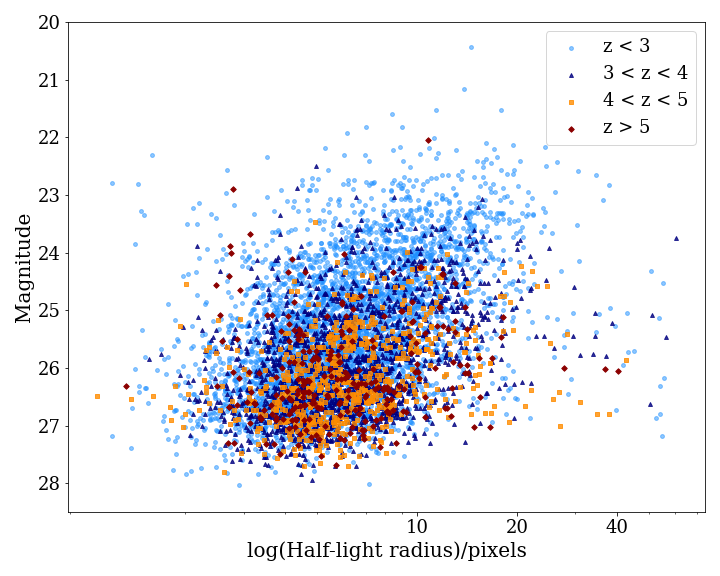
实验结果
研究问题
- RQ1无监督机器学习能否在不依赖预定义目视类别的前提下,从高红移星系中提取出具有物理意义的形态类别?
- RQ2在z > 2的星系中,特别是球状星系和盘状星系的形态分布如何随宇宙时间演化?
- RQ3传统目视分类系统在区分复杂高红移形态(如致密或扰动的盘状星系)方面存在多大程度的失效?
- RQ4哪些结构和物理参数最能表征无监督方法识别出的独立形态类别?
- RQ5提取的形态特征能否可靠地与恒星形成率和Sersic指数等物理属性关联?
主要发现
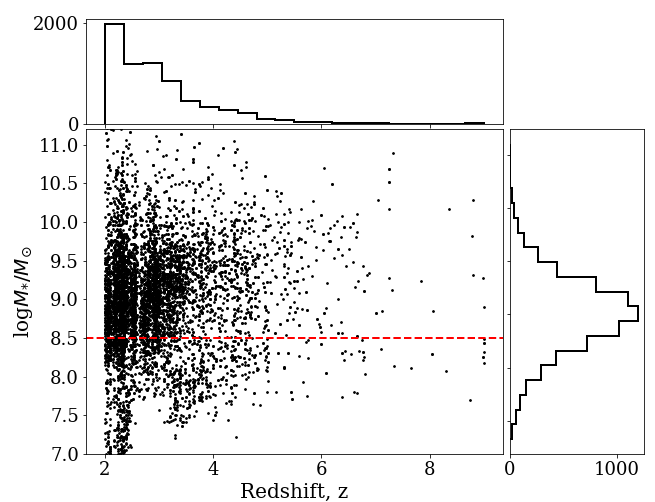
- 本研究基于JWST/NIRCam数据,对6,869个高红移星系(z > 2)进行无监督学习,识别出11种独特的形态类别,其中255个星系红移z > 5。
- 这些形态类别在物理参数空间中分布清晰,包括CAS-M20、Sersic指数、轴比和sSFR,表明其具有强物理一致性。
- 随着红移增加,球状星系的比例明显下降,证实了早期研究结果,并支持早期宇宙中以盘状、致密和扰动形态为主导的观点。
- 传统目视分类系统对非球状类型(尤其是盘状星系和特殊星系)的分离效果较差,凸显了建立更细致、基于数据的分类体系的必要性。
- 与以往研究相比,该无监督方法产生的聚类更少、分离更清晰,且更具物理可解释性,而以往研究常产生数百个定义模糊的类别。
- 特征空间具有物理意义,因其排除了取向和背景污染的影响,使模型能够专注于固有形态结构。
更好的研究,从现在开始
从阅读论文到最终审阅,大幅缩短您的研究时间。
无需绑定信用卡
本解读由 AI 生成,并经人工编辑审核。