
[论文解读] A room-temperature moiré interlayer exciton laser
本研究首次展示了基于MoS₂/WSe₂异质结中莫尔周期势的室温激子激光,该异质结与硅基拓扑纳米腔集成。莫尔势增强了激子寿命,实现了宽范围的发射波长调谐,并在光通信O波段实现了亚0.1 nm谱线宽的超低阈值激光。
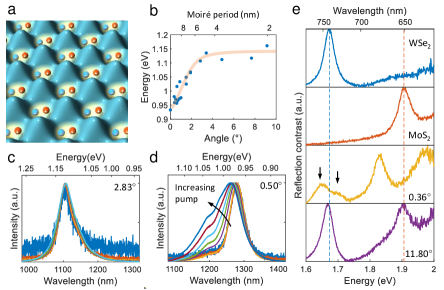
Moiré superlattices in van der Waals heterostructures offer highly tunable quantum systems with emergent electronic and excitonic properties such as superconductivity, topological edge states, and moiré-trapped excitons. Theoretical calculations predicted the existence of the moiré potential at elevated temperatures; however, its impact on the optical properties of interlayer excitons (IXs) at room temperature is lacking, and the benefits of the moiré effects for lasing applications remain unexplored. We report that the moiré potential in a molybdenum disulfide/tungsten diselenide (MoS2/WSe2) heterobilayer system can significantly enhance light emission, elongate the IX lifetime, and modulate the IX emission energy at room temperature. By integrating a moiré superlattice with a silicon topological nanocavity, we achieve ultra-low-threshold lasing at the technologically important telecommunication O-band thanks to the significant moiré modulation. Moreover, the high-quality topological nanocavities facilitate the highest spectral coherence of < 0.1 nm linewidth among all reported two-dimensional material-based laser systems. Our findings not only open a new avenue for studying correlated states at elevated temperatures, but also enable novel architectures for integrated on-chip photonics and optoelectronics.
研究动机与目标
- 展示基于二维异质结中莫尔超晶格的室温层间激子激光。
- 研究莫尔势在室温下对激子寿命和发射波长可调性的增强作用。
- 将莫尔层间激子与高品质因子拓扑光子纳米腔集成,实现低阈值激光。
- 在基于二维材料的激光系统中实现高光谱相干性和侧模抑制。
- 探索莫尔激子在室温下用于片上集成光子学与光电子学的潜力。
提出的方法
- 采用扭转角依赖的光致发光(PL)和反射率对比光谱测量,研究室温下MoS₂/WSe₂异质结中莫尔势的影响。
- 通过功率依赖的PL和时间分辨PL测量,评估激子复合动力学与辐射效率。
- 将异质结与基于硅的拓扑光子晶体纳米腔集成,实现高品质因子(Q > 10⁴)的光学限制。
- 使用具有高槽密度光栅(600–1200条/mm)的Czerny-Turner单色仪,实现对激光模式的高分辨率光谱检测。
- 通过偏振分辨二次谐波生成(SHG)测量,确定异质结的扭转角。
- 采用有限元差分时域(FDTD)方法模拟拓扑纳米腔,以优化共振波长与模场分布。
实验结果
研究问题
- RQ1MoS₂/WSe₂中的莫尔层间激子是否能在室温下维持强光学活性和长寿命的激子态?
- RQ2在常温条件下,莫尔势在多大程度上增强二维异质结中激子的寿命并调制发射能量?
- RQ3当与高品质因子拓扑纳米腔耦合时,二维异质结中的莫尔激子能否实现低阈值激光?
- RQ4与其它基于二维材料的激光器相比,该系统中激光的光谱相干性与侧模抑制比如何?
- RQ5莫尔势与拓扑纳米腔的结合是否能在室温下实现技术上重要的O波段(1260–1360 nm)激光?
主要发现
- MoS₂/WSe₂异质结中的莫尔势显著延长了层间激子(IX)的寿命,并在室温下实现了超宽的发射波长调谐。
- 室温下的层间激子表现出非辐射复合的抑制,从而提升了光致发光量子产率。
- 由于强莫尔调制与高品质因子拓扑纳米腔的限制作用,O波段(1260–1360 nm)实现了超低阈值激光。
- 激光的谱线宽小于0.1 nm,为迄今报道的基于二维材料激光中最窄的线宽。
- 实现了超过30 dB的侧模抑制比(SMSR),表明具有高光谱纯度和单模工作特性。
- 相干时间估计在纳秒量级,与高光谱相干性和稳定激光工作一致。

更好的研究,从现在开始
从阅读论文到最终审阅,大幅缩短您的研究时间。
无需绑定信用卡
本解读由 AI 生成,并经人工编辑审核。