
[论文解读] A simple model for the emergence of relaxation-oscillator convection
该论文表明,松弛振荡器(RO)对流——其特征为周期性强烈风暴后紧随干季——可在具有参数化对流的单列辐射对流平衡模型中出现,而不仅限于云分辨的三维模拟。当对流可用潜能能(CAPE)无法再维持深层、夹卷的气块上升时,RO状态便会出现,这导致在稳态解析模型中出现不稳定性,从而引发振荡行为;该机制适用于任何水汽行星大气,包括土卫六的甲烷循环。
Earth's tropics are characterized by quasi-steady precipitation with small oscillations about a mean value, which has led to the hypothesis that moist convection is in a state of quasi-equilibrium (QE). In contrast, very warm simulations of Earth's tropical convection are characterized by relaxation-oscillator-like (RO) precipitation, with short-lived convective storms and torrential rainfall forming and dissipating at regular intervals with little to no precipitation in between. We develop a model of moist convection by combining a zero-buoyancy model of bulk-plume convection with a QE heat engine model, and we use it to show that QE is violated at high surface temperatures. We hypothesize that the RO state emerges when the equilibrium condition of the convective heat engine is violated, i.e., when the heating rate times a thermodynamic efficiency exceeds the rate at which work can be performed. We test our hypothesis against one- and three-dimensional numerical simulations and find that it accurately predicts the onset of RO convection. The proposed mechanism for RO emergence from QE breakdown is agnostic of the condensable, and can be applied to any planetary atmosphere undergoing moist convection. To date, RO states have only been demonstrated in three-dimensional convection-resolving simulations, which has made it seem that the physics of the RO state requires simulations that can explicitly resolve the three-dimensional interaction of cloudy plumes and their environment. We demonstrate that RO states also exist in single-column simulations of radiative-convective equilibrium with parameterized convection, albeit in a different surface temperature range and with much longer storm-free intervals.
研究动机与目标
- 研究松弛振荡器(RO)对流——即周期性强烈风暴后紧随干季——是否可在具有参数化对流的单列模型中出现,而非必须依赖云分辨的三维模拟。
- 通过分析简化准平衡(QE)模型在辐射对流平衡中不存在稳态解的情况,确定RO状态出现的物理机制。
- 检验所提出的机制在不同凝结物质(包括地球上的水和土卫六上的甲烷)中的普适性。
- 确立RO状态并非依赖于显式对流解析,而是源于当CAPE不足以维持持续对流时能量收支中的基本不稳定性。
提出的方法
- 在单列模式下使用修改后的ECHAM6通用环流模型,包含参数化辐射、对流和云过程。
- 采用具有夹卷与变性过程的块体气块对流方案,以及基于相对湿度的大尺度凝结/再蒸发方案。
- 将海面温度(SST)从290 K逐步增加至370 K,每步增加1–5 K,以探索对流型态的转变。
- 构建一个假设恒定夹卷率和固定对流层顶温度(200 K)的辐射对流平衡的解析准平衡(QE)模型。
- 利用湿位能守恒和块体气块参数化方法,推导出夹卷气块的温度直减率和潜热释放。
- 通过分析解析模型中不存在稳态解的情况,评估系统的稳定性,将此与振荡性RO状态的出现相联系。
实验结果
研究问题
- RQ1松弛振荡器(RO)对流是否可在具有参数化对流的单列模型中出现,而无需依赖云分辨的三维模拟?
- RQ2RO状态在辐射对流平衡中出现的物理机制是什么?
- RQ3为何RO状态在高表面温度或高大气水汽条件下出现?这与对流可用潜能能(CAPE)有何关联?
- RQ4该RO机制是否可推广至不同凝结物质,如地球上的水和土卫六上的甲烷?
- RQ5在RCE的简化解析模型中,稳态解的缺失是否可解释振荡行为的出现?
主要发现
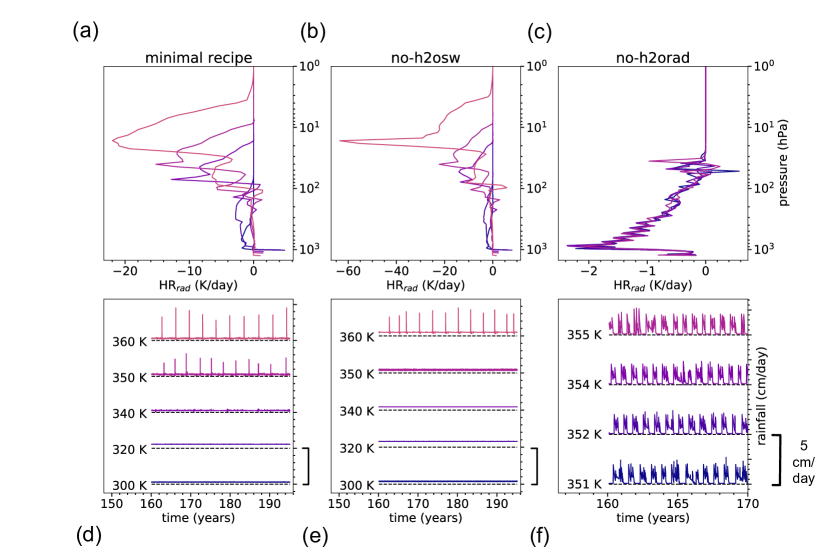
- 在具有参数化对流的单列辐射对流平衡模型(1D-RCE)中出现松弛振荡器(RO)状态,证实显式云分辨并非RO行为所必需。
- RO状态在地表温度约350 K时出现,此时降水爆发可达每日5 cm,每100–1000天重复一次,交替出现干季。
- 当对流可用潜能能(CAPE)无法再支持深层对流持续维持时,RO状态便会出现,导致解析QE模型中稳态解的崩溃。
- 该机制具有普适性:适用于任何水汽行星大气,无论凝结物质为何,已通过成功应用于土卫六甲烷循环得到验证。
- 解析模型表明,当可降水量与夹卷率之比(PE/a)非常数时,稳态解失效,导致与RO状态一致的振荡行为。
- 向RO行为的转变与CAPE崩溃以及夹卷气块无法维持浮力密切相关,最终导致周期性风暴循环。
更好的研究,从现在开始
从阅读论文到最终审阅,大幅缩短您的研究时间。
无需绑定信用卡
本解读由 AI 生成,并经人工编辑审核。