
[论文解读] A Survey on Detection of LLMs-Generated Content
本综述对大型语言模型(LLM)生成内容的检测方法进行了全面分析,将技术分类为基于训练的方法、零样本方法和水印方法。它指出了关键挑战,如模型鲁棒性、对非母语者的偏见,以及在不断演化的LLM中泛化能力不足的问题,并倡导采用多维度、自适应的检测系统,以确保在实际应用中的可靠性。
The burgeoning capabilities of advanced large language models (LLMs) such as ChatGPT have led to an increase in synthetic content generation with implications across a variety of sectors, including media, cybersecurity, public discourse, and education. As such, the ability to detect LLMs-generated content has become of paramount importance. We aim to provide a detailed overview of existing detection strategies and benchmarks, scrutinizing their differences and identifying key challenges and prospects in the field, advocating for more adaptable and robust models to enhance detection accuracy. We also posit the necessity for a multi-faceted approach to defend against various attacks to counter the rapidly advancing capabilities of LLMs. To the best of our knowledge, this work is the first comprehensive survey on the detection in the era of LLMs. We hope it will provide a broad understanding of the current landscape of LLMs-generated content detection, offering a guiding reference for researchers and practitioners striving to uphold the integrity of digital information in an era increasingly dominated by synthetic content. The relevant papers are summarized and will be consistently updated at https://github.com/Xianjun-Yang/Awesome_papers_on_LLMs_detection.git.
研究动机与目标
- 为不同应用场景下LLM生成的文本和代码的现有检测策略提供系统性概述。
- 识别检测中的关键挑战,包括模型鲁棒性、对非母语者的偏见,以及在不同LLM变体间泛化能力差的问题。
- 分析对检测系统的对抗性攻击,并强调需要具备弹性的、多维度的防御机制。
- 倡导在检测工具中采用标准化评估、可解释性和透明性,以确保公平性和可靠性。
- 为致力于在合成内容时代维护数字信息完整性的研究人员和实践者提供基础参考。
提出的方法
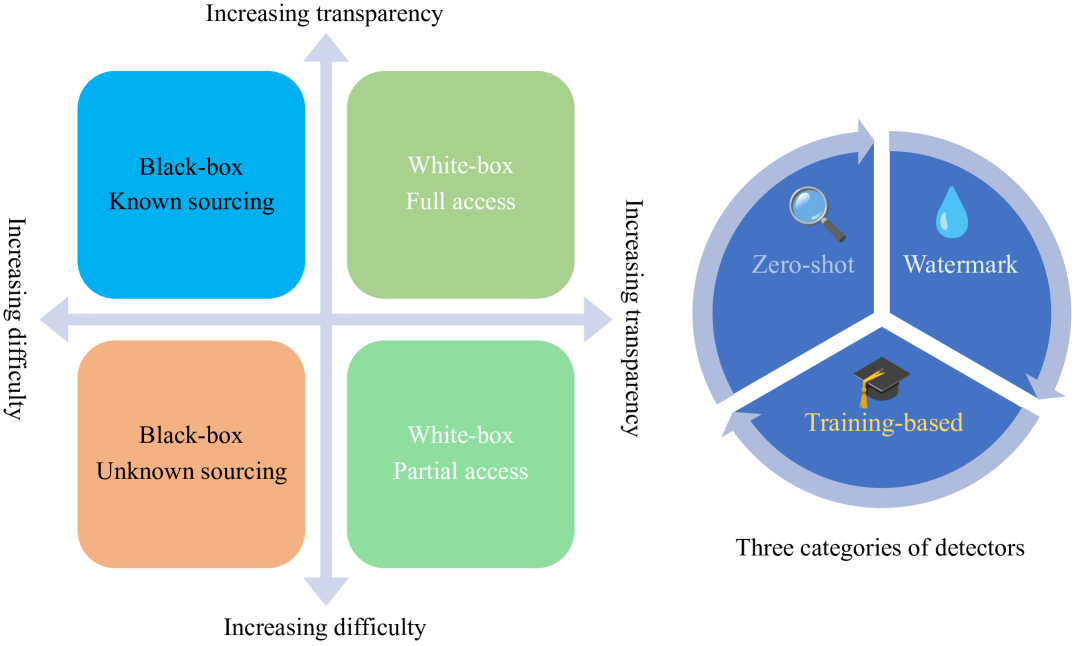
- 根据工作原理和适用范围对检测方法进行分类,包括基于训练的方法、零样本方法和水印技术。
- 回顾LLM检测研究中使用的基准数据集和评估指标,强调可复现性和标准化。
- 分析模型溯源方法(如GPT-who),通过统计特征(如均匀信息密度,UID)识别生成文本的具体LLM来源。
- 研究水印方法作为主动检测手段,评估其在改写和上下文长度攻击下的鲁棒性。
- 调查对检测器的对抗性攻击,如提示工程和文本改写,以测试其鲁棒性和可靠性。
- 评估检测器在未见过的LLM和数据源上的泛化性能,突出零样本检测的局限性。
实验结果
研究问题
- RQ1LLM生成内容的主流检测方法是什么?它们在机制和性能上如何不同?
- RQ2当前检测器在不同语言、风格和领域特定场景下的表现如何,特别是在非英语文本和代码方面?
- RQ3检测器在多大程度上能泛化到新发布或微调后的LLM(如更新版的ChatGPT)?
- RQ4现有检测系统在对抗性攻击下的关键弱点是什么?如何加以缓解?
- RQ5如何使检测系统更具公平性、透明性和可解释性,以减少偏见并提升实际部署中的信任度?
主要发现
- 当前检测器对非母语英语使用者表现出显著偏见,且在非英语或短文本上的表现较差。
- 零样本检测器在不同LLM生成器之间无法泛化,如Pu等人(2023)所展示,表明其鲁棒性不足。
- 根据Kirchenbauer等人(2023b)的研究,水印技术在人类改写和上下文长度约1000个token的攻击下仍表现出可靠性。
- 如GPT-who等模型溯源方法利用基于UID的特征,可实现对特定LLM和人类作者的准确归属识别。
- 随着LLM的更新,检测器性能随时间下降,如Tu等人(2023)通过每日监控ChatGPT响应所证实。
- 目前尚无检测器具有普遍可靠性,所有检测器在应对LLM能力的持续演进时均面临挑战,因此亟需采用自适应且多维度的检测策略。
更好的研究,从现在开始
从阅读论文到最终审阅,大幅缩短您的研究时间。
无需绑定信用卡
本解读由 AI 生成,并经人工编辑审核。