
[论文解读] A Survey on Safety-Critical Driving Scenario Generation -- A Methodological Perspective
本综述提出了一种针对自动驾驶车辆安全关键驾驶场景生成的全面方法论分类法,将方法分为数据驱动、对抗性以及基于知识的方法。它识别出关键挑战——保真度、效率、多样性、可迁移性和可控性,并提出未来研究方向,包括整合物理定律,利用生成的场景通过课程学习和对抗性训练提升系统鲁棒性与泛化能力。
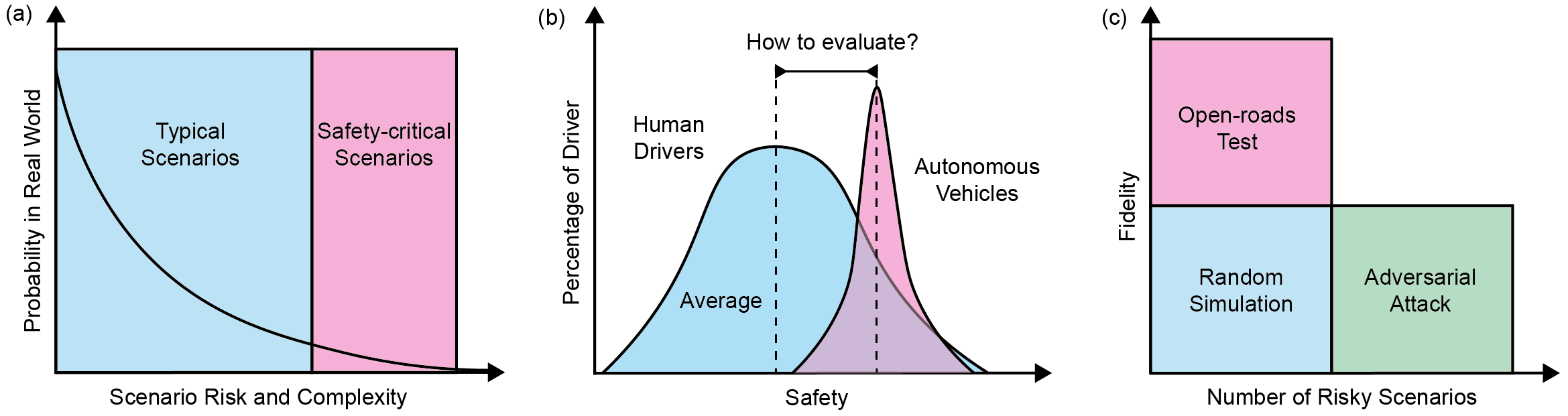
Autonomous driving systems have witnessed a significant development during the past years thanks to the advance in machine learning-enabled sensing and decision-making algorithms. One critical challenge for their massive deployment in the real world is their safety evaluation. Most existing driving systems are still trained and evaluated on naturalistic scenarios collected from daily life or heuristically-generated adversarial ones. However, the large population of cars, in general, leads to an extremely low collision rate, indicating that the safety-critical scenarios are rare in the collected real-world data. Thus, methods to artificially generate scenarios become crucial to measure the risk and reduce the cost. In this survey, we focus on the algorithms of safety-critical scenario generation in autonomous driving. We first provide a comprehensive taxonomy of existing algorithms by dividing them into three categories: data-driven generation, adversarial generation, and knowledge-based generation. Then, we discuss useful tools for scenario generation, including simulation platforms and packages. Finally, we extend our discussion to five main challenges of current works -- fidelity, efficiency, diversity, transferability, controllability -- and research opportunities lighted up by these challenges.
研究动机与目标
- 为解决在真实世界数据中代表性不足的罕见高风险场景下评估自动驾驶车辆安全性的关键挑战。
- 基于其底层信息源和框架,对现有场景生成方法进行系统性分类。
- 识别当前场景生成方法中的关键挑战——保真度、效率、多样性、可迁移性和可控性。
- 指导研究人员和从业者根据特定评估需求选择合适的生成算法。
- 概述未来研究方向,包括整合物理定律、利用离线强化学习,以及利用生成场景提升系统鲁棒性与泛化能力。
提出的方法
- 将场景生成划分为三大方法学类别:数据驱动(基于真实世界数据使用深度生成模型)、对抗性(应用优化或强化学习以发现故障案例)、基于知识(使用基于规则或符号约束定义安全关键条件)。
- 提出一种分层场景表示方法,嵌入物理定律与物体交互关系,以提升真实感与可解释性。
- 回顾广泛使用的仿真平台(如 CARLA、LGSVL)和开源工具(如 AirSim、ScenarioGen)在场景设计与评估中的应用。
- 整合离线强化学习与模仿学习,以更好地使生成场景与真实世界数据分布对齐。
- 建议结合多种方法(如数据驱动 + 对抗性,或基于知识 + 对抗性),以在多样性、真实感与可控性之间取得平衡。
- 提出课程学习与分布鲁棒优化作为策略,利用生成场景提升自动驾驶系统泛化能力与鲁棒性。
实验结果
研究问题
- RQ1如何基于其底层方法论与信息源,系统性地对安全关键驾驶场景进行分类?
- RQ2当前场景生成方法的关键局限是什么,它们如何影响自动驾驶车辆安全的评估?
- RQ3如何使生成的场景既具备高保真度(真实感强),又能有效揭示系统漏洞(高关键性)?
- RQ4外部知识(如物理定律与交通规则)在提升生成场景的可解释性与有效性方面发挥什么作用?
- RQ5如何不仅将生成场景用于评估,还可用于提升自动驾驶系统的鲁棒性与泛化能力?
主要发现
- 数据驱动方法,尤其是深度生成模型,能够捕捉复杂的交通模式,但常因数据稀疏性而难以生成高风险场景。
- 对抗性生成方法在发现故障案例方面非常有效,但可能产生不真实或物理上不可能的场景。
- 基于知识的方法提供高可解释性与控制性,但通常缺乏多样性,可能遗漏罕见而复杂的交互行为。
- 结合数据驱动与对抗性方法,为发现多样化、真实且安全关键的场景提供了有前景的路径。
- 将物理定律与真实世界数据分布整合到场景生成中,可提升保真度,并确保生成场景既具意义又可测试。
- 在课程学习与分布鲁棒优化框架中使用生成场景,可显著提升自动驾驶系统的鲁棒性与泛化能力。

更好的研究,从现在开始
从阅读论文到最终审阅,大幅缩短您的研究时间。
无需绑定信用卡
本解读由 AI 生成,并经人工编辑审核。