
[论文解读] A unified accretion disc model for supermassive black holes in galaxy formation simulations: method and implementation
本文提出了一种适用于星系形成模拟中超大质量黑洞(SMBHs)的统一吸积盘模型,整合了主导吸积流-喷流解(ADIOS)与薄 $α$-盘物理模型,自洽地模拟了吸积盘从厚态到薄态的转变过程以及通过兰斯-蒂林预cession驱动的SMBH自转演化。该模型预测的吸积盘亮度显著低于标准薄盘模型,同时喷流产生效率更高,对SMBH双星的电磁与引力波对应体具有重要影响。
It is well established that supermassive black hole (SMBH) feedback is crucial for regulating the evolution of massive, if not all, galaxies. However, modelling the interplay between SMBHs and their host galaxies is challenging due to the vast dynamic range. Previous simulations have utilized simple subgrid models for SMBH accretion, while recent advancements track the properties of the unresolved accretion disc, usually based on the thin $α$-disc model. However, this neglects accretion in the radiatively inefficient regime, expected to occur through a thick disc for a significant portion of an SMBH's lifetime. To address this, we present a novel 'unified' accretion disc model for SMBHs, harnessing results from the analytical advection-dominated inflow-outflow solution (ADIOS) model and state-of-the-art GR(R)MHD simulations. Going from low to high Eddington ratios, our model transitions from an ADIOS flow to a thin $α$-disc via a truncated disc, incorporating self-consistently SMBH spin evolution due to Lense-Thirring precession. Utilizing the moving mesh code AREPO, we perform simulations of single and binary SMBHs within gaseous discs to validate our model and assess its impact. The disc state significantly affects observable luminosities, and we predict markedly different electromagnetic counterparts in SMBH binaries. Crucially, the assumed disc model shapes SMBH spin magnitudes and orientations, parameters that gravitational wave observatories like LISA and IPTA are poised to constrain. Our simulations emphasize the importance of accurately modelling SMBH accretion discs and spin evolution, as they modulate the available accretion power, profoundly shaping the interaction between SMBHs and their host galaxies.
研究动机与目标
- 解决现有星系形成模拟中亚网格吸积模型的局限性,这些模型通常仅假设薄$α$-盘,而忽略了辐射效率低下吸积态。
- 整合从厚态ADIOS流到截断薄盘的现实吸积盘转变过程,覆盖不同爱丁顿比值范围。
- 通过兰斯-蒂林预cession自洽建模SMBH自转演化,该过程影响反馈效率与引力波信号特征。
- 评估吸积盘状态对可观测亮度与喷流产生效率的影响,尤其关注SMBH双星及未来多信使任务(如LISA与SKA)的探测潜力。
- 通过以物理解释的统一框架替代简化的吸积模型,提升SMBH并合事件电磁与引力波对应体的预测精度。
提出的方法
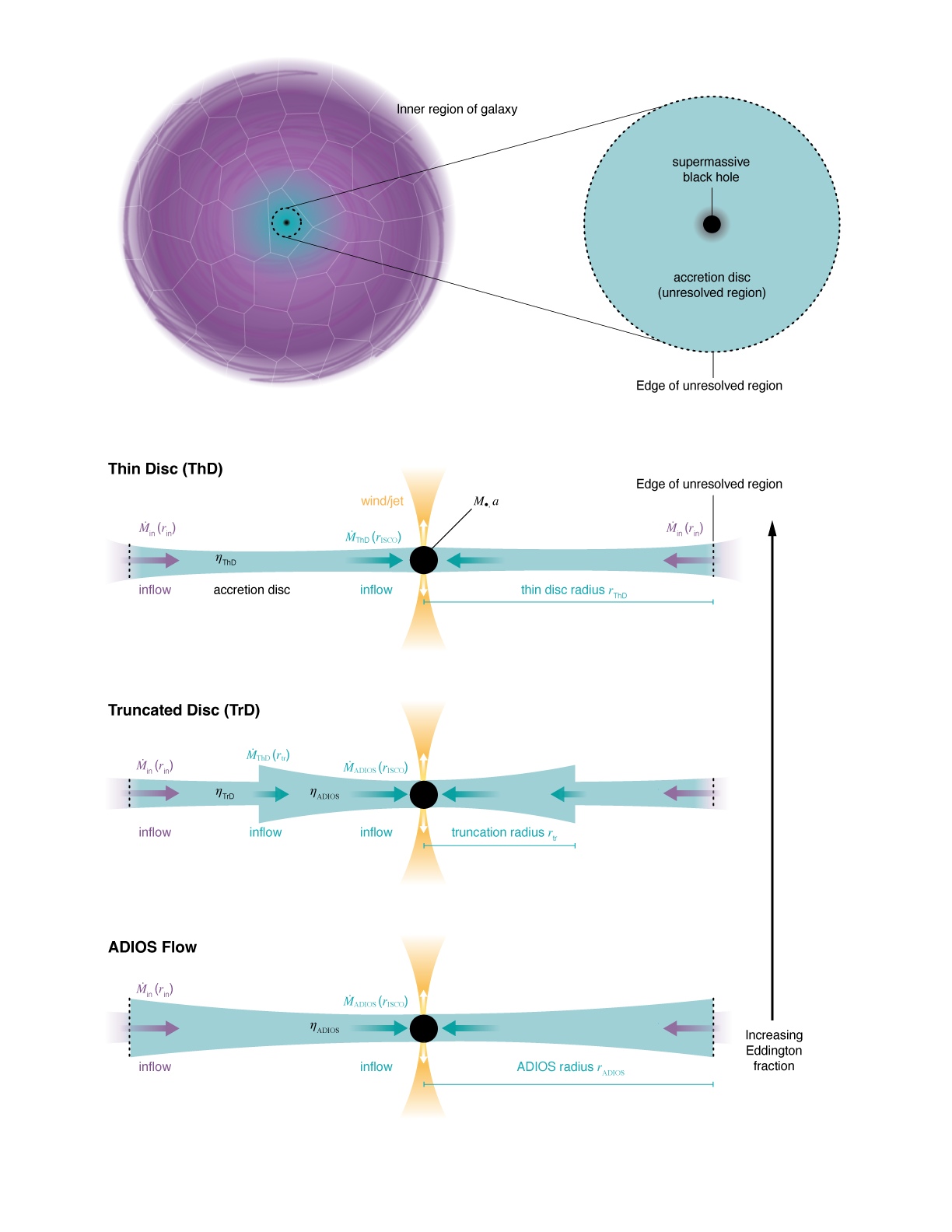
- 该模型结合解析ADIOS解与GR(R)MHD模拟结果,描述从低到高爱丁顿比值范围的吸积流行为。
- 在低吸积率下平滑过渡为热、辐射效率低的厚ADIOS流,在高吸积率下过渡为薄$α$-盘,中间经历截断盘状态。
- SMBH自转演化通过兰斯-蒂林预cession计算,自转大小与方向与盘面几何结构及角动量转移动态耦合。
- 该统一模型被集成至移动网格代码arepo中,用于模拟孤立及双SMBH系统在气态盘中的演化。
- 模拟追踪不同吸积盘状态下的吸积率、亮度、喷流功率与自转演化,以评估其对可观测信号的影响。
- 通过将预测亮度与喷流效率与标准薄盘假设结果对比,验证模型可靠性。
实验结果
研究问题
- RQ1从厚ADIOS流向薄$α$-盘的过渡如何影响星系形成模拟中SMBH预测亮度?
- RQ2吸积盘模型的选择在多大程度上影响SMBH自转演化,包括自转大小与方向?
- RQ3与标准薄$α$-盘模型相比,该统一模型在电磁辐射与喷流亮度方面有何差异?
- RQ4该统一模型对SMBH双星在X射线、光学、红外与射电波段的可探测性有何影响?
- RQ5吸积盘状态如何影响SMBH双星并合过程中的引力波背景与反冲速度?
主要发现
- 与薄$α$-盘模型相比,该统一模型将预测的吸积盘亮度降低了整整一个数量级,尤其在低爱丁顿比值区域,这是由于内层热ADIOS流占主导所致。
- 该模型预测来自几何厚ADIOS流的喷流亮度显著更高,使SKA与ngVLA更可能探测到射电喷流。
- 由于外部吸积率较低,SMBH自转大小在不同盘态间演化平缓;但在截断盘区域,自转方向受兰斯-蒂林预cession影响迅速变化。
- 自转方向从缓慢的Bardeen-Petterson对齐演变为快速的刚体预cession,可能增强反馈中喷流能量的空间分布。
- 对于SMBH双星,不同盘态下自转演化差异可显著改变反冲速度与并合率,从而影响引力波背景特征。
- 与薄盘模型相比,该模型预测的可探测吸积盘亮度红移范围大幅缩小,光谱能量分布向更高能段移动。
更好的研究,从现在开始
从阅读论文到最终审阅,大幅缩短您的研究时间。
无需绑定信用卡
本解读由 AI 生成,并经人工编辑审核。