
[论文解读] A Unified Learning Model for Estimating Fiber Orientation Distribution Functions on Heterogeneous Multi-shell Diffusion-weighted MRI
本文提出一种单阶段球面卷积神经网络(spherical CNN),并引入动态头机制,用于从异质多壳扩散加权磁共振成像(multi-shell diffusion-weighted MRI)中统一、端到端地估计纤维方向分布函数(fODFs)。通过联合建模q空间与径向b值信息,该方法在不同壳层配置下均优于多阶段学习方法,在fODF精度与扫描-重扫描一致性方面表现更优,在HCP年轻成人数据集上达到最先进性能。
Diffusion-weighted (DW) MRI measures the direction and scale of the local diffusion process in every voxel through its spectrum in q-space, typically acquired in one or more shells. Recent developments in micro-structure imaging and multi-tissue decomposition have sparked renewed attention to the radial b-value dependence of the signal. Applications in tissue classification and micro-architecture estimation, therefore, require a signal representation that extends over the radial as well as angular domain. Multiple approaches have been proposed that can model the non-linear relationship between the DW-MRI signal and biological microstructure. In the past few years, many deep learning-based methods have been developed towards faster inference speed and higher inter-scan consistency compared with traditional model-based methods (e.g., multi-shell multi-tissue constrained spherical deconvolution). However, a multi-stage learning strategy is typically required since the learning process relies on various middle representations, such as simple harmonic oscillator reconstruction (SHORE) representation. In this work, we present a unified dynamic network with a single-stage spherical convolutional neural network, which allows efficient fiber orientation distribution function (fODF) estimation through heterogeneous multi-shell diffusion MRI sequences. We study the Human Connectome Project (HCP) young adults with test-retest scans. From the experimental results, the proposed single-stage method outperforms prior multi-stage approaches in repeated fODF estimation with shell dropoff and single-shell DW-MRI sequences.
研究动机与目标
- 解决依赖中间表示(如SHORE)的多阶段深度学习流水线在多壳扩散MRI中的局限性。
- 开发一种单一、统一的模型,可无需微调即可处理任意b值组合。
- 提升在异质多壳采集中fODF估计的跨扫描一致性与精度。
- 通过动态调整网络头以适应不同壳层配置,实现即插即用的微结构特性估计。
- 在fODF预测与组织体积分数估计方面,超越基于模型的方法(如MSMT-CSD)与数据驱动基线方法。
提出的方法
- 在多壳DW-MRI数据上端到端训练单阶段球面卷积神经网络(SCNN),直接从原始q空间信号映射至fODF表示。
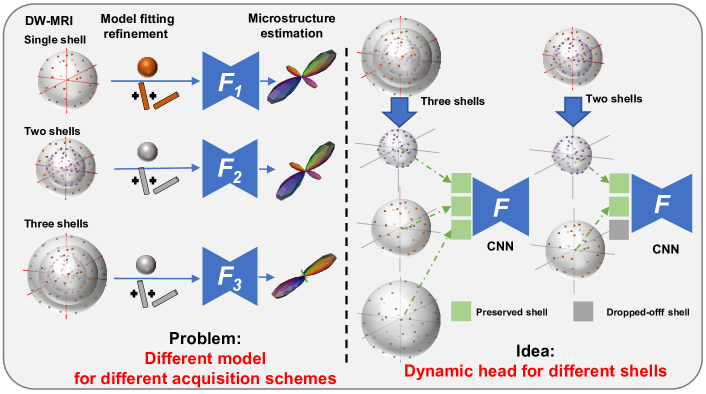
- 引入动态头机制,根据输入壳层配置自适应调整最终全连接层,实现对不同b值组合的泛化能力。
- 网络同时利用角度(球面)与径向(b值)信号维度,避免使用SHORE或球面谐函数等中间表示。
- 采用均方误差(MSE)损失进行组织体积分数预测,采用角相关系数(ACC)损失衡量fODF与真实值的相似性。
- 在包含测试-重测扫描的HCP数据上评估模型的可重复性与泛化能力。
- 与每种壳层配置独立训练的模型及基线深度学习与基于模型的方法(如MSMT-CSD)进行对比。
实验结果
研究问题
- RQ1单一深度学习模型是否能在无需微调的情况下泛化至多种多壳扩散MRI配置?
- RQ2与多阶段方法相比,通过联合建模q空间与径向b值信息的端到端学习是否能提升fODF估计精度?
- RQ3所提方法在fODF与组织体积分数估计方面的扫描-重扫描一致性表现如何?
- RQ4动态头机制是否能有效适应不同b值组合,同时保持高性能?
- RQ5统一模型是否在fODF预测与组织分数恢复方面均优于基于模型(如MSMT-CSD)与数据驱动基线方法?
主要发现
- 所提单阶段方法在所有壳层配置下的平均角相关系数(ACC)达到0.824,优于最佳基线(0.815)与银标准(MSMT-CSD)的fODF预测性能。
- 采用动态头与球面卷积的统一模型在完整三壳配置(C1,2,3)下取得最高ACC(0.837),甚至超越独立训练的模型。
- 扫描-重扫描一致性显著提升,统一模型在完整多壳数据上的一致性评分为0.865,优于MSMT-CSD银标准(0.856)。
- 组织体积分数预测的MSE降低至5.92×10⁻⁴(完整多壳情况),为所有方法中最低,表明微结构估计性能更优。
- 动态头设计使单一模型可泛化至所有壳层配置,无需重新训练或为每种配置单独部署模型。
- 该方法在壳层缺失场景下仍保持高精度与一致性,而多阶段方法则出现性能下降甚至失效。

更好的研究,从现在开始
从阅读论文到最终审阅,大幅缩短您的研究时间。
无需绑定信用卡
本解读由 AI 生成,并经人工编辑审核。