
[论文解读] A velocity-space adaptive unified gas kinetic scheme for continuum and rarefied flows
本文提出了一种速度空间自适应统一气体动理学格式(AUGKS),根据非平衡效应动态切换连续与离散速度空间,实现了从连续到稀薄流动区域的精确高效模拟。该方法在保持跨克努森数范围精度的同时,相比传统UGKS显著提高了计算效率并降低了内存占用,且无需缓冲区。
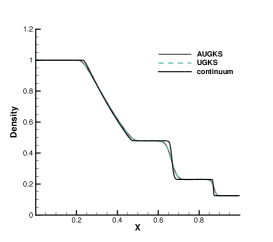
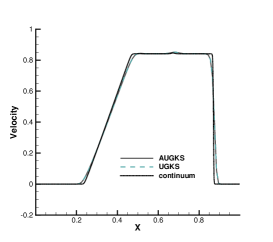
In this paper, a unified gas kinetic scheme with adaptive velocity space (AUGKS) for multiscale flow transport will be developed. In near-equilibrium flow regions, particle distribution function is close to the Chapman-Enskog expansion and can be formulated with a continuous velocity space, where only macroscopic conservative variables are updated. With the emerging of non-equilibrium effects, the AUGKS automatically switches to a discrete velocity space to follow the evolution of particle distribution function. Based on the Chapman-Enskog expansion, a criterion is proposed in this paper to quantify the intensity of non-equilibrium effects and is used for the continuous-discrete velocity space transformation. Following the scale-dependent local evolution solution, the AUGKS presents the discretized gas dynamic equations directly on the cell size and time step scales, i.e., the so-called direct modeling method. As a result, the scheme is able to capture the cross-scale flow physics from particle transport to hydrodynamic wave propagation, and provides a continuous variation of solutions from the Boltzmann to the Navier-Stokes. Under the unified framework, different from conventional DSMC-NS hybrid method, the AUGKS does not need a buffer zone to match up kinetic and hydrodynamic solutions. Instead, a continuous and discrete particle velocity space is naturally connected, which is feasible for the numerical simulations with unsteadiness or complex geometries. Compared with the asymptotic preserving (AP) methods which solves kinetic equations uniformly over the entire flow field with discretized velocity space, the current velocity-space adaptive unified scheme speeds up the computation and reduces the memory requirement in multiscale flow problems, and maintains the equivalent accuracy. The AUGKS provides an effective tool for non-equilibrium flow simulations.
研究动机与目标
- 解决在高超声速和再入条件下密度和特征长度尺度变化极大的多尺度气体流动模拟挑战。
- 克服传统混合方法需通过缓冲区连接动力学与水动力学求解器的局限性。
- 开发一种统一的数值框架,自然实现从连续到动力学描述的过渡,无需人工界面。
- 相比均匀离散速度空间方法(如UGKS),降低多尺度模拟中的计算成本和内存使用。
- 利用单一自适应算法,实现对具有内在非平衡效应的非定常和复杂几何流动的精确模拟。
提出的方法
- 基于Chapman-Enskog展开提出切换准则,以量化非平衡强度并触发速度空间自适应。
- 基于尺度相关的局部Boltzmann模型方程演化解,推导出单元和时间步长尺度下的离散气体动力学方程。
- 在接近平衡区域使用连续速度空间,仅更新宏观守恒变量,从而降低计算成本。
- 在非平衡区域切换至离散速度空间,直接演化粒子分布函数,以捕捉动力学效应。
- 将统一气体动理学格式(UGKS)框架与自适应速度空间相结合,消除了连续与动力学求解器之间对缓冲区的需求。
- 采用直接建模方法确保跨尺度一致性,实现从Boltzmann方程到Navier-Stokes行为的无缝过渡。
实验结果
研究问题
- RQ1如何通过单一数值格式在从连续到自由分子流动区域的整个克努森数范围内精确捕捉流动物理?
- RQ2何种准则可动态且准确地识别基于非平衡强度从连续到离散速度空间的切换时机?
- RQ3速度空间自适应格式是否能消除混合连续-动力学模拟中对缓冲区的需求,同时保持精度?
- RQ4与均匀离散速度空间格式相比,自适应速度空间方法在多大程度上降低了计算成本和内存使用?
- RQ5该格式在捕捉稀薄流中复杂非平衡结构(如激波和尾迹)方面的表现如何?
主要发现
- 在圆柱绕流模拟中,与原始UGKS相比,AUGKS在Kn = 0.001时CPU时间减少约3.3倍,内存使用减少47%;在Kn = 0.01时内存使用减少67%。
- 在Kn = 0.001时,GKS比UGKS快约30倍,但AUGKS在保持精度的同时实现了比UGKS快3.3倍的加速。
- 在Kn = 0.01时,AUGKS正确捕捉了激波结构和尾迹动力学,而连续GKS因非平衡效应失效,AUGKS结果与UGKS一致。
- 速度空间自适应由流场变量的高梯度和碰撞时间增加触发,尤其在低密度尾迹区域(如圆柱后方)明显。
- 基于Chapman-Enskog展开的切换准则能有效识别非平衡区域,实现无需人工界面的精确高效模拟。
- AUGKS实现了从Navier-Stokes到Boltzmann解的连续过渡,避免了传统混合方法中的不连续性和低效性。
更好的研究,从现在开始
从阅读论文到最终审阅,大幅缩短您的研究时间。
无需绑定信用卡
本解读由 AI 生成,并经人工编辑审核。