
[论文解读] Accelerated Formation of Ultra-Massive Galaxies in the First Billion Years
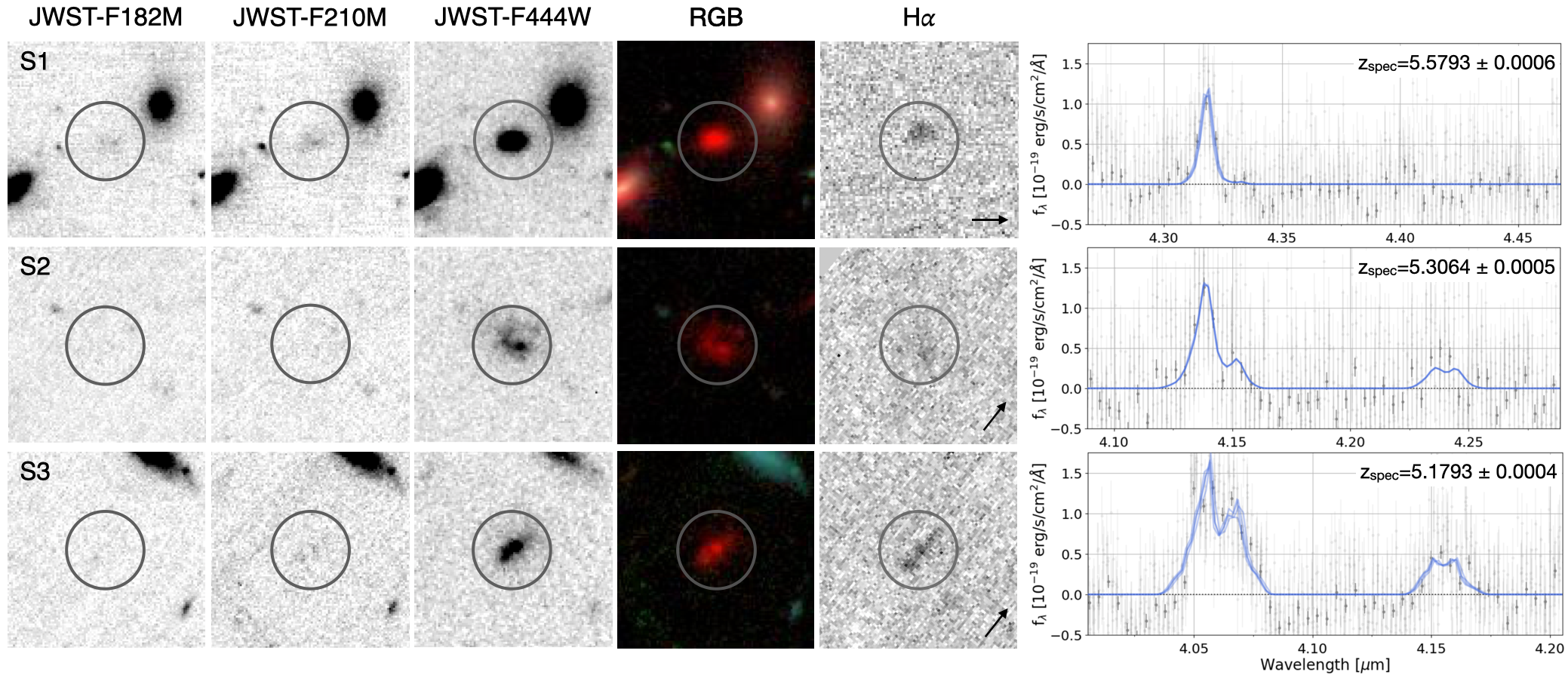
本研究基于 JWST FRESCO,呈现了 36 只经光谱确认的光学隐暗/弱信号星系,zspec 5–9;其中在 z~5.5 出现了 3 个超大质量系统,M* > 10^11 Msun,暗示早期宇宙中异常高的恒星形成效率。
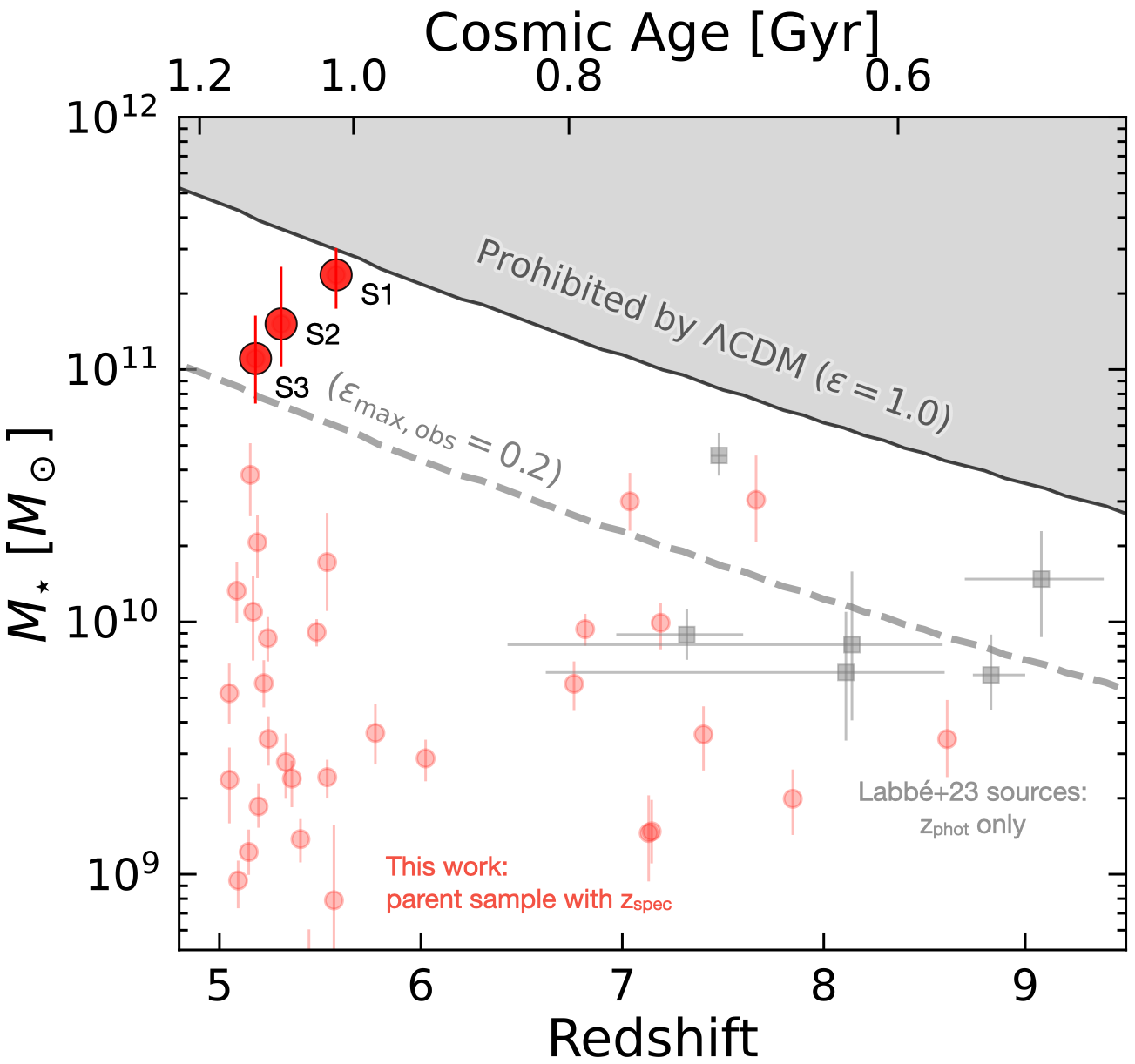
Recent JWST observations have revealed an unexpected abundance of massive galaxy candidates in the early Universe, extending further in redshift and to lower luminosity than what had previously been found by sub-millimeter surveys. These JWST candidates have been interpreted as challenging the $Λ$CDM cosmology, but, so far, they have mostly relied only on rest-frame ultraviolet data and lacked spectroscopic confirmation of their redshifts. Here we report a systematic study of 36 massive dust-obscured galaxies with spectroscopic redshifts between $z_{ m spec}=5-9$ from the JWST FRESCO survey. We find no tension with the $Λ$CDM model in our sample. However, three ultra-massive galaxies (log$M_{\star}/M_{\odot}$ $\gtrsim11.0$) require an exceptional fraction of 50% of baryons converted into stars -- two to three times higher than even the most efficient galaxies at later epochs. The contribution from an active nucleus is unlikely because of their extended emission. Ultra-massive galaxies account for as much as 17% of the total cosmic star formation rate density at $z\sim5-6$.
研究动机与目标
- 使用来自 JWST FRESCO 的鲁棒光谱红移,证明在 z > 5 的宇宙中存在尘埃丰富、质量较高的星系群体。
- 量化光学隐暗/微弱星系的恒星质量、恒星形成率和尘埃特性,以评估它们在早期宇宙星形成中的作用。
- 评估高红移的超大质量星系是否可以被现有星系形成模型以及晕-重子转化效率所容纳,或对其构成挑战。
提出的方法
- 利用 JWST FRESCO 的 NIRCam 成像和光栅光谱,通过红色颜色和强发射线来识别光学隐暗/微弱星系。
- 从 F444W 光栅数据中的 Hα + NII + SII 或 OIII + Hβ 线获取 zspec(约 z=4.9–9.0)。
- 在固定 zspec 的情况下,对紫外到近红外光度分布进行 SED 拟合,使用 BAGPIPES 和 CIGALE 进行发射线扣除,以导出 M* 和 SFR。
- 校正 F444W 光度测量中的发射线污染,以恢复恒星连续光谱。
- 与辅助的 HST/JWST 成像以及远红外/毫米波数据(ALMA GOODS-ALMA)进行交叉匹配,在有数据时约束尘埃与星形成性质。
- 将观测到的超大质量系统与晕质量函数预测进行比较,以推断重子对恒星的转化效率。
实验结果
研究问题
- RQ1JWST 在 FRESCO 调查中发现的光学隐暗/微弱星系的红移分布和质量范围是多少?
- RQ2在 z ~ 5–6 存在 M* > 10^11 Msun 的超大质量星系吗,它们暗示了哪些重子对恒星的转化效率?
- RQ3这些星系的尘埃和恒星形成特性如何揭示它们的形成机制及潜在的活动星系核(AGN)贡献?
- RQ4此类超大质量系统是否与标准的 Lambda-CDM 晕质量函数及观测到的最大星形成效率相容?
- RQ5在高红移时,光学隐暗/微弱星系对宇宙星形成率密度的贡献是多少?
主要发现
- 检测到 36 颗经光谱确认的光学隐暗/微弱星系,zspec 5–9,恒星质量范围为 log(M*/Msun) = 8.3–11.4。
- 在 zspec ~ 5.5 的 3 颗超大质量星系的 log(M*/Msun) > 11.0,意味着平均约 0.5 的重子转化为恒星的比例,约为低红shift 时最高效率的两到三倍。
- 在 zspec ~ 7.5 的另外两颗超大质量系统也暗示了同样高的效率(ε > 0.2),尽管它们的质量约束不如前者稳健。
- 这三颗 z ~ 5.5 的超大质量星系尘埃遮蔽极强(AV > 3 mag),其红外恒星形成率(SFR_IR)为 625–1137 Msun/yr,并且尘埃发射相对于恒星分量呈现扩展性。
- 在考虑 ε > 0.2 时,观测到的超大质量星系在 z ~ 5–6 的总宇宙星形成率密度中贡献高达约 20%,表明早期星形成效率较高。
- 观测到的系统对标准星系形成模型提出挑战,暗示需要更高的早期重子对恒星的转化效率或替代的形成通道(例如顶部偏重的初始质量函数 IMF 或无反馈爆发)。
更好的研究,从现在开始
从论文设计到论文写作,大幅缩短您的研究时间。
无需绑定信用卡
本解读由 AI 生成,并经人工编辑审核。