
[论文解读] Active and reactive behaviour in human mobility: the influence of attraction points on pedestrians
本研究提出一种基于朗之万动力学的模型,以解耦公共集市中人类移动的主动(内在)与反应(情境依赖)成分。通过GPS追踪行人及模拟的吸引点,研究发现可见摊位产生的反应力显著塑造了移动模式,而主动持续性与记忆则贡献于轨迹复杂性,为城市规划与活动设计提供了可扩展的框架。
Human mobility is becoming an accessible field of study thanks to the progress and availability of tracking technologies as a common feature of smart phones. We describe an example of a scalable experiment exploiting these circumstances at a public, outdoor fair in Barcelona (Spain). Participants were tracked while wandering through an open space with activity stands attracting their attention. We develop a general modeling framework based on Langevin Dynamics, which allows us to test the influence of two distinct types of ingredients on mobility: reactive or context-dependent factors, modelled by means of a force field generated by attraction points in a given spatial configuration, and active or inherent factors, modelled from intrinsic movement patterns of the subjects. The additive and constructive framework model accounts for the observed features. Starting with the simplest model (purely random walkers) as a reference, we progressively introduce different ingredients such as persistence, memory, and perceptual landscape, aiming to untangle active and reactive contributions and quantify their respective relevance. The proposed approach may help in anticipating the spatial distribution of citizens in alternative scenarios and in improving the design of public events based on a facts-based approach.
研究动机与目标
- 开发一种可扩展、开放获取的实验框架,利用公民科学与GPS追踪研究人类移动。
- 量化主动(内在)与反应(情境驱动)行为在城市化环境中行人移动中的相对贡献。
- 构建一个基于朗之万动力学的通用建模框架,整合持续性、记忆与感知景观。
- 检验模型再现巴塞罗那公共科学节中观测到的真实世界移动模式的能力。
- 提供一种数据驱动的方法,用于预测人群分布并改进城市环境中公共空间的设计。
提出的方法
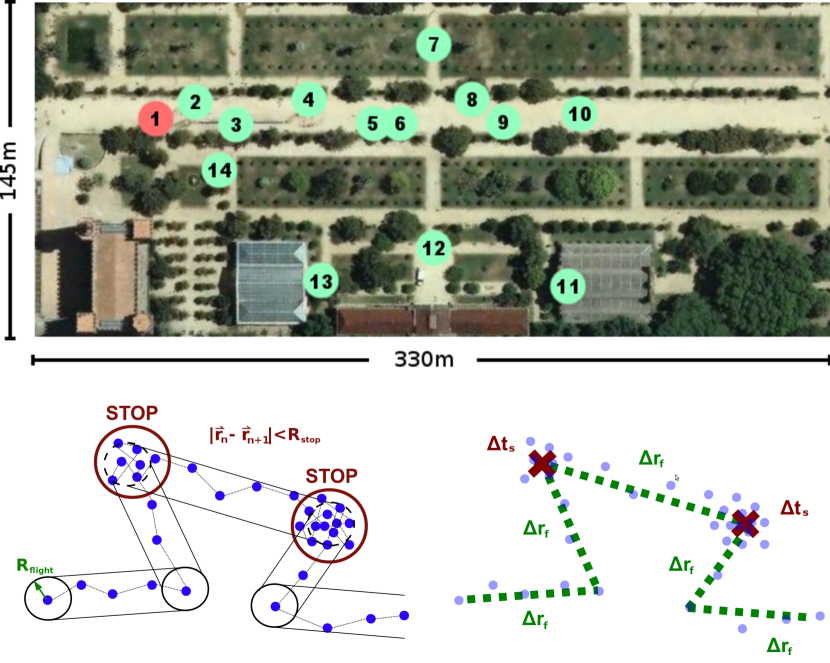
- 在巴塞罗那的公共集市开展大规模公民科学实验,使用GPS智能手机追踪50余名参与者。
- 以平均位置误差4.071米、15秒采样间隔收集真实世界GPS数据,以模拟真实数据采集过程。
- 开发朗之万动力学模型,包含加法分量:用于随机运动的随机项、通过冯·米塞斯分布实现的持续性项,以及代表摊位的吸引力点(势阱)产生的力场。
- 在330米×145米区域内模拟20,000秒(约5.5小时)的移动,摊位配置与真实集市完全一致。
- 使用dBBMM(动态布朗桥移动模型)与GIS工具(ArcGIS、Geospatial Modelling Environment)计算活动范围与轨迹方差。
- 采用11个点的滑动窗口计算轨迹方差,以评估随时间变化的移动复杂性。
实验结果
研究问题
- RQ1可见吸引点产生的反应力在开放城市化空间中如何影响行人移动模式?
- RQ2内在移动特性(如持续性与记忆)在多大程度上塑造人类移动轨迹?
- RQ3结合主动与反应成分的统一朗之万模型能否有效再现真实世界行人动力学?
- RQ4感知景观与个体移动模式之间的相互作用如何影响空间分布与活动范围估计?
- RQ5在公共活动中,主动行为与反应行为在塑造集体移动中的相对贡献如何?
主要发现
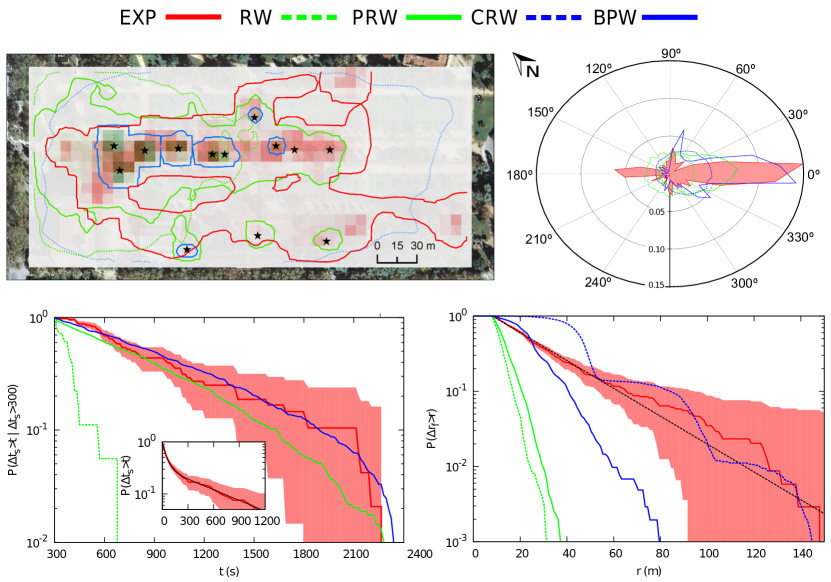
- 朗之万模型中引入吸引点(势阱)显著提升了对真实GPS轨迹的拟合度,表明可见摊位产生了强烈的反应影响。
- 轨迹方差分析显示,靠近吸引点时移动复杂性增加,证实了情境依赖的行为转变。
- dBBMM分析表明,包含反应力的模拟中,参与者的95%活动范围始终大于仅含主动模型的情况。
- 同时包含持续性与记忆组件的模型比仅含其中一项或均无的模型更准确地再现了观测到的移动模式。
- 模拟轨迹在空间分布与移动强度方面与真实数据高度吻合,验证了模型的预测能力。
- 研究表明,由可见吸引点驱动的反应行为是塑造行人流的关键因素,尤其在摊位附近的高流量区域。
更好的研究,从现在开始
从阅读论文到最终审阅,大幅缩短您的研究时间。
无需绑定信用卡
本解读由 AI 生成,并经人工编辑审核。