
[论文解读] Adaptive coding efficiency in recurrent cortical circuits via gain control
本文提出,复发皮层回路中的自适应编码效率源于单神经元增益调制,而非突触权重变化。通过推导一个平衡刺激保真度与代谢成本的自适应高效编码目标,该模型表明增益调节可通过复发网络传播,从而仅用 O(N) 个参数即可解释多种适应效应——包括调谐曲线偏移、响应去相关性以及响应范围变化,提供了一种快速、可逆且代谢高效的群体感官适应机制。
Sensory systems across all modalities and species exhibit adaptation to continuously changing input statistics. Individual neurons have been shown to modulate their response gains so as to maximize information transmission in different stimulus contexts. Experimental measurements have revealed additional, nuanced sensory adaptation effects including changes in response maxima and minima, tuning curve repulsion from the adapter stimulus, and stimulus-driven response decorrelation. Existing explanations of these phenomena rely on changes in inter-neuronal synaptic efficacy, which, while more flexible, are unlikely to operate as rapidly or reversibly as single neuron gain modulations. Using published V1 population adaptation data, we show that propagation of single neuron gain changes in a recurrent network is sufficient to capture the entire set of observed adaptation effects. We propose a novel adaptive efficient coding objective with which single neuron gains are modulated, maximizing the fidelity of the stimulus representation while minimizing overall activity in the network. From this objective, we analytically derive a set of gains that optimize the trade-off between preserving information about the stimulus and conserving metabolic resources. Our model generalizes well-established concepts of single neuron adaptive gain control to recurrent populations, and parsimoniously explains experimental adaptation data.
研究动机与目标
- 使用单一、生物上合理的机制解释复杂的神经群体适应效应,如响应最大值/最小值偏移、调谐曲线排斥和刺激驱动的去相关性。
- 解决现有模型依赖快速、可逆的突触权重变化所带来的局限性,因为这类变化在短时间尺度上代谢成本高且不稳定。
- 提出一个规范性框架,其中单神经元增益被自适应调节,以在代谢和稳态约束下最大化编码效率。
- 证明复发网络动力学能够将单神经元增益变化传播至群体水平,从而产生与V1数据中观察到的适应效应一致的结果。
- 通过证明仅用 O(N) 个增益参数即可重现 O(N²) 个突触权重适应效应,为基于突触可塑性的模型提供一种简洁的替代方案。
提出的方法
- 构建一个具有全连接侧向连接的递归神经网络(RNN),其中每个神经元接收由标量增益调制的前馈驱动以及来自其他神经元的复发输入。
- 定义一种新颖的自适应高效编码目标,以优化刺激表征保真度与总网络活动(代谢成本)之间的权衡。
- 推导出最小化目标函数的最优单神经元增益的解析表达式,从而在输入统计特性变化时实现增益调节的闭式解。
- 使用已发表的猫视觉皮层V1群体数据对模型进行仿真,其中刺激来自均匀或有偏倚的方向分布。
- 将模型预测与实验数据进行比较,重点关注调谐曲线偏移、响应去相关性以及响应范围(最大值/最小值)的变化。
- 通过展示不同复发连接结构(W)可产生定性相似的适应效应,验证模型的鲁棒性,表明其对特定连接模式具有功能不变性。

实验结果
研究问题
- RQ1在复发网络中,单神经元增益调制是否能够解释V1中观察到的所有神经适应现象,包括调谐曲线排斥和响应去相关性?
- RQ2是否仅通过增益调节而无需改变突触权重,就能在神经群体中实现高效编码,并且仍能与实验数据匹配?
- RQ3所提出的自适应高效编码目标如何在复发电路中平衡刺激保真度与代谢成本?
- RQ4该机制对皮层适应的稳定性和可逆性有何影响,特别是在数百毫秒的时间尺度下?
- RQ5该模型是否能够在不依赖突触可塑性的情况下,解释不同刺激集合(例如均匀与有偏倚的方向分布)中的适应效应?
主要发现
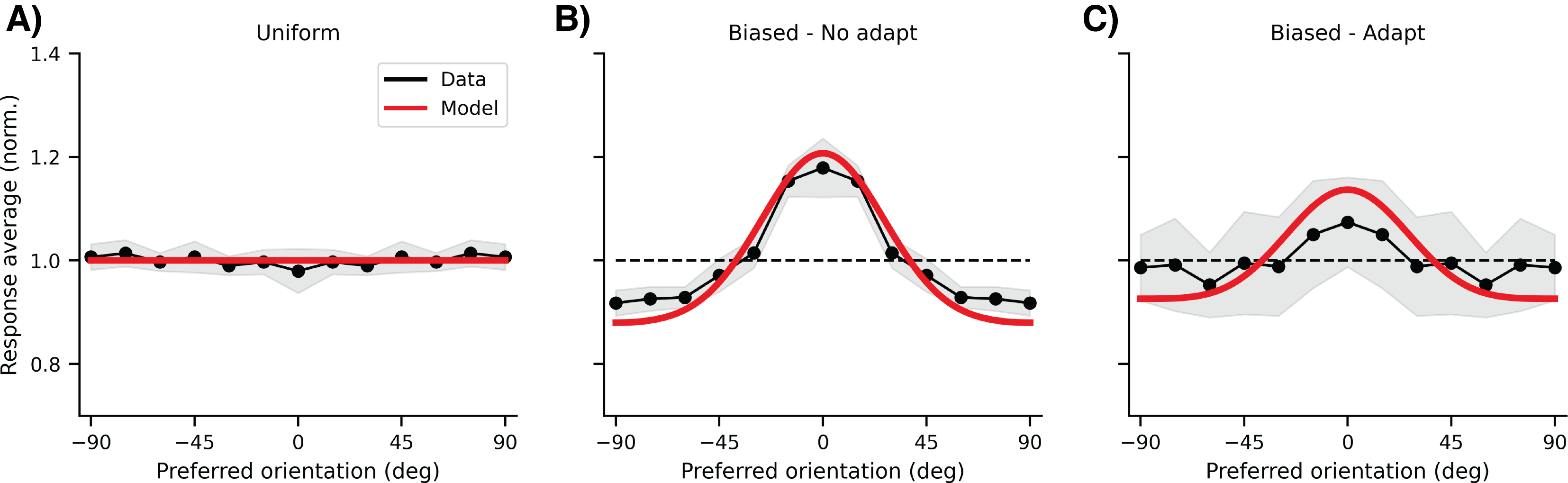
- 该模型成功再现了猫V1中观察到的所有主要适应效应:响应最大值和最小值降低、调谐曲线排斥以及刺激驱动的响应去相关性。
- 当通过复发连接传播时,自适应增益控制能够产生与实验测量结果一致的响应去相关性,且在均匀和有偏倚刺激条件下均成立。
- 所推导的增益控制机制实现了编码保真度与代谢成本之间的最优权衡,如自适应高效编码目标所形式化描述。
- 该模型仅使用 O(N) 个可调参数(增益)解释适应效应,相比之下,先前模型需 O(N²) 个突触权重变化,因此更具代谢效率和稳定性。
- 实验验证显示,模型预测与已发表的V1群体记录数据具有高度定量一致性,尤其在调谐曲线偏移和响应范围调节方面表现突出。
- 该模型在不同复发连接模式(W)下仍保持鲁棒性,表明其核心机制与特定解剖连接模式无关,支持其通用性。
更好的研究,从现在开始
从阅读论文到最终审阅,大幅缩短您的研究时间。
无需绑定信用卡
本解读由 AI 生成,并经人工编辑审核。