
[论文解读] Adaptive Force-based Control for Legged Robots
本文提出了一种新颖的自适应力控框架,用于足式机器人,将 $L_1$ 自适应控制整合到基于二次规划(QP)的力控中,以应对显著的模型不确定性。该方法使12公斤重的Unitree A1机器人能够在崎岖地形上稳定行走,携带高达6公斤(相当于体重的50%)的负载,且能稳定站立高达11公斤(占体重的92%)的负载,而传统非自适应控制器在3至6公斤时即因模型不确定性而失效。
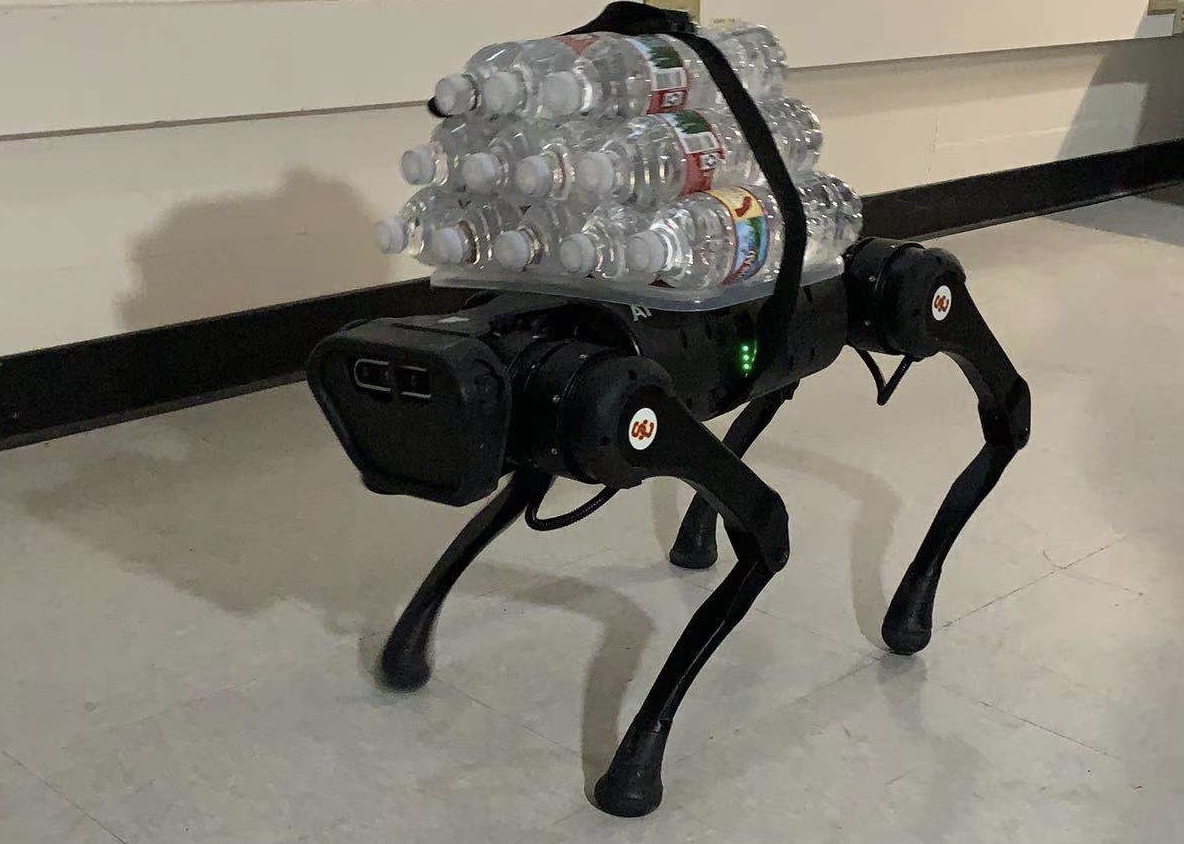
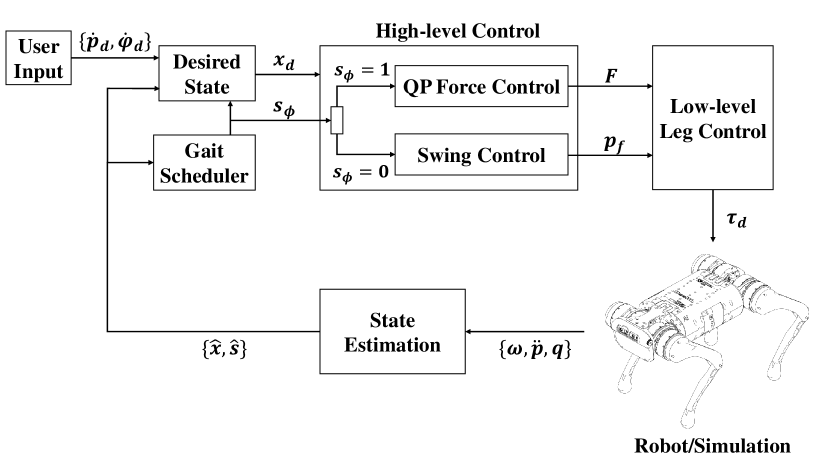
Adaptive control can address model uncertainty in control systems. However, it is preliminarily designed for tracking control. Recent advancements in the control of quadruped robots show that force control can effectively realize agile and robust locomotion. In this paper, we present a novel adaptive force-based control framework for legged robots. We introduce a new architecture in our proposed approach to incorporate adaptive control into quadratic programming (QP) force control. Since our approach is based on force control, it also retains the advantages of the baseline framework, such as robustness to uneven terrain, controllable friction constraints, or soft impacts. Our method is successfully validated in both simulation and hardware experiments. While the baseline QP control has shown a significant degradation in the body tracking error with a small load, our proposed adaptive force-based control can enable the 12-kg Unitree A1 robot to walk on rough terrains while carrying a heavy load of up to 6 kg (50% of the robot weight). When standing with four legs, our proposed adaptive control can even allow the robot to carry up to 11 kg of load (92% of the robot weight) with less than 5-cm tracking error in the robot height.
研究动机与目标
- 解决足式机器人控制中的模型不确定性问题,尤其是在未知且时变负载条件下。
- 将此前仅用于轨迹跟踪的自适应控制方法拓展至动态足式机器人的力控领域。
- 在保持基于QP的力控方法鲁棒性与灵活性的同时,实现对系统动力学不确定性的自适应调整。
- 通过严格的理论分析,确保系统在外部干扰和模型误差下仍保持稳定。
- 在高保真仿真和Unitree A1机器人真实硬件实验中验证该框架的有效性。
提出的方法
- 提出一种新型控制架构,将 $L_1$ 自适应控制嵌入基于QP的力控框架中,以应对动态模型不确定性。
- 在自适应律中引入低通滤波器,确保控制输入平滑且具有鲁棒性,从而在干扰下仍能保持稳定性能。
- 采用基于控制李雅普诺夫函数(CLF)的参考模型,定义用于自适应的稳定非线性参考轨迹。
- 推导出自适应控制律,根据估计的系统不确定性实时调整力指令,维持力跟踪精度与系统稳定性。
- 应用输入到状态稳定性(ISS)分析,证明在有界干扰和模型误差下,闭环系统仍保持稳定。
- 将自适应机制集成到QP优化层中,实现实时自适应,同时保持对摩擦力和冲击力的约束。
实验结果
研究问题
- RQ1自适应控制能否成功地从轨迹跟踪扩展到足式机器人的力控?
- RQ2如何将 $L_1$ 自适应控制整合到基于QP的力控框架中,以在模型不确定性下保持稳定性和性能?
- RQ3四足机器人在使用自适应力控时,最多能承载多少负载以维持平衡和轨迹跟踪精度?
- RQ4在未知且时变的加载条件下,所提方法与非自适应QP控制相比表现如何?
- RQ5该自适应力控框架能否在不平地形上以及受到软冲击时保持鲁棒性?
主要发现
- 自适应力控控制器使12公斤重的Unitree A1机器人在崎岖地形上稳定行走,可承载6公斤负载(占体重的50%),而传统非自适应基线控制器在3公斤时即失效。
- 在自适应控制器下,机器人成功以11公斤负载(占体重的92%)站立,高度跟踪误差小于5厘米,而传统非自适应控制器在6公斤时无法站立。
- 在仿真中,机器人在不平整且陡峭的斜坡上携带6公斤负载并受到未知干扰,实现了稳定性能,且跟踪误差极小。
- 在11公斤负载站立状态下,自适应控制器实现了小于3厘米的高度跟踪误差和小于8°的俯仰角误差。
- 实验结果证实了输入到状态稳定性(ISS),即尽管存在小的恒定跟踪误差,系统在干扰下仍保持有界。
- 该框架成功保留了基线力控方法的优势,包括对不平地形的鲁棒性、可控的摩擦力约束以及对软冲击的处理能力。
更好的研究,从现在开始
从阅读论文到最终审阅,大幅缩短您的研究时间。
无需绑定信用卡
本解读由 AI 生成,并经人工编辑审核。