
[论文解读] Adversarial Deep Structured Nets for Mass Segmentation from Mammograms
本文提出一种端到端的对抗性深度结构化网络,结合全卷积网络(FCN)与条件随机场(CRF),用于乳腺X线摄影肿块分割。通过整合空间先验、多尺度FCN以及对抗性训练以缓解小样本数据集上的过拟合问题,该方法在DDSM-BCRP数据集上取得91.30%的Dice分数,在INbreast数据集上取得90.97%的Dice分数,性能达到当前最先进水平。
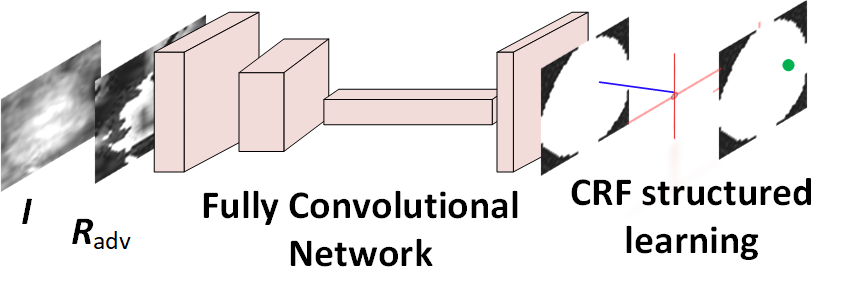
Mass segmentation provides effective morphological features which are important for mass diagnosis. In this work, we propose a novel end-to-end network for mammographic mass segmentation which employs a fully convolutional network (FCN) to model a potential function, followed by a CRF to perform structured learning. Because the mass distribution varies greatly with pixel position, the FCN is combined with a position priori. Further, we employ adversarial training to eliminate over-fitting due to the small sizes of mammogram datasets. Multi-scale FCN is employed to improve the segmentation performance. Experimental results on two public datasets, INbreast and DDSM-BCRP, demonstrate that our end-to-end network achieves better performance than state-of-the-art approaches. \footnote{https://github.com/wentaozhu/adversarial-deep-structural-networks.git}
研究动机与目标
- 解决因训练数据有限而导致的乳腺X线摄影肿块分割中的过拟合问题。
- 通过整合反映肿块在乳腺X线中位置分布的空间先验,提升分割精度。
- 开发一种端到端可训练的框架,统一FCN与CRF以实现联合优化,避免多阶段训练。
- 通过结构化CRF推理增强分割边界检测与结构一致性。
- 在公开数据集上展示优于现有最先进方法的性能表现。
提出的方法
- 采用具有多尺度卷积的全卷积网络(FCN),从乳腺X线图像中学习分层特征。
- 在FCN中引入位置先验,以建模肿块区域的空间分布,提升定位能力。
- 通过优化生成对抗网络(GAN)框架实施对抗性训练,以最小化像素级标注损失并减少过拟合。
- 使用全连接成对CRF与Potts模型兼容性,以在预测标签中强制实现空间一致性。
- 采用期望传播近似方法实现高效的CRF推理,将其视为循环神经网络以实现可微分优化。
- 使用反向传播端到端训练整个网络,联合优化FCN、CRF及对抗性组件。
实验结果
研究问题
- RQ1在小样本乳腺X线数据集上,通过对抗正则化的端到端FCN-CRF网络训练是否能提升肿块分割性能?
- RQ2整合空间先验在多大程度上能提升乳腺X线中肿块分割的定位与精度?
- RQ3在低数据量场景下,对抗性训练在多大程度上能减少过拟合并提升医学图像分割的泛化能力?
- RQ4多尺度特征学习是否显著提升分割质量,尤其是在病灶边界区域?
- RQ5所提出的对抗性FCN-CRF框架在公开乳腺X线分割基准上与现有最先进方法相比,其定量表现如何?
主要发现
- 所提出的对抗性FCN-CRF模型在DDSM-BCRP数据集上取得91.30%的Dice分数,比之前最先进方法高出0.3%。
- 在INbreast数据集上,模型Dice分数达到90.97%,相较于基线FCN提升0.97%。
- 仅对抗性训练在各数据集上平均提升Dice分数0.4%,表明其对过拟合具有有效正则化作用。
- 多尺度FCN的整合对性能提升贡献最大,相比单尺度基线提升0.3%。
- 基于Trimap的边界精度分析显示,对抗性训练使病灶边界附近区域的分割精度提升2–3%。
- McNemar卡方检验确认该模型在[6]方法之上具有显著优势,p值<0.001,具有统计学显著性。
更好的研究,从现在开始
从阅读论文到最终审阅,大幅缩短您的研究时间。
无需绑定信用卡
本解读由 AI 生成,并经人工编辑审核。