
[论文解读] Age of Information for Multiple-Source Multiple-Server Networks
本文提出了一种多源多服务器网络模型,以优化实时监控系统中的年龄信息(AoI)。在采用指数服务时间与泊松更新的后进先出(LCFS)排队策略下,推导出同质网络中平均AoI的闭式表达式,并为异质情况开发了递归算法,显著提升了多个源和服务器下的数据新鲜度。
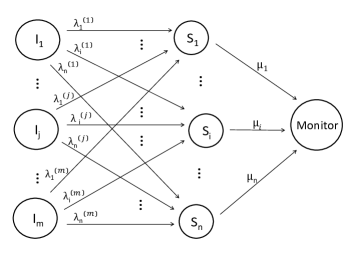
Having timely and fresh knowledge about the current state of information sources is critical in a variety of applications. In particular, a status update may arrive at the destination later than its generation time due to processing and communication delays. The freshness of the status update at the destination is captured by the notion of age of information. In this study, we analyze a multiple sensing network with multiple sources, multiple servers, and a monitor (destination). Each source corresponds to an independent piece of information and its age is measured individually. Given a particular source, the servers independently sense the source of information and send the status update to the monitor. We assume that updates arrive at the servers according to Poisson random processes. Each server sends its updates to the monitor through a direct link, which is modeled as a queue. The service time to transmit an update is considered to be an exponential random variable. We examine both homogeneous and heterogeneous service and arrival rates for the single-source case, and only homogeneous arrival and service rates for the multiple-source case. We derive a closed-form expression for the average age of information under a last-come-first-serve (LCFS) queue for a single source and arbitrary number of homogeneous servers. Using a recursive method, we derive the explicit average age of information for any number of sources and homogeneous servers. We also investigate heterogeneous servers and a single source, and present algorithms for finding the average age of information.
研究动机与目标
- 对每个源由多个服务器独立感知的多源多服务器网络中的年龄信息(AoI)进行建模与分析。
- 量化在每个源使用多个服务器相较于单服务器模型时AoI的改善程度。
- 在具有任意数量源与服务器的同质网络中,推导出LCFS带抢占机制下的平均AoI的闭式表达式。
- 为单源异质服务器网络开发递归算法与AoI的解析表达式。
- 通过多种排队模型与网络配置的仿真验证分析结果的准确性。
提出的方法
- 将每个服务器建模为独立的M/M/1队列,其更新到达为泊松过程,服务时间为指数分布。
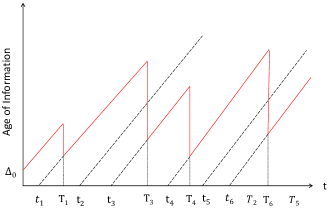
- 应用后进先出(LCFS)抢占策略,其中新更新立即取代正在进行的传输。
- 利用随机跳变系统(SHS)推导平均AoI,通过状态方程的递归分解方法实现。
- 开发了一种递归算法(算法2),将方程组分解为更小的子问题,可通过基础算法(算法3)求解,其系数矩阵形式为T₀。
- 采用分层消去过程求解系统,从最高阶方程开始,逐步下推至基础情形,确保解的非负性。
- 通过数学归纳法证明非负性,表明所有推导出的变量均保持非负,从而验证了解的物理一致性。
实验结果
研究问题
- RQ1在单源多同质服务器网络中,采用LCFS抢占排队策略时,平均年龄信息(AoI)是多少?
- RQ2在同质多源多服务器网络中,平均AoI如何随源与服务器数量的变化而变化?
- RQ3在单源多异质服务器网络中,任意服务与到达速率下,平均AoI的解析表达式是什么?
- RQ4能否构建一种递归算法,以高效计算同质服务器的多源多服务器网络中的平均AoI?
- RQ5在多源多服务器系统中,不同排队策略与网络配置下的AoI性能表现如何比较?
主要发现
- 推导出单源多同质服务器网络在LCFS带抢占机制下的平均AoI的闭式表达式,适用于任意数量的服务器。
- 对于具有多个源的同质网络,当服务器数量为2或3时,本文推导出平均AoI的显式闭式表达式。
- 开发了一种递归算法,可计算任意数量源与同质服务器下的平均AoI,实现可扩展分析。
- 对于单源异质服务器网络,本文给出了2台与3台服务器的解析表达式,并提出适用于任意数量的通用算法。
- 严格证明了所有推导变量的非负性,确保了解析解的有效性与物理一致性。
- 仿真结果在多种排队模型与网络配置下验证了分析结果的准确性,证实了理论框架的可靠性。
更好的研究,从现在开始
从阅读论文到最终审阅,大幅缩短您的研究时间。
无需绑定信用卡
本解读由 AI 生成,并经人工编辑审核。