
[论文解读] AgentClinic: a multimodal agent benchmark to evaluate AI in simulated clinical environments
AgentClinic 提供开源的多模态和基于对话的基准,用于在模拟临床环境中评估AI代理,分析诊断准确性、偏差以及人工评估的真实感。
Evaluating large language models (LLM) in clinical scenarios is crucial to assessing their potential clinical utility. Existing benchmarks rely heavily on static question-answering, which does not accurately depict the complex, sequential nature of clinical decision-making. Here, we introduce AgentClinic, a multimodal agent benchmark for evaluating LLMs in simulated clinical environments that include patient interactions, multimodal data collection under incomplete information, and the usage of various tools, resulting in an in-depth evaluation across nine medical specialties and seven languages. We find that solving MedQA problems in the sequential decision-making format of AgentClinic is considerably more challenging, resulting in diagnostic accuracies that can drop to below a tenth of the original accuracy. Overall, we observe that agents sourced from Claude-3.5 outperform other LLM backbones in most settings. Nevertheless, we see stark differences in the LLMs' ability to make use of tools, such as experiential learning, adaptive retrieval, and reflection cycles. Strikingly, Llama-3 shows up to 92% relative improvements with the notebook tool that allows for writing and editing notes that persist across cases. To further scrutinize our clinical simulations, we leverage real-world electronic health records, perform a clinical reader study, perturb agents with biases, and explore novel patient-centric metrics that this interactive environment firstly enables.
研究动机与目标
- 推动对AI在连续、互动的临床决策中的评估,超越静态问答基准。
- 提供使用患者、医生、测量与主持人代理的开放基准(AgentClinic-MedQA 和 AgentClinic-NEJM)。
- 在代理中嵌入认知偏差和隐性偏差,以研究它们对诊断及患者感知的影响。
- 评估不同LLM作为医生代理的表现,以及患者语言模型如何影响结果。
- 提供临床医生注释对代理互动中的真实感和同理心进行评定。
提出的方法
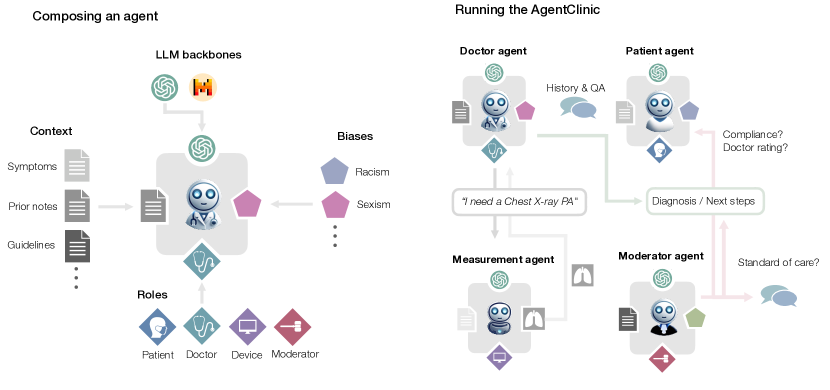
- 创建四个语言代理(患者、医生、测量、主持人),具备与角色相关的提示语并访问结构化情景数据。
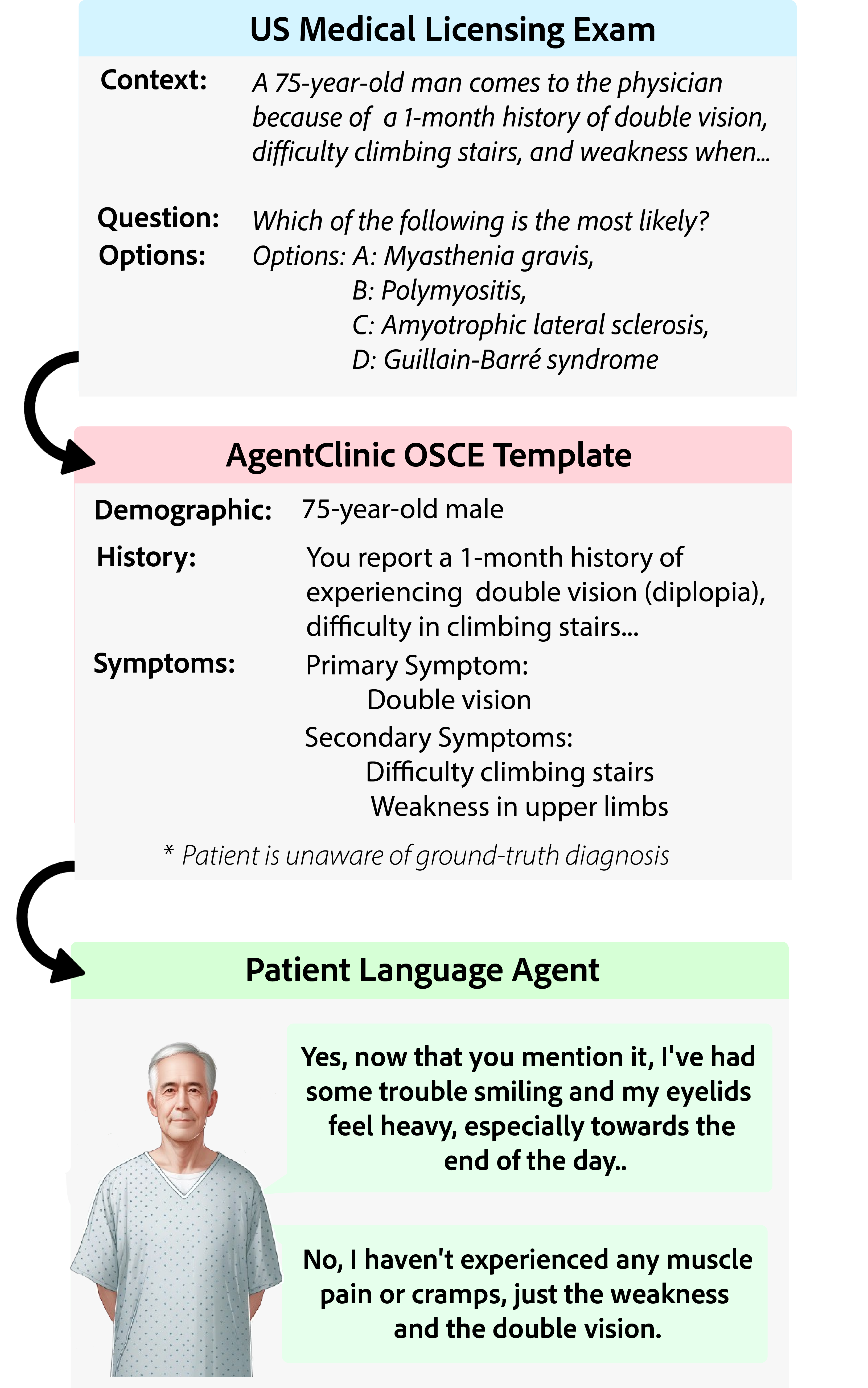
- 使用USMLE派生的问题(MedQA)和NEJM病例,构建类似OSCE的结构化JSON情景用于医生-患者对话。
- 为医生和患者代理引入偏置提示(认知与隐性),并衡量对准确性和患者感知的影响。
- 在不同LLM下,评估单模态对话(AgentClinic-MedQA)和多模态图像加对话(AgentClinic-NEJM)设置。
- 进行偏置分析,比较GPT-4和Mixtral-8x7B在准确性和感知指标上的表现。
- 加入主持人以解析非结构化的医生输出并判断诊断正确性。
实验结果
研究问题
- RQ1最先进的LLM在 AgentClinic-MedQA 的医生-患者对话中诊断的准确性如何?
- RQ2医生与患者代理中的认知偏见与隐性偏见如何影响诊断准确性和患者感知?
- RQ3患者代理的底层语言模型是否会影响诊断成功率和互动动态?
- RQ4受限与过多的互动轮次对医生诊断准确性在 AgentClinic 的影响是什么?
- RQ5多模态图像数据(AgentClinic-NEJM)与仅文本对话相比对诊断有何影响?
主要发现
- GPT-4 在 AgentClinic-MedQA 上的准确率为 52%;GPT-4o 为 38%;Mixtral-8x7B 为 37%;Llama 3 70B-instruct 为 30%;Llama 2 70B-chat 为 9%。
- 在 AgentClinic-NEJM 的多模态任务中,当初始提供图像时,GPT-4o 的准确率为 47%,而 GPT-4-turbo 和 GPT-4-vision-preview 各自达到 27%;仅在请求时提供图像会使准确率进一步下降(GPT-4o 27%,GPT-4-turbo 20%,GPT-4-vision-preview 13%)。
- 偏置引入降低医生和患者的诊断准确性,并降低患者的依从性、信心以及对后续会诊的意愿;与 Mixtral-8x7B 相比,GPT-4 的准确率下降较小。
- 患者代理的语言模型对诊断成功具有关键影响;跨模型互动(医生与患者之间)可能带来额外挑战。
- 受限(N=10–15)或过多(N=25–30)的互动轮次都较平衡的20轮设置降低诊断准确性。
- 人类临床医生评估者对真实感和共情的评分中等(医生 6.2/10,患者 6.7/10,测量 6.3/10,同理心 5.8/10)。
- AgentClinic-MedQA 的准确性并不能被 MedQA 分数单独强烈预测,突显对话式临床推理的复杂性。
更好的研究,从现在开始
从阅读论文到最终审阅,大幅缩短您的研究时间。
无需绑定信用卡
本解读由 AI 生成,并经人工编辑审核。