
[论文解读] Agri-GNN: A Novel Genotypic-Topological Graph Neural Network Framework Built on GraphSAGE for Optimized Yield Prediction
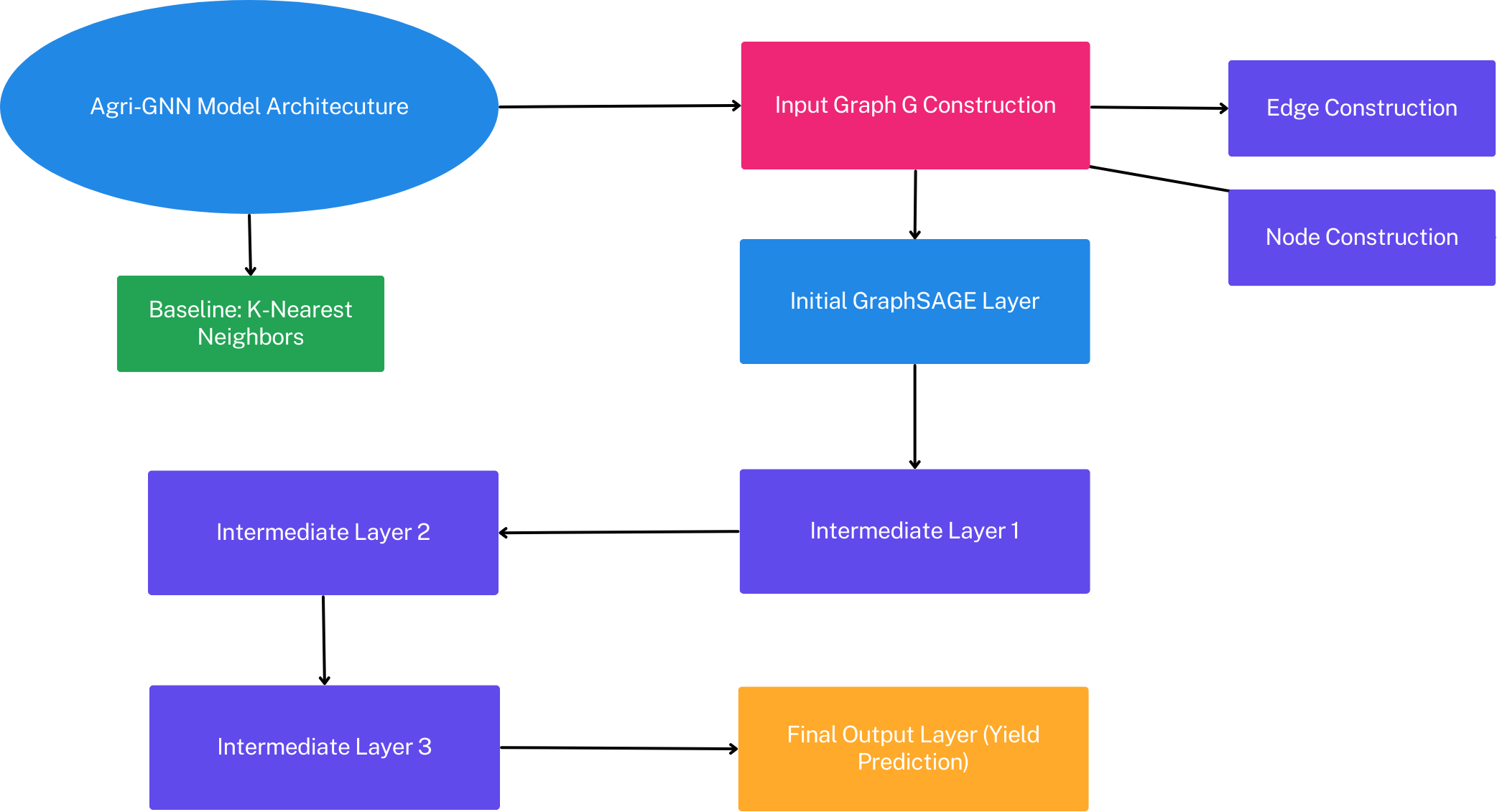
Agri-GNN 是一种基于 GraphSAGE 的新型图神经网络框架,通过将农田地块表示为图中的节点,并依据空间和基因型相似性定义边,来建模作物产量。在爱荷华州田间数据上,其产量预测的 R² 达到 0.876,显著优于基线模型,能够捕捉多模态农业数据中复杂的基因型-拓扑相互作用。
Agriculture, as the cornerstone of human civilization, constantly seeks to integrate technology for enhanced productivity and sustainability. This paper introduces $ extit{Agri-GNN}$, a novel Genotypic-Topological Graph Neural Network Framework tailored to capture the intricate spatial and genotypic interactions of crops, paving the way for optimized predictions of harvest yields. $ extit{Agri-GNN}$ constructs a Graph $\mathcal{G}$ that considers farming plots as nodes, and then methodically constructs edges between nodes based on spatial and genotypic similarity, allowing for the aggregation of node information through a genotypic-topological filter. Graph Neural Networks (GNN), by design, consider the relationships between data points, enabling them to efficiently model the interconnected agricultural ecosystem. By harnessing the power of GNNs, $ extit{Agri-GNN}$ encapsulates both local and global information from plants, considering their inherent connections based on spatial proximity and shared genotypes, allowing stronger predictions to be made than traditional Machine Learning architectures. $ extit{Agri-GNN}$ is built from the GraphSAGE architecture, because of its optimal calibration with large graphs, like those of farming plots and breeding experiments. $ extit{Agri-GNN}$ experiments, conducted on a comprehensive dataset of vegetation indices, time, genotype information, and location data, demonstrate that $ extit{Agri-GNN}$ achieves an $R^2 = .876$ in yield predictions for farming fields in Iowa. The results show significant improvement over the baselines and other work in the field. $ extit{Agri-GNN}$ represents a blueprint for using advanced graph-based neural architectures to predict crop yield, providing significant improvements over baselines in the field.
研究动机与目标
- 解决传统机器学习模型在捕捉农业数据中复杂关系交互方面的局限性。
- 将多模态数据——基因型、空间、时间及环境数据——整合到统一的预测框架中。
- 通过基于基因型和空间相似性的图结构,将农田地块建模为相互关联的节点,以提高产量预测的准确性。
- 开发一种可扩展、模块化且自适应的框架,适用于精准农业和气候适应性农业。
- 通过基于图的学习方法,在真实农业数据集中展示优于现有模型的性能。
提出的方法
- 构建图 𝒢,其中每个农田地块为一个节点,边根据空间邻近性和基因型相似性形成。
- 应用基因型-拓扑过滤器,从邻近节点聚合节点特征,突出相关且相似的邻居,以减少噪声。
- 利用 GraphSAGE 的归纳学习框架,生成可泛化到推理阶段未见地块的节点嵌入。
- 将多样化的数据模态——植被指数、时间、基因型和位置——整合到统一的图结构表示中。
- 使用带标签的产量数据端到端训练模型,以 RMSE、MAE 和 R² 指标进行优化。
- 采用 t-SNE 可视化分析学习到的节点嵌入,验证模型对相似地块进行有意义聚类的能力。
实验结果
研究问题
- RQ1是否能够通过同时建模空间和基因型关系的图神经网络,提升作物产量预测的准确性,相比传统机器学习模型?
- RQ2基于 GraphSAGE 的归纳学习在大规模、异构农业数据集上,且标注样本有限的情况下,应用效果如何?
- RQ3整合多模态数据(基因、空间、时间、环境)在多大程度上提升了产量预测性能?
- RQ4学习到的节点嵌入在多大程度上反映了农田地块在生物学和空间上的有意义分组?
- RQ5Agri-GNN 框架是否能在极少微调的情况下泛化到新的、未见过的农田地块?
主要发现
- Agri-GNN 在爱荷华州 Ames 市的真实田间数据上,产量预测的 R² 达到 0.876,显著优于基线模型。
- 该模型在相同数据集和评估设置下,性能优于先前研究,包括 Chattopadhyay 等人(2023)的工作。
- 对学习到的嵌入进行 t-SNE 可视化显示,基于基因型和空间相似性的地块呈现出一致的聚类,验证了模型捕捉有意义关系的能力。
- 基因型-拓扑过滤的使用减少了特征聚合中的噪声,从而提升了预测的鲁棒性和准确性。
- Agri-GNN 的归纳学习能力实现了对新未见地块的有效泛化,凸显其可扩展性和适应性。
- 该框架对数据变异性和不确定性表现出强鲁棒性,在不同田间条件下均保持一致的性能表现。
更好的研究,从现在开始
从阅读论文到最终审阅,大幅缩短您的研究时间。
无需绑定信用卡
本解读由 AI 生成,并经人工编辑审核。