
[论文解读] AI-driven materials design: a mini-review
本文综述了AI驱动的材料设计,强调从前向筛选向逆向设计的转变,使用深度生成模型、强化学习/贝叶斯优化以及自主实验室,并讨论挑战与未来方向。
Materials design is an important component of modern science and technology, yet traditional approaches rely heavily on trial-and-error and can be inefficient. Computational techniques, enhanced by modern artificial intelligence (AI), have greatly accelerated the design of new materials. Among these approaches, inverse design has shown great promise in designing materials that meet specific property requirements. In this mini-review, we summarize key computational advancements for materials design over the past few decades. We follow the evolution of relevant materials design techniques, from high-throughput forward machine learning (ML) methods and evolutionary algorithms, to advanced AI strategies like reinforcement learning (RL) and deep generative models. We highlight the paradigm shift from conventional screening approaches to inverse generation driven by deep generative models. Finally, we discuss current challenges and future perspectives of materials inverse design. This review may serve as a brief guide to the approaches, progress, and outlook of designing future functional materials with technological relevance.
研究动机与目标
- 推动在试错方法之外实现更快速、更高效的材料发现的需求。
- 总结材料科学中从前向筛选到逆向设计的演化。
- 突出实现逆向设计的关键AI方法(深度生成模型、RL、BO、自主实验室)。
- 讨论当前挑战并提出AI驱动材料设计的未来路线图。
提出的方法
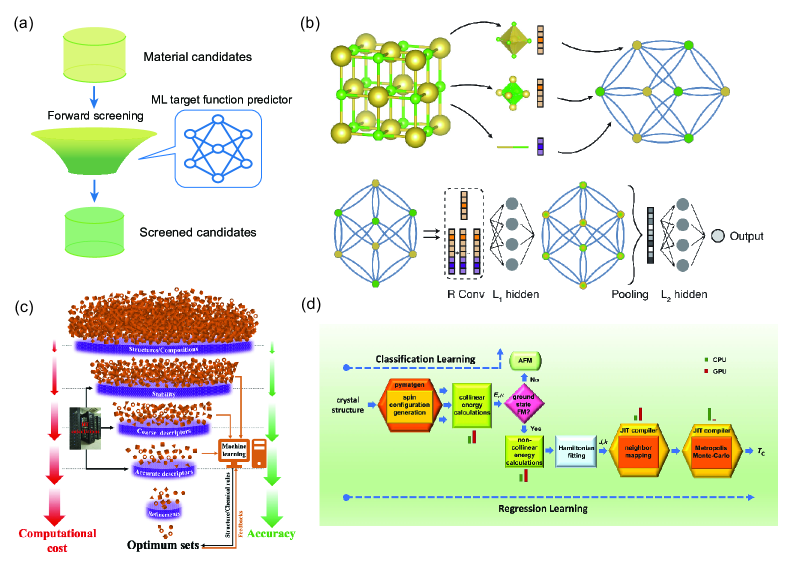
- 描述前向筛选工作流程以及ML代理和基于图的表示(如CGCNN)在性质预测中的作用。
- 概述进化算法家族(GA、PSO、MCTS)及其在晶体结构预测、材料优化和纳米粒子设计中的应用。
- 说明自适应与交互式方法(贝叶斯优化、强化学习、自主实验室)及其闭环设计-评估循环。
- 讨论用于逆向设计的深度生成模型(VAE、GAN、扩散模型、LLMs)及用于目标属性的条件生成。
- 提供对自适应设计当前挑战的综合分析,包括数据速度、以数据库为中心的工作流和基础设施需求。
实验结果
研究问题
- RQ1哪些AI方法推动了材料科学中从前向筛选向逆向设计的转变?
- RQ2在发现具有目标性质的材料方面,前向筛选与逆向设计在效率和能力上有何比较?
- RQ3将AI驱动的逆向设计整合到科学研究和技术开发中的主要挑战和未来方向是什么?
主要发现
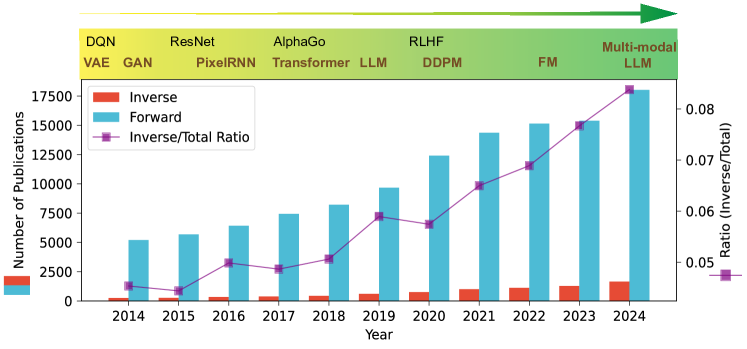
- 逆向设计越来越重要,现在约占材料设计文献的8%。
- 深度生成模型通过潜在空间和条件采样实现直接、面向性质的材料生成。
- 自适应、交互式方法(贝叶斯优化、强化学习、自主实验室)在数据与实验约束下可以加速设计。
- 前向筛选通过ML代理加速,但由于巨大设计空间,外推困难且假阴性率高。
- 进化算法(GA、PSO、MCTS)为逆向设计奠定了基础,但面临计算成本和超参数敏感性挑战。
更好的研究,从现在开始
从阅读论文到最终审阅,大幅缩短您的研究时间。
无需绑定信用卡
本解读由 AI 生成,并经人工编辑审核。