
[论文解读] AI Ethics: An Empirical Study on the Views of Practitioners and Lawmakers
本实证研究通过覆盖20个国家的99名从业者和立法者的全球调查,探讨了人工智能伦理原则及其挑战。研究识别出透明度、问责制和隐私是最关键的伦理原则,同时指出了伦理知识缺乏、法律框架缺失以及监督机构薄弱等主要挑战——为伦理意识导向的人工智能开发和成熟度建模奠定了基础。
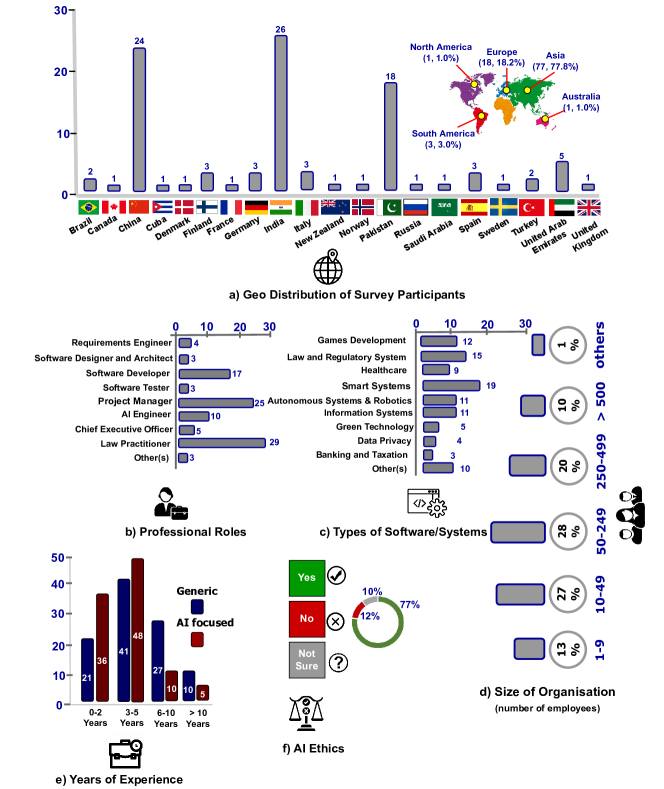
Artificial Intelligence (AI) solutions and technologies are being increasingly adopted in smart systems context, however, such technologies are continuously concerned with ethical uncertainties. Various guidelines, principles, and regulatory frameworks are designed to ensure that AI technologies bring ethical well-being. However, the implications of AI ethics principles and guidelines are still being debated. To further explore the significance of AI ethics principles and relevant challenges, we conducted a survey of 99 representative AI practitioners and lawmakers (e.g., AI engineers, lawyers) from twenty countries across five continents. To the best of our knowledge, this is the first empirical study that encapsulates the perceptions of two different types of population (AI practitioners and lawmakers) and the study findings confirm that transparency, accountability, and privacy are the most critical AI ethics principles. On the other hand, lack of ethical knowledge, no legal frameworks, and lacking monitoring bodies are found the most common AI ethics challenges. The impact analysis of the challenges across AI ethics principles reveals that conflict in practice is a highly severe challenge. Moreover, the perceptions of practitioners and lawmakers are statistically correlated with significant differences for particular principles (e.g. fairness, freedom) and challenges (e.g. lacking monitoring bodies, machine distortion). Our findings stimulate further research, especially empowering existing capability maturity models to support the development and quality assessment of ethics-aware AI systems.
研究动机与目标
- 通过实证方法考察人工智能从业者和立法者对核心AI伦理原则及挑战的认知。
- 评估所识别挑战在不同AI伦理原则上的严重性影响。
- 比较和对比从业者与立法者在伦理原则与挑战认知上的差异。
- 通过基于证据的指导方针,为开发稳健、合法且伦理对齐的人工智能系统提供可操作的见解。
- 通过识别来自现实世界利益相关者的重点原则与挑战,支持人工智能伦理能力成熟度模型的构建。
提出的方法
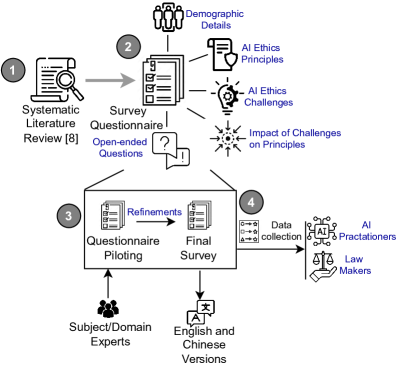
- 对来自20个国家的99名受访者(包括人工智能工程师、律师和政策制定者)开展横断面调查。
- 通过结构化问卷收集关于15项AI伦理原则和12项关键挑战的认知数据。
- 应用统计分析(如相关性检验和显著性检验)比较从业者与立法者之间的认知差异。
- 采用严重性影响分析,评估挑战在不同伦理原则上的长期后果。
- 通过与先前的系统性文献综述(SLR)进行对比验证,确保研究发现与现有理论框架一致。
- 最终制定出可用于未来AI伦理成熟度建模和工业应用的原则与挑战目录。
实验结果
研究问题
- RQ1从业者和立法者对AI伦理原则及挑战有何见解?
- RQ2所识别挑战在不同AI伦理原则上的严重性影响是什么?
- RQ3从业者与立法者对这些挑战和原则的认知有何不同?
主要发现
- 透明度、问责制和隐私被从业者和立法者共同视为最重要的AI伦理原则。
- 最严重的挑战包括伦理知识缺乏、法律框架缺失以及监督机构缺失。
- 实践中的冲突被识别为一项高度严重的挑战,尤其对公平性和自由原则造成显著影响。
- 从业者与立法者认知之间存在显著的统计相关性,但在公平性和自由原则方面仍存在明显差异。
- 立法者比从业者更认为监督机构缺失和机器失真为严重挑战。
- 本研究最终形成的伦理原则与挑战目录,为未来AI伦理成熟度模型的开发提供了经验证的基础。
更好的研究,从现在开始
从阅读论文到最终审阅,大幅缩短您的研究时间。
无需绑定信用卡
本解读由 AI 生成,并经人工编辑审核。