
[论文解读] AI Increases Global Access to Reliable Flood Forecasts
本文提出了一种基于深度学习的洪水预报系统,采用长短期记忆(LSTM)网络,在全球河流流量数据上进行训练,以实现在无流量监测站流域(即缺乏河流测站的区域)中提供可靠、实时的洪水预报,其性能在0天预警时间下与当前最先进的GloFAS系统相当或更优,并在极端事件中实现了更长的预警时间和更高的准确性。
Floods are one of the most common natural disasters, with a disproportionate impact in developing countries that often lack dense streamflow gauge networks. Accurate and timely warnings are critical for mitigating flood risks, but hydrological simulation models typically must be calibrated to long data records in each watershed. Using AI, we achieve reliability in predicting extreme riverine events in ungauged watersheds at up to a 5-day lead time that is similar to or better than the reliability of nowcasts (0-day lead time) from a current state of the art global modeling system (the Copernicus Emergency Management Service Global Flood Awareness System). Additionally, we achieve accuracies over 5-year return period events that are similar to or better than current accuracies over 1-year return period events. This means that AI can provide flood warnings earlier and over larger and more impactful events in ungauged basins. The model developed in this paper was incorporated into an operational early warning system that produces publicly available (free and open) forecasts in real time in over 80 countries. This work highlights a need for increasing the availability of hydrological data to continue to improve global access to reliable flood warnings.
研究动机与目标
- 解决无流量监测站流域中洪水预报的关键挑战,因缺乏河流测站数据而限制了可靠预测。
- 克服传统水文模型依赖长期、流域特异性校准数据的局限性。
- 开发一种可扩展、全球适用的AI模型,能够在无需本地校准的情况下跨多种水文环境实现泛化。
- 提升中低收入国家的早期预警能力,这些国家洪水风险最高,但数据获取受限。
- 将AI模型与当前最先进的全球系统GloFAS进行基准对比,以验证其性能和可靠性。
提出的方法
- 在5,680个全球河流流量测站上训练长短期记忆(LSTM)循环神经网络,使用历史日径流量数据。
- 采用k折交叉验证评估模型泛化能力,确保在无流量监测站流域中的样本外性能。
- 利用观测和模拟水文过程得出的重现期阈值(1年、5年、10年、25年、50年、100年事件)来定义极端事件。
- 针对每个测站和重现期计算精确率、召回率和F1分数,将AI模型预测结果与实际观测流量进行比较。
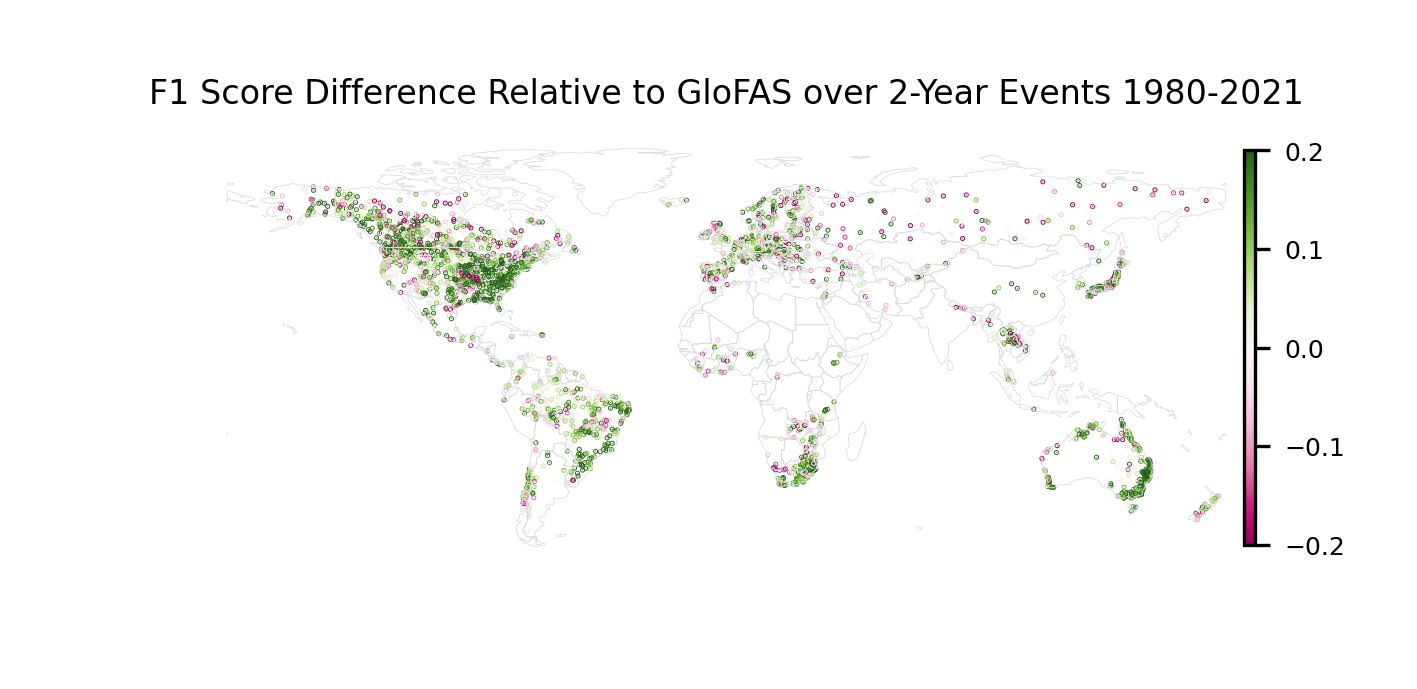
- 使用相同的评估指标,将AI模型与当前运行中的全球洪水预报系统GloFAS版本4进行基准对比。
- 将训练好的模型集成到一个可公开访问的运营级早期预警系统中,通过一个免费、开放的平台(https://g.co/floodhub)向超过80个国家提供服务。
实验结果
研究问题
- RQ1基于AI的模型是否能在无需本地校准数据的情况下,实现在无流量监测站流域中的可靠洪水预报?
- RQ2AI模型的性能与GloFAS相比如何,特别是在极端事件的预警时间和准确性方面?
- RQ3AI模型在多大程度上能可靠预测高量级、低频次洪水事件(例如5年重现期事件)?
- RQ4AI模型在有测站流域中是否保持或优于GloFAS的性能,其在无测站流域中的表现如何?
- RQ5开放的公共数据是否能够支持构建一种可扩展、全球可访问的洪水预报系统,从而减少洪水预警获取方面的不平等?
主要发现
- AI模型在无流量监测站流域中对极端河流洪水事件的预报可靠性可达5天预警时间,与GloFAS在0天预警时间下的可靠性相当或更优。
- 对于5年重现期事件,AI模型的准确性与当前GloFAS对1年重现期事件的性能相当或更优。
- 在NSE和KGE指标上,AI模型在无流量监测站流域中的表现优于GloFAS在有测站流域中的表现,表明其具备强大的泛化能力。
- AI模型在不同水文气候区域均保持高精确率和高召回率,对10年重现期事件的F1分数始终高于0.7。
- 该系统已投入运行,无需注册或费用,即可向超过80个国家提供实时、公开可访问的洪水预报。
- 数据可得性仍是主要瓶颈,因为模型性能受限于公开可用河流流量观测的质量和覆盖范围。

更好的研究,从现在开始
从阅读论文到最终审阅,大幅缩短您的研究时间。
无需绑定信用卡
本解读由 AI 生成,并经人工编辑审核。