
[论文解读] AirPhyNet: Harnessing Physics-Guided Neural Networks for Air Quality Prediction
AirPhyNet 将扩散-对流物理引入神经网络,用于预测 PM2.5,在数据稀疏情况下尤为提升,与先进基线相比表现更好。
Air quality prediction and modelling plays a pivotal role in public health and environment management, for individuals and authorities to make informed decisions. Although traditional data-driven models have shown promise in this domain, their long-term prediction accuracy can be limited, especially in scenarios with sparse or incomplete data and they often rely on black-box deep learning structures that lack solid physical foundation leading to reduced transparency and interpretability in predictions. To address these limitations, this paper presents a novel approach named Physics guided Neural Network for Air Quality Prediction (AirPhyNet). Specifically, we leverage two well-established physics principles of air particle movement (diffusion and advection) by representing them as differential equation networks. Then, we utilize a graph structure to integrate physics knowledge into a neural network architecture and exploit latent representations to capture spatio-temporal relationships within the air quality data. Experiments on two real-world benchmark datasets demonstrate that AirPhyNet outperforms state-of-the-art models for different testing scenarios including different lead time (24h, 48h, 72h), sparse data and sudden change prediction, achieving reduction in prediction errors up to 10%. Moreover, a case study further validates that our model captures underlying physical processes of particle movement and generates accurate predictions with real physical meaning.
研究动机与目标
- 通过将物理学与数据驱动学习相结合,激励准确的户外 PM2.5 预测。
- 将基本的空气传输物理(扩散与对流)融入深度学习框架。
- 提高预测准确性和可解释性,尤其在数据稀疏和突变情形下。
提出的方法
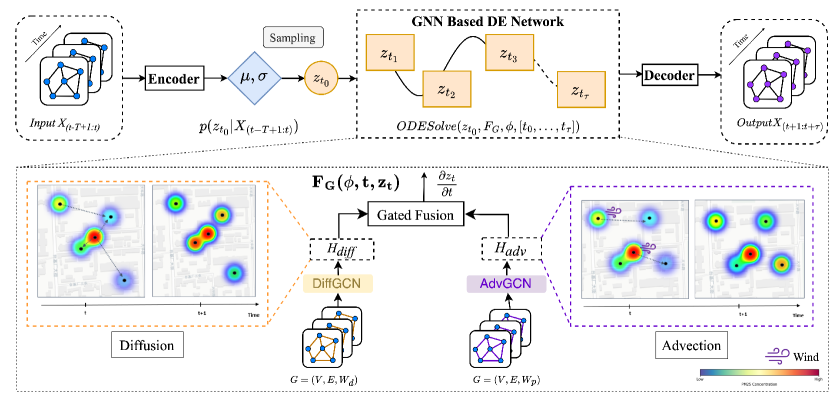
- 使用 RNN 编码器(GRU)对历史 PM2.5 与天气数据进行编码。
- 将传感器网络中的扩散与对流建模为带图拉普拉斯的微分方程网络。
- 通过门控机制融合扩散和对流动力学,形成扩散-对流微分方程(DE)。
- 用由GNN启发的神经 ODE 对 DE 网络参数化,以随时间演化潜在状态。
- 将潜在预测解码为未来时 horizon 的 PM2.5 浓度(最多 72 小时)。
- 端到端训练,通过最小化预测值与真实浓度之间的 MAE 来优化。
实验结果
研究问题
- RQ1物理引导的深度学习(扩散-对流)能否提高户外 PM2.5 预测,相较于纯数据驱动模型?
- RQ2物理信息组件在数据稀疏和突变情景中是否提升性能?
- RQ3提出的基于 GNN 的微分方程网络是否能有效捕捉传感器网络上的时空传输动力学?
- RQ4将预测与潜在扩散和对流过程联系起来的可解释性收益是什么?
主要发现
- AirPhyNet 在北京和深圳数据集的 24h、48h、72h 预测中始终优于基线。
- 在全数据设定下,平均相比第二佳方法在 MAE 提升 3.7%,在 RMSE 提升 6.1%。
- 在数据稀疏设置下,AirPhyNet 相比竞争对手平均在 MAE 提升 8.3%,在 RMSE 提升 8.1%。
- 模型在突变情景下的预测误差减少高达 8%。
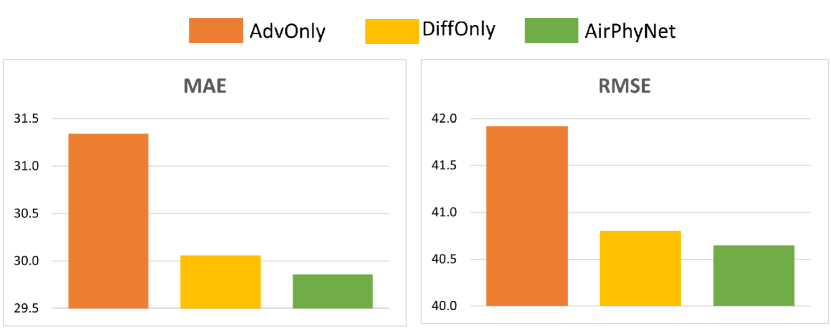
- 消融研究显示结合扩散和对流的优势,以及使用 GRU 编码器优于基于 TCN 的编码器。
- 案例研究可视化展示了预测中的物理意义的扩散与对流模式。
更好的研究,从现在开始
从阅读论文到最终审阅,大幅缩短您的研究时间。
无需绑定信用卡
本解读由 AI 生成,并经人工编辑审核。