
[论文解读] ALCM: Autonomous LLM-Augmented Causal Discovery Framework
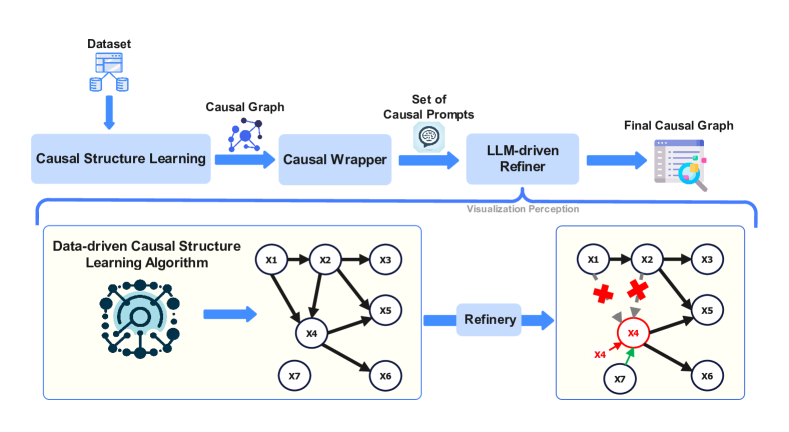
ALCM 是一种新颖的自主框架,将数据驱动的因果发现与大型语言模型(LLMs)相结合,以生成更准确、更稳健且可解释性更强的因果图。通过整合因果结构学习、因果包装器和 LLM 驱动的优化器,ALCM 在因果发现准确性方面优于现有的基于 LLM 的方法和传统方法,并识别出此前未被发现的因果关系和隐变量。
To perform effective causal inference in high-dimensional datasets, initiating the process with causal discovery is imperative, wherein a causal graph is generated based on observational data. However, obtaining a complete and accurate causal graph poses a formidable challenge, recognized as an NP- hard problem. Recently, the advent of Large Language Models (LLMs) has ushered in a new era, indicating their emergent capabilities and widespread applicability in facilitating causal reasoning across diverse domains, such as medicine, finance, and science. The expansive knowledge base of LLMs holds the potential to elevate the field of causal reasoning by offering interpretability, making inferences, generalizability, and uncovering novel causal structures. In this paper, we introduce a new framework, named Autonomous LLM-Augmented Causal Discovery Framework (ALCM), to synergize data-driven causal discovery algorithms and LLMs, automating the generation of a more resilient, accurate, and explicable causal graph. The ALCM consists of three integral components: causal structure learning, causal wrapper, and LLM-driven causal refiner. These components autonomously collaborate within a dynamic environment to address causal discovery questions and deliver plausible causal graphs. We evaluate the ALCM framework by implementing two demonstrations on seven well-known datasets. Experimental results demonstrate that ALCM outperforms existing LLM methods and conventional data-driven causal reasoning mechanisms. This study not only shows the effectiveness of the ALCM but also underscores new research directions in leveraging the causal reasoning capabilities of LLMs.
研究动机与目标
- 解决从高维观测数据中生成准确且完整的因果图的挑战,该问题为 NP-难问题且易出错。
- 克服传统数据驱动因果发现方法的局限性,例如对专家知识的依赖、数据偏差以及无法解决马尔可夫等价类的问题。
- 利用 LLM 的涌现推理能力和世界知识,提升因果图的准确性、可解释性与泛化能力。
- 开发一种自主的端到端框架,协同 LLM 与因果发现算法,减少人工干预并提高可靠性。
- 通过 LLM 引导的推理,实现对原始数据集中未包含的隐藏或此前被忽略的因果变量和边的发现。
提出的方法
- ALCM 采用三组件架构:(1) 使用成熟算法(如 PC、GES)进行因果结构学习,(2) 因果包装器用于验证和优化候选图,(3) LLM 驱动的因果优化器用于假设生成与验证。
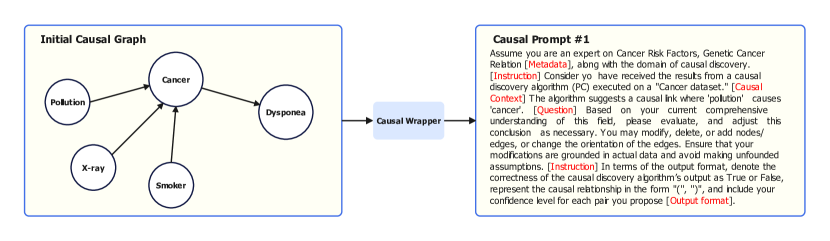
- LLM 驱动的优化器利用思维链提示和置信度评分,生成并评估潜在的因果关系,包括新增节点与边。
- 该框架整合了检索增强生成(RAG)和 openCHA,以减少幻觉并提升 LLM 输出的事实准确性。
- 一种混合变体 ALCM-Hybrid 将算法精度与 LLM 洞察相结合,进一步提升性能。
- 系统以动态、自主的循环运行,通过数据、算法和 LLM 推理的迭代,持续优化因果图。
- 评估包括在七个基准数据集(包括 Sachs 和神经病理性疼痛数据)上与真实情况的可视化与定量对比。
实验结果
研究问题
- RQ1LLM 是否能有效增强数据驱动的因果发现,从而提升学习到的因果图的准确性和完整性?
- RQ2LLM 在多大程度上能够识别出原始数据集中未包含的隐藏或此前未被发现的因果变量与边?
- RQ3将 LLM 推理与因果发现算法结合,如何减少对专家标注的依赖并提升可解释性?
- RQ4结合算法精度与 LLM 推理的混合框架,是否能优于纯算法方法与纯 LLM 方法?
- RQ5ALCM 框架在检测和验证现实世界高维数据集中的因果结构方面具有多强的鲁棒性?
主要发现
- ALCM 在七个基准数据集上显著优于传统数据驱动因果发现方法(如 PC)和现有基于 LLM 的方法,在因果发现准确性方面表现更优。
- ALCM-Hybrid 变体性能最高,证明了将算法精度与 LLM 推理相结合的有效性。
- ALCM 识别出原始因果发现输出中不存在的新节点与边,其结果经最新医学文献验证。
- LLM 驱动的优化器组件显著提升了对真实因果关系的检测能力,尤其在复杂或模糊情况下表现更优。
- ALCM 通过利用 LLM 广泛的世界知识与推理能力,减轻了数据偏差与模型局限性的影响。
- 可视化结果证实,ALCM 揭示了标准算法所遗漏的隐藏或被忽略的因果连接,例如马尔可夫毯中的关系。
更好的研究,从现在开始
从阅读论文到最终审阅,大幅缩短您的研究时间。
无需绑定信用卡
本解读由 AI 生成,并经人工编辑审核。