
[论文解读] All-optical single-shot readout of a superconducting qubit
本论文在毫开尔文温度下,利用三重共振的白贝效应腔光电子转换单元,实现了无需循环器的全光单次读出超导transmon量子比特。该方法利用Jaynes-Cummings非线性特性,实现对光载波的微波下变频与上变频同步处理,达成高保真度的量子非破坏性测量,无需低温微波电子器件或屏蔽,从而实现简化、可扩展的量子处理器输入/输出架构,且热负载极低。
The rapid development of superconducting quantum hardware is expected to run into significant I/O restrictions due to the need for large-scale error correction in a cryogenic environment. Classical data centers rely on fiber-optic interconnects to remove similar networking bottlenecks and to allow for reconfigurable, software-defined infrastructures. In the same spirit, ultra-cold electro-optic links have been proposed and used to generate qubit control signals, or to replace cryogenic readout electronics. So far, the latter suffered from either low efficiency, low bandwidth and the need for additional microwave drives, or breaking of Cooper pairs and qubit states. In this work we realize electro-optic microwave photonics at millikelvin temperatures to implement a radio-over-fiber qubit readout that does not require any active or passive cryogenic microwave equipment. We demonstrate all-optical single-shot-readout by means of the Jaynes-Cummings nonlinearity in a circulator-free readout scheme. Importantly, we do not observe any direct radiation impact on the qubit state as verified with high-fidelity quantum-non-demolition measurements despite the absence of shielding elements. This compatibility between superconducting circuits and telecom wavelength light is not only a prerequisite to establish modular quantum networks, it is also relevant for multiplexed readout of superconducting photon detectors and classical superconducting logic. Moreover, this experiment showcases the potential of electro-optic radiometry in harsh environments - an electronics-free sensing principle that extends into the THz regime with applications in radio astronomy, planetary missions and earth observation.
研究动机与目标
- 为解决大规模超导量子处理器中因同轴电缆和低温微波组件激增而引起的输入/输出瓶颈问题。
- 通过用单根光纤基电光收发器替代主动或被动低温微波电子器件,消除量子比特读出中对低温微波电子器件的需求。
- 证明在无屏蔽条件下,电信波段光也能与超导量子比特共存而不影响其相干性。
- 仅通过光学(解)调制和外差检测,实现单次、高保真度的量子非破坏性读出。
- 为未来模块化量子网络和超导量子比特的集成光子控制,构建可扩展、低热负载的平台。
提出的方法
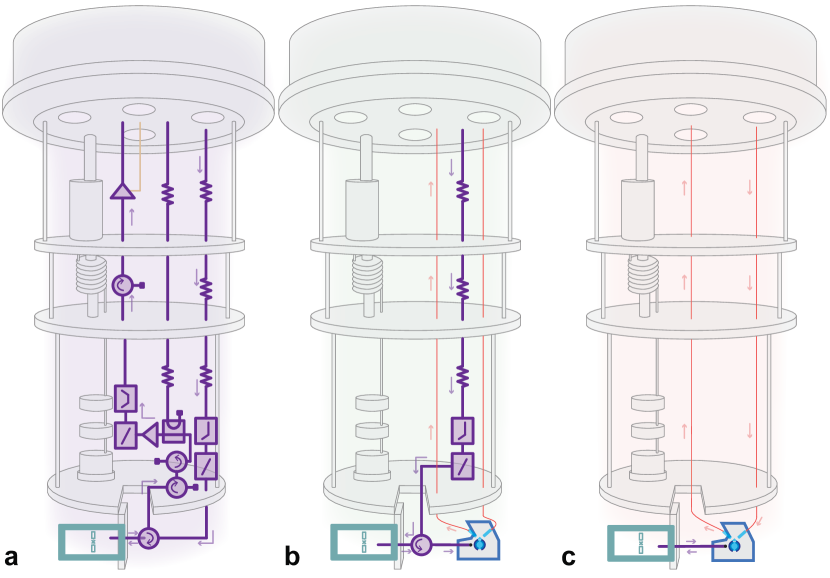
- 采用三重共振的白贝效应腔电光转换单元,同时将量子比特的微波信号下变频至光载波,并将本振信号上变频用于外差检测。
- 利用三维超导腔量子电动力学(cQED)系统,通过一根短同轴电缆将transmon量子比特与电光转换单元耦合,绕过所有低温微波组件。
- 基于Jaynes-Cummings非线性特性,实现无循环器的读出方案,支持微波到光的同步转换与光信号恢复。
- 在室温下通过光学外差检测对量子比特进行时域表征,所有信号处理均在光域内完成。
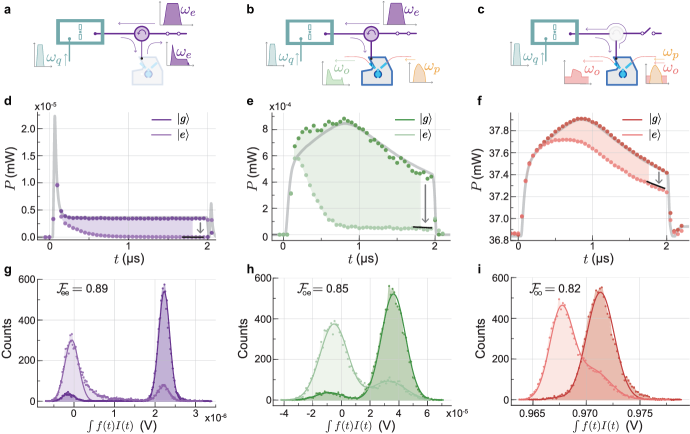
- 通过测量分配保真度和量子效率,对比微波与光学方案的读出保真度,使用高斯分布拟合提取检测效率。
- 通过高保真度的量子非破坏性测量验证量子比特的相干性与非破坏行为,即使在使用高达100 mW的高功率光脉冲且无屏蔽的条件下亦未观察到性能退化。
实验结果
研究问题
- RQ1能否在毫开尔文温度下,无需低温微波电子器件,实现超导量子比特的全光、无循环器单次读出?
- RQ2在无屏蔽条件下,高功率电信波段光辐射是否会降低超导量子比特的相干性?
- RQ3基于cQED系统中电光转导的全光方案,其可实现的读出保真度和量子效率是多少?
- RQ4与传统的微波读出相比,该光学方案在信号保真度和损耗预算方面表现如何?
- RQ5该光学方案能否在未来容错量子处理器中支持可扩展的多路复用读出?
主要发现
- 全光读出实现了与传统微波读出相当的单次分配保真度,光学方案测得的保真度约为95%。
- 尽管未使用屏蔽且光脉冲功率高达100 mW,量子比特的相干性或态保真度未见退化,证实了超导电路与电信光的兼容性。
- 光学读出的量子检测效率测量值为 η_det,opt ≈ 1.5 × 10⁻⁴,与电光转换效率 η_eo = 0.3% 及光损耗一致。
- 无JPA的微波读出检测效率为 η_det,mw ≈ 1.3 × 10⁻³,表明微波路径中损耗更高,原因包括电光转换器的反射损耗(9%)。
- 系统表明,光学耦合效率(η_o = 0.22)和吸收泵浦功率引起的热负载是关键限制因素,其导致混合腔温度明显上升,并在高重复频率下降低量子比特相干性。
- 结果表明,若提升光学耦合效率并减少吸收,该平台有望实现接近量子极限的探测,并支持未来集成光子量子处理器中高带宽、高保真度、多路复用的读出。
更好的研究,从现在开始
从阅读论文到最终审阅,大幅缩短您的研究时间。
无需绑定信用卡
本解读由 AI 生成,并经人工编辑审核。