
[论文解读] All the Little Things in Abell 2744: $>$1000 Gravitationally Lensed Dwarf Galaxies at $z=0-9$ from JWST NIRCam Grism Spectroscopy
本文介绍 All the Little Things (ALT) JWST Cycle 2 NIRCam grism survey of Abell 2744,提供了 >1000 个被放大矮星系的光谱与红移(z=0-9),并引入新颖的 mosaic 拼接与线识别技术,在 z=0.2-8.5 范围内测得 1630 个红移。
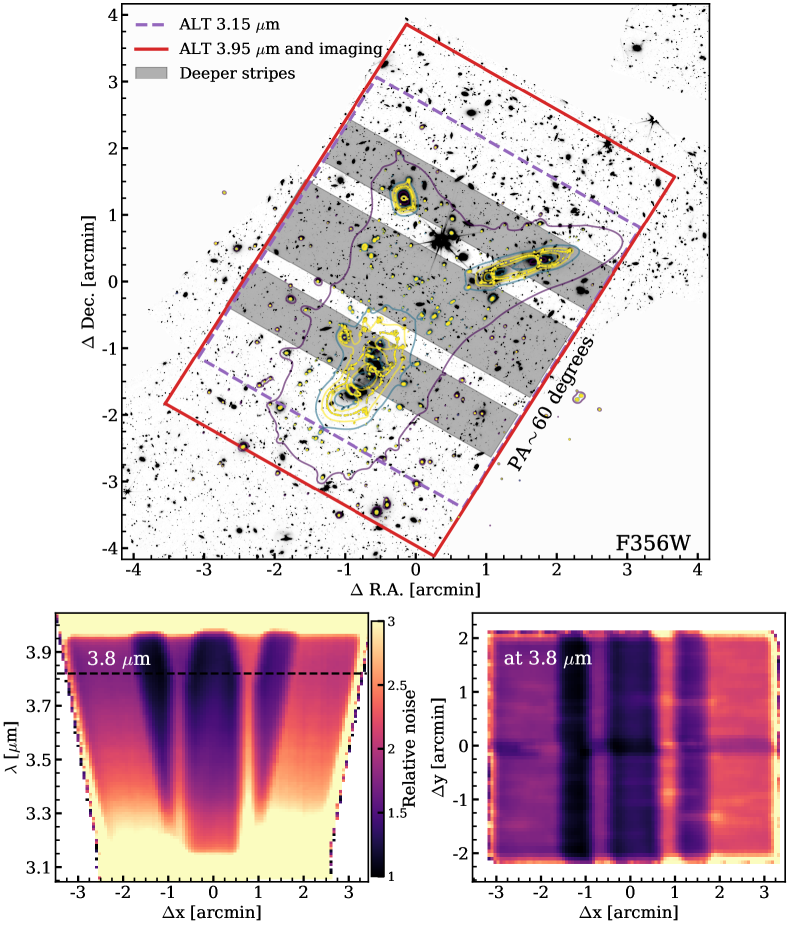
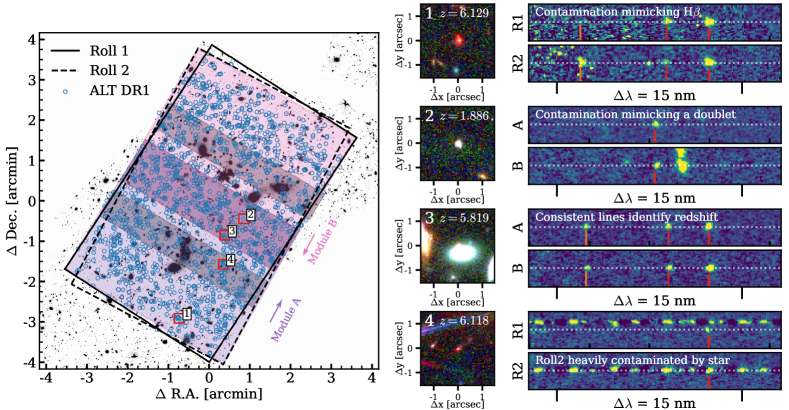
Dwarf galaxies hold the key to crucial frontiers of astrophysics, however, their faintness renders spectroscopy challenging. Here we present the JWST Cycle 2 survey, All the Little Things (ALT, PID 3516), which is designed to seek late-forming Pop III stars and the drivers of reionization at $z\sim6-7$. ALT has acquired the deepest NIRCam grism spectroscopy yet (7-27 hr), at JWST's most sensitive wavelengths (3-4 $μ$m), covering the powerful lensing cluster Abell 2744. Over the same 30 arcmin$^2$, ALT's ultra-deep F070W+F090W imaging ($\sim$30 mag) enables selection of very faint sources at $z>6$. We demonstrate the success of ALT's novel ``butterfly" mosaic to solve spectral confusion and contamination, and introduce the ``Allegro" method for emission line identification. By collecting spectra for every source in the field of view, ALT has measured precise ($R\sim1600$) redshifts for 1630 sources at $z=0.2-8.5$. This includes one of the largest samples of distant dwarf galaxies: [1015, 475, 50] sources less massive than the SMC, Fornax, and Sculptor with $\log(M_{*}/M_{\odot})<$[8.5, 7.5, 6.5]. We showcase ALT's discovery space with: (i) spatially resolved spectra of lensed clumps in galaxies as faint as $M_{ m{UV}}\sim-15$; (ii) large-scale clustering -- overdensities at $z$=[2.50, 2.58, 3.97, 4.30, 5.66, 5.77, 6.33] hosting massive galaxies with striking Balmer breaks; (iii) small-scale clustering -- a system of satellites around a Milky Way analog at $z\sim6$; (iv) spectroscopically confirmed multiple images that help constrain the lensing model underlying all science in this legacy field; (v) sensitive star-formation maps based on dust-insensitive tracers such as Pa$α$; (vi) direct spectroscopic discovery of rare sources such as AGN with ionized outflows. These results provide a powerful proof of concept for how grism surveys maximize the potential of strong lensing fields.
研究动机与目标
- Motivate a deep spectroscopic census of extremely faint, lensed galaxies to study metal-poor pockets and reionization-era sources.
- Leverage Abell 2744’s lensing to push to very faint masses and capture spatially resolved spectra of clumps and satellites.
- Develop and validate mosaicking and analysis techniques to mitigate spectral confusion in WFSS data.
- Provide a large, homogeneous catalog of spectroscopic redshifts and emission-line measurements for diverse galaxy environments in a lensing field.
- Demonstrate science outcomes including metal-poor candidates, AGN with outflows, and clustering in both large- and small-scale regimes.
提出的方法
- Use JWST NIRCam WFSS (R~1600) in the F356W-dominated setup to obtain deep grism spectroscopy (7–27 hr total exposure per field) over Abell 2744.
- Implement a novel butterfly mosaic strategy with two close roll angles to solve spectral confusion across module overlap and dispersion directions.
- Develop and apply Allegro and grizli pipelines for robust emission-line identification and spectroscopic redshift measurement.
- Construct photometric catalogs from multi-band NIRCam/HST data with careful foreground subtraction to detect highly magnified sources.
- Derive physical properties by 27-band SED fitting and use spectroscopic redshifts to anchor metallicity-sensitive line diagnostics (e.g., [OIII]/Hβ).
- research_questions_role_in_study_or_queries_ignored_if_not_present_or_redundant_to_keep_focus_on_key_rqs_and_results__
实验结果
研究问题
- RQ1What is the redshift distribution and spectral completeness achievable in a deep WFSS survey of a strong-lensing cluster like Abell 2744?
- RQ2How effective is the butterfly mosaic and Allegro/grizli approaches at mitigating spectral contamination and enabling robust line identifications in crowded lensing fields?
- RQ3How many dwarf galaxies (log(M*/Msun)<8.5,7.5,6.5 for corresponding templates) can be detected and characterized behind Abell 2744, extending to z~9?
- RQ4What do spatially resolved spectra reveal about star formation, metallicity, and ionizing photon production in highly magnified clumps and satellites?
- RQ5What do the large- and small-scale clustering analyses reveal about the environments of massive galaxies at z~2–6 within a lensing field?
主要发现
| 波段 | 深度 (0.16) [mag AB] | 深度 (0.08) [mag AB] |
|---|---|---|
| F435W | 28.91 | 29.89 |
| F606W | 28.62 | 29.62 |
| F814W | 28.52 | 29.51 |
| F105W | 27.63 | 28.63 |
| F125W | 27.73 | 28.76 |
| F140W | 29.06 | 30.11 |
| F160W | 27.45 | 28.44 |
| JWST F070W | 28.91 | 29.89 |
| JWST F090W | 29.36 | 30.34 |
| JWST F115W | 29.02 | 30.05 |
| JWST F140M | 28.03 | 29.04 |
| JWST F150W | 29.12 | 30.14 |
| JWST F162M | 28.11 | 29.11 |
| JWST F182M | 28.48 | 29.50 |
| JWST F200W | 29.21 | 30.26 |
| JWST F210M | 28.37 | 29.37 |
| JWST F250M | 28.11 | 29.11 |
| JWST F277W | 29.64 | 30.66 |
| JWST F300M | 28.63 | 29.64 |
| JWST F335M | 28.65 | 29.70 |
| JWST F356W | 29.82 | 30.86 |
| JWST F360M | 28.72 | 29.72 |
| JWST F410M | 29.02 | 29.99 |
| JWST F430M | 27.98 | 28.98 |
| JWST F460M | 27.75 | 28.72 |
| JWST F480M | 27.91 | 28.87 |
| JWST F444W | 29.44 | 30.43 |
- Measured precise redshifts for 1630 sources in the field, spanning z=0.2–8.5.
- Detected one of the largest samples of distant dwarf galaxies with log(M*/M⊙) < 8.5 (and lower) in a lensing field.
- Demonstrated spatially resolved spectra of lensed clumps as faint as MUV ~ -15.
- Identified overdensities and clustering signals at multiple redshifts (e.g., z=2.50, 2.58, 3.97, 4.30, 5.66, 5.77, 6.33) and a Milky Way–like satellite system at z~6.
- Provided spectroscopic confirmations that help constrain the Abell 2744 lensing model.
- Achieved sensitive tracers of star formation (e.g., Paα) and discovery of rare sources such as AGN with ionized outflows.
更好的研究,从现在开始
从论文设计到论文写作,大幅缩短您的研究时间。
无需绑定信用卡
本解读由 AI 生成,并经人工编辑审核。