
[论文解读] Amortized Normalizing Flows for Transcranial Ultrasound with Uncertainty Quantification
该论文提出了一种用于经颅超声计算机断层扫描的渐近归一化流框架,与全波形反演(FWI)相比,将图像重建速度提升了98%,同时提供了校准的不确定性量化。通过使用物理信息摘要统计量压缩高维超声数据,该方法实现了仅需每个源一次前向/梯度计算即可完成快速、可泛化的后验推断,从而实现高保真度重建和与重建误差相关的不确定性图。
We present a novel approach to transcranial ultrasound computed tomography that utilizes normalizing flows to improve the speed of imaging and provide Bayesian uncertainty quantification. Our method combines physics-informed methods and data-driven methods to accelerate the reconstruction of the final image. We make use of a physics-informed summary statistic to incorporate the known ultrasound physics with the goal of compressing large incoming observations. This compression enables efficient training of the normalizing flow and standardizes the size of the data regardless of imaging configurations. The combinations of these methods results in fast uncertainty-aware image reconstruction that generalizes to a variety of transducer configurations. We evaluate our approach with in silico experiments and demonstrate that it can significantly improve the imaging speed while quantifying uncertainty. We validate the quality of our image reconstructions by comparing against the traditional physics-only method and also verify that our provided uncertainty is calibrated with the error.
研究动机与目标
- 解决经颅超声计算机断层扫描(TUCT)中全波形反演(FWI)计算不可行的问题,其单次重建耗时长达36小时。
- 通过将物理波动力学融入数据压缩过程,克服基于深度学习成像中高维复杂超声数据的挑战。
- 实现高效、具备不确定性的图像重建,且无需微调即可在多种探头配置下泛化。
- 提供与重建误差相关联的校准贝叶斯不确定性量化,提升临床决策的可靠性。
- 开发一种结合物理信息建模与数据驱动归一化流的方法,在保持图像质量与不确定性保真度的同时实现快速推理。
提出的方法
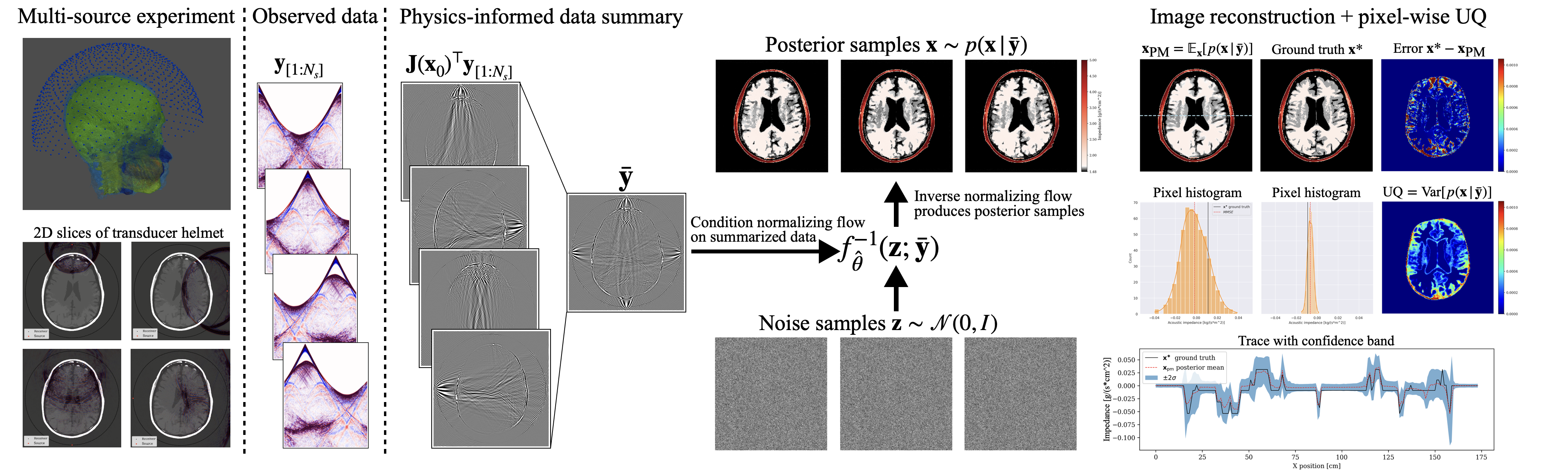
- 采用物理信息摘要统计量,将原始超声数据(32个源,256个接收器,2377个时间步)压缩70倍,降低输入维度的同时保持物理一致性。
- 使用条件归一化流建模给定压缩摘要统计量下声阻抗的后验分布,实现高效采样与不确定性量化。
- 以渐近方式训练归一化流,使得每个源仅需一次前向与梯度计算即可完成后验推断,极大降低在线推理成本。
- 在贝叶斯框架下构建逆问题,支持完整的后验采样与逐点方差估计,准确反映图像重建中的不确定性。
- 通过单次预训练阶段学习归一化流,实现在无需微调的情况下,快速适应多种探头配置的在线推理。
- 将可变密度标量声波方程的物理特性整合到摘要函数中,确保数据压缩过程尊重波传播物理规律。
实验结果
研究问题
- RQ1物理信息摘要统计量是否能在不损失物理保真度的前提下,实现经颅超声成像中高维数据的高效压缩?
- RQ2渐近归一化流是否能在保持与全波形反演相当图像质量的同时,提供快速且校准的不确定性量化?
- RQ3所提方法在不同探头源配置与采集几何结构下的泛化能力如何?
- RQ4模型生成的不确定性图是否与实际重建误差相关,从而满足临床可靠性要求?
- RQ5该方法是否能将重建时间从数小时缩短至数分钟,同时相比纯物理模型的FWI保持或提升图像保真度?
主要发现
- 所提方法将在线推理时间缩短至约48秒(44.8 + 3.23秒),相比全波形反演(FWI)的约2100秒,提升了98%。
- 该方法的峰值信噪比(PSNR)达到38.67,显著高于FWI(33.25)与监督式U-Net(35.63),表明图像保真度更优。
- 后验均值的结构相似性指数(SSIM)为0.9646,超过FWI(0.9450)与U-Net(0.9332),证实结构保留更佳。
- 均方根误差(RMSE)为0.0119,显著低于FWI(0.0215)与U-Net(0.0168),表明重建精度更高。
- 后验样本的逐点方差与重建误差强相关,验证了不确定性估计的校准性与临床意义。
- 该方法在不同探头配置下具有良好泛化能力:三种不同设置的后验均值与不确定性图均在约3分钟内完成计算,而FWI每种配置需约1.5小时。
更好的研究,从现在开始
从阅读论文到最终审阅,大幅缩短您的研究时间。
无需绑定信用卡
本解读由 AI 生成,并经人工编辑审核。