
[论文解读] An Adventure in Topological Phase Transitions in 3 + 1-D: Non-abelian Deconfined Quantum Criticalities and a Possible Duality
本文在3+1维中提出了任意子非阿贝尔禁闭量子临界点(DQCPs),涵盖自旋系统与费米子系统,实现临界理论为非阿贝尔规范理论,并在Banks-Zaks固定点处流动。文章引入了“非必要量子临界点”的概念——即同一相内的连续相变——并提出了一种新颖的3+1维对偶性:SU(2)规范理论与一个伴随狄拉克费米子,与一个狄拉克费米子耦合拓扑场论之间的对偶。
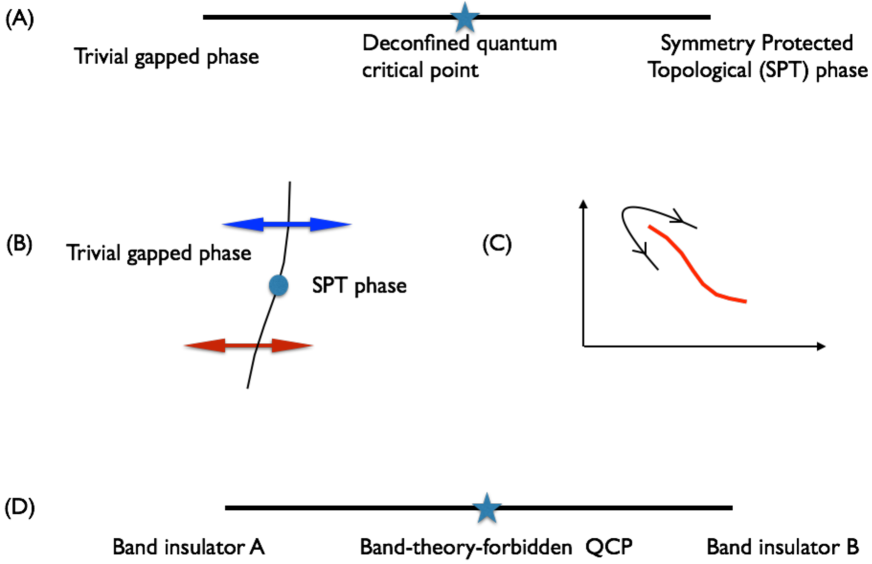
Continuous quantum phase transitions that are beyond the conventional paradigm of fluctuations of a symmetry breaking order parameter are challenging for theory. These phase transitions often involve emergent deconfined gauge fields at the critical points as demonstrated in 2+1-dimensions. Examples include phase transitions in quantum magnetism as well as those between Symmetry Protected Topological phases. In this paper, we present several examples of Deconfined Quantum Critical Points (DQCP) between Symmetry Protected Topological phases in 3+1-D for both bosonic and fermionic systems. Some of the critical theories can be formulated as non-abelian gauge theories either in their Infra-Red free regime, or in the conformal window when they flow to the Banks-Zaks fixed points. We explicitly demonstrate several interesting quantum critical phenomena. We describe situations in which the same phase transition allows for multiple universality classes controlled by distinct fixed points. We exhibit the possibility - which we dub "unnecessary quantum critical points" - of stable generic continuous phase transitions within the same phase. We present examples of interaction driven band-theory- forbidden continuous phase transitions between two distinct band insulators. The understanding we develop leads us to suggest an interesting possible 3+1-D field theory duality between SU(2) gauge theory coupled to one massless adjoint Dirac fermion and the theory of a single massless Dirac fermion augmented by a decoupled topological field theory.
研究动机与目标
- 探索超越朗道-金兹堡-威尔逊范式的3+1维连续量子相变。
- 识别并表征3+1维中对称保护拓扑(SPT)相之间的自禁闭量子临界点(DQCPs)。
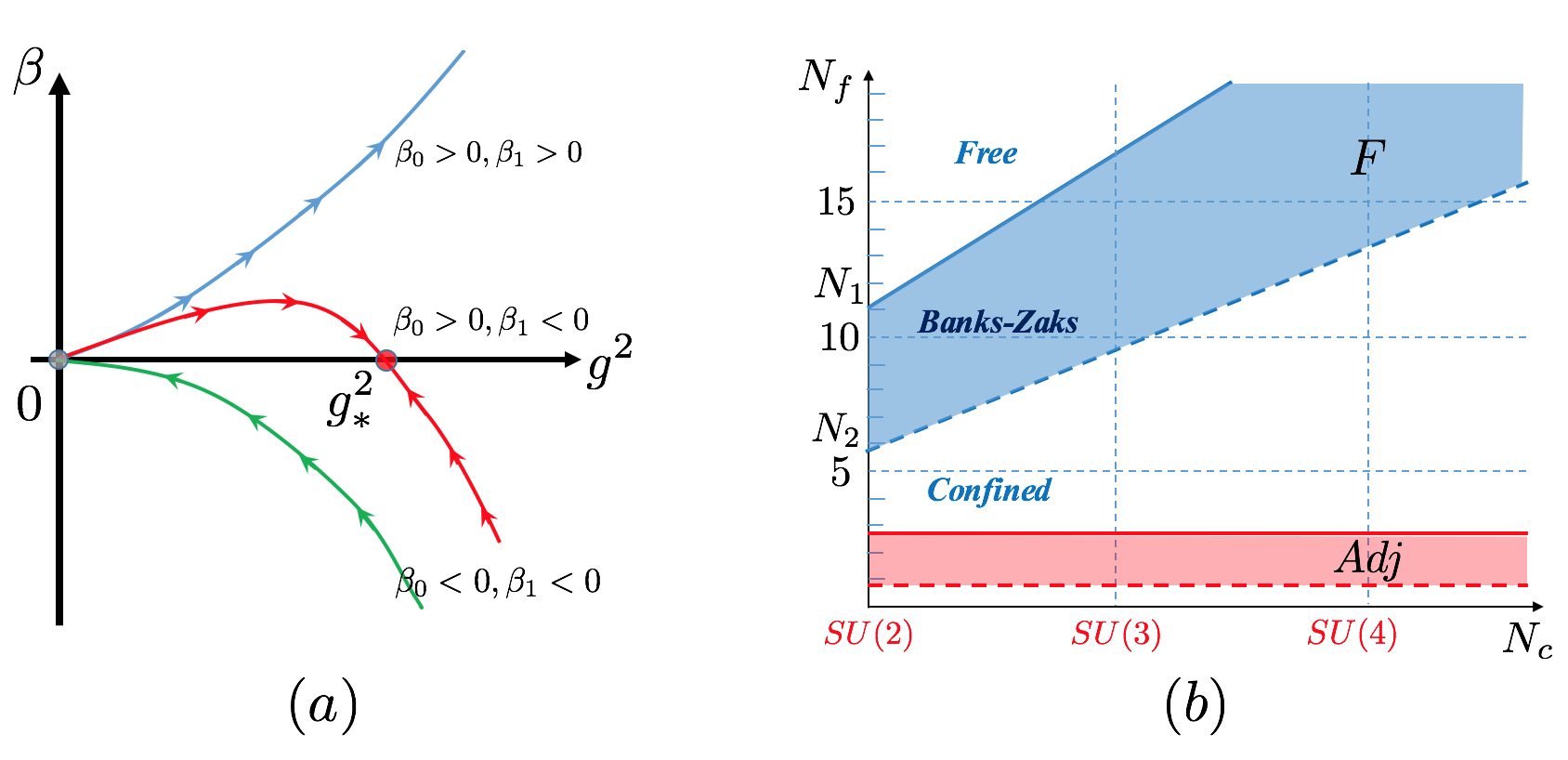
- 研究临界点处非阿贝尔规范理论的出现,特别是Banks-Zaks固定点的共形窗口。
- 提出一种涉及SU(2)规范理论与一个伴随狄拉克费米子及拓扑场论的新型3+1维场论对偶。
- 展示由相互作用驱动、在能带理论中被禁止的能带绝缘体之间的连续相变。
提出的方法
- 使用非阿贝尔规范理论,特别是带有基础或伴随费米子的SU(2),形式化3+1维临界理论。
- 利用Banks-Zaks固定点框架分析这些规范理论的红外行为,以识别共形场论。
- 通过全局对称性和异常匹配,识别临界点处的涌现对称性和拓扑序。
- 通过对偶性网络构建对偶场论,特别是将带有单个伴随狄拉克费米子的SU(2)规范理论与单个狄拉克费米子加一个拓扑场论联系起来。
- 使用1形式对称性异常和拓扑响应函数对相进行分类,并检测非平凡的拓扑序。
- 应用时间反演与电荷共轭对称性(记为CT),对规范不变算符及其变换性质进行分类。
实验结果
研究问题
- RQ1在3+1维中,对称保护拓扑相之间是否存在自禁闭量子临界性?
- RQ2此类相变的临界理论是什么?能否在共形窗口中由非阿贝尔规范理论描述?
- RQ3同一相变是否可支持多个由不同固定点控制的普适类?
- RQ4是否可能在无对称性破缺的情况下,于同一相内发生连续相变——即‘非必要量子临界点’?
- RQ5在3+1维中,是否存在带有单个伴随狄拉克费米子的SU(2)规范理论与一个狄拉克费米子耦合拓扑场论之间的对偶?
主要发现
- 本文为自旋系统与费米子系统在3+1维中构建了SPT相之间DQCP的明确例子,临界理论由非阿贝尔规范理论描述。
- 对于带有$ N_f = 3 $个伴随费米子的SU(2)规范理论,临界点位于共形窗口内,并流动至Banks-Zaks固定点。
- 证明了同一相变中可共存多个普适类,不同固定点分别控制不同的临界行为。
- 确立了‘非必要量子临界点’的概念:即使无对称性破缺,同一相内也可发生稳定的连续相变。
- 提出了一种新颖的3+1维对偶:带有单个伴随狄拉克费米子的SU(2)规范理论,与一个附加了解耦拓扑场论的单个狄拉克费米子之间。
- 该对偶得到异常匹配的支持,包括1形式对称性异常和时间反演对称性异常,并与拓扑响应函数及全局对称性结构一致。
更好的研究,从现在开始
从阅读论文到最终审阅,大幅缩短您的研究时间。
无需绑定信用卡
本解读由 AI 生成,并经人工编辑审核。