
[论文解读] An Atlas of Color-selected Quiescent Galaxies at $z>3$ in Public $JWST$ Fields
本研究利用11个天区的公开JWST与哈勃空间望远镜数据,系统性地搜寻红移$z>3$的宁静星系,通过紫外-可见-红外颜色(UVJ)和一种新颖的高斯混合模型(GMM)方法在静止帧颜色空间中识别出约80个候选宁静及熄灭星系。研究揭示了不同天区之间星系数密度存在显著差异(达2–3倍),表明存在宇宙方差及潜在的星系团聚现象,同时展示了JWST对低质量、高红移宁静星系的增强探测能力。
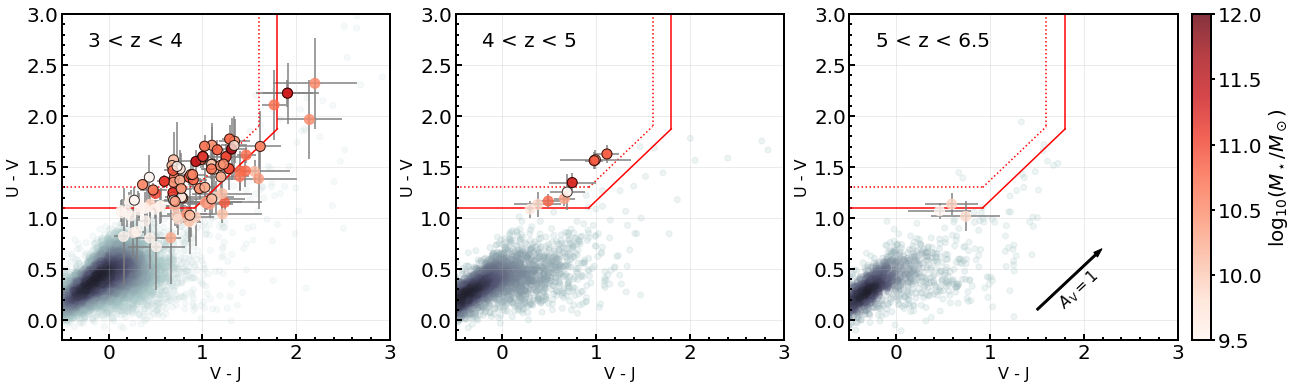
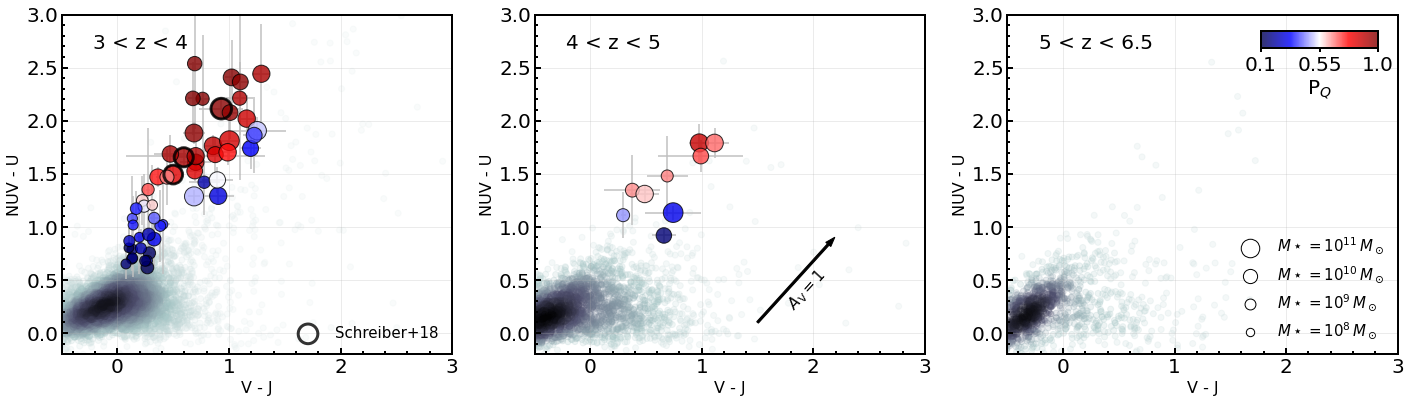
We present the results of a systematic search for candidate quiescent galaxies in the distant Universe in eleven $JWST$ fields with publicly available observations collected during the first three months of operations and covering an effective sky area of $\sim145$ arcmin$^2$. We homogeneously reduce the new $JWST$ data and combine them with existing observations from the $Hubble\,Space\,Telescope$. We select a robust sample of $\sim80$ candidate quiescent and quenching galaxies at $3 < z < 5$ using two methods: (1) based on their rest-frame $UVJ$ colors, and (2) a novel quantitative approach based on Gaussian Mixture Modeling of the $NUV-U$, $U-V$, and $V-J$ rest-frame color space, which is more sensitive to recently quenched objects. We measure comoving number densities of massive ($M_\star\geq 10^{10.6} M_\odot$) quiescent galaxies consistent with previous estimates relying on ground-based observations, after homogenizing the results in the literature with our mass and redshift intervals. However, we find significant field-to-field variations of the number densities up to a factor of $2-3$, highlighting the effect of cosmic variance and suggesting the presence of overdensities of red quiescent galaxies at $z>3$, as it could be expected for highly clustered massive systems. Importantly, $JWST$ enables the robust identification of quenching/quiescent galaxy candidates at lower masses and higher redshifts than before, challenging standard formation scenarios. All data products, including the literature compilation, are made publicly available.
研究动机与目标
- 利用深度、公开的JWST与HST数据,识别并表征$z>3$的宁静星系与熄灭星系。
- 评估$3<z<5$区间内大质量宁静星系($M_* \geq 10^{10.6} M_\odot$)的共动数密度,并与以往地面望远镜的估计结果进行比较。
- 研究$z>3$时宁静星系数密度在不同天区之间的变化,以量化宇宙方差并探测大尺度结构。
- 展示JWST对低质量、高红移宁静星系的探测灵敏度,挑战当前星系形成模型。
- 为科学界提供一个公开的、基于颜色选择的宁静星系候选体图集及相关数据产品。
提出的方法
- 对11个公开天区的JWST与HST数据进行统一处理,覆盖约145平方弧分的天区。
- 采用两种方法筛选宁静星系候选体:(1) 静止帧UVJ颜色标准;(2) 在$NUV-U$、$U-V$、$V-J$颜色空间中应用高斯混合模型(GMM),以提升对近期熄灭星系的探测灵敏度。
- 通过谱能成分拟合(SED fitting)并积分最优参数,推导星族质量函数(SMF),质量修正采用Chabrier初始质量函数(IMF)。
- 在$3<z<4$区间内计算共动数密度,误差采用泊松分布估算,并通过$\sigma_{\rm CV}$量化宇宙方差。
- 在GMM方法中,将$P_{\rm Q,50\%} \geq 0.1$设为判定宁静星系的概率阈值。
- 与文献及模拟结果(如Illustris、TNG、EAGLE)进行交叉对比,以将结果置于理论框架中加以解释。
实验结果
研究问题
- RQ1JWST测得的$3<z<5$区间内大质量宁静星系($M_* \geq 10^{10.6} M_\odot$)的共动数密度是多少?
- RQ2在$z>3$时,宁静星系数密度的天区间差异在多大程度上反映了宇宙方差及潜在的星系团聚现象?
- RQ3与地面望远镜巡天相比,JWST在探测低质量、高红移宁静星系方面提升了多少?
- RQ4与传统的UVJ选择方法相比,新型高斯混合模型(GMM)在识别近期熄灭星系方面有多高效?
- RQ5在$z \sim 3$–$4$时,观测到的数密度与宇宙学模拟(如Illustris、TNG、EAGLE)的预测相比如何?
主要发现
- 本研究通过UVJ与基于GMM的颜色选择方法,识别出一个稳健的约80个候选宁静及熄灭星系样本,红移范围为$3<z<5$。
- 在统一质量与红移区间处理后,大质量宁静星系($M_* \geq 10^{10.6} M_\odot$)的共动数密度与以往地面望远镜的估计结果一致。
- 观测到显著的天区间数密度差异,波动幅度达2–3倍,表明存在强烈的宇宙方差,且可能对应于大质量宁静星系的团聚现象。
- 基于GMM的方法对近期熄灭星系的探测灵敏度更高,尤其在低质量与高红移区域,超越了以往的探测极限。
- JWST使探测$z>3$、星族质量低于$10^{10.6} M_\odot$的宁静星系候选体成为可能,对标准星系熄灭情景构成挑战。
- 所有天区合并后的数密度为$2.8 \times 10^{-5}$ Mpc⁻³(GMM方法)和$2.3 \times 10^{-5}$ Mpc⁻³(UVJ方法),不确定性分别为$\sim 10\%$与$\sim 18\%$,宇宙方差$\sigma_{\rm CV} \approx 0.1$–$0.67$。
更好的研究,从现在开始
从阅读论文到最终审阅,大幅缩短您的研究时间。
无需绑定信用卡
本解读由 AI 生成,并经人工编辑审核。