
[论文解读] An Exploration of Self-Supervised Pretrained Representations for End-to-End Speech Recognition
本文在基于Transformer和Conformer等先进模型的端到端自动语音识别(E2E-ASR)系统中,评估了自监督预训练语音表征——特别是HuBERT和Wav2Vec2.0。在不修改模型架构或训练策略的前提下,这些表征在多个公开ASR语料库上实现了或超越了当前最先进(SOTA)的性能,展现出强大的泛化能力与快速收敛特性。
Self-supervised pretraining on speech data has achieved a lot of progress. High-fidelity representation of the speech signal is learned from a lot of untranscribed data and shows promising performance. Recently, there are several works focusing on evaluating the quality of self-supervised pretrained representations on various tasks without domain restriction, e.g. SUPERB. However, such evaluations do not provide a comprehensive comparison among many ASR benchmark corpora. In this paper, we focus on the general applications of pretrained speech representations, on advanced end-to-end automatic speech recognition (E2E-ASR) models. We select several pretrained speech representations and present the experimental results on various open-source and publicly available corpora for E2E-ASR. Without any modification of the back-end model architectures or training strategy, some of the experiments with pretrained representations, e.g., WSJ, WSJ0-2mix with HuBERT, reach or outperform current state-of-the-art (SOTA) recognition performance. Moreover, we further explore more scenarios for whether the pretraining representations are effective, such as the cross-language or overlapped speech. The scripts, configuratons and the trained models have been released in ESPnet to let the community reproduce our experiments and improve them.
研究动机与目标
- 评估自监督预训练语音表征(SSLRs)在先进端到端ASR系统中的泛化能力与性能表现。
- 在包含不同语音特征(如朗读与非正式语音、单说话人与多说话人)的多样化公开ASR语料库上,对比SSLRs的表现。
- 探究SSLRs在跨语言识别和重叠语音识别等挑战性场景下的有效性。
- 通过在ESPnet中发布脚本、配置文件和训练好的模型,为社区提供可复现的基准。
提出的方法
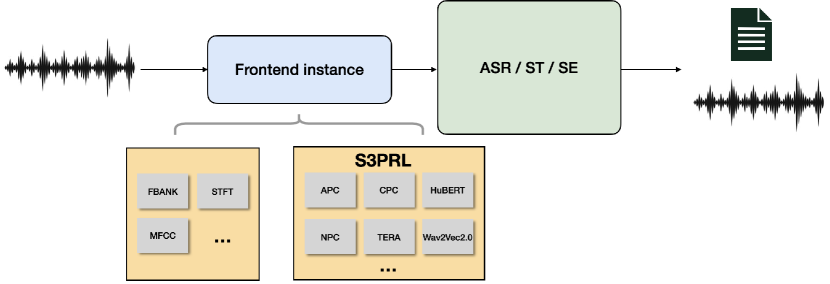
- 将S3PRL工具包中的SSLRs集成到ESPnet端到端语音处理框架中,实现在不同设置下的无缝评估。
- 使用相同的后端模型架构,在多种ASR语料库上评估多种SSLR模型(包括HuBERT、Wav2Vec2.0、APC、Mockingjay、TERA、NPC和VQ-APC)。
- 探索三种特征融合策略:所有编码器层的加权求和、最后一层表征,以及微调后的最后一层特征。
- 采用基于联合CTC/注意力机制的Transformer和Conformer编码器-解码器模型,使用固定的SSLR特征进行端到端ASR训练。
- 应用标准训练技术,包括梯度累积、Dropout正则化和语音样本级别的归一化,以提升训练稳定性。
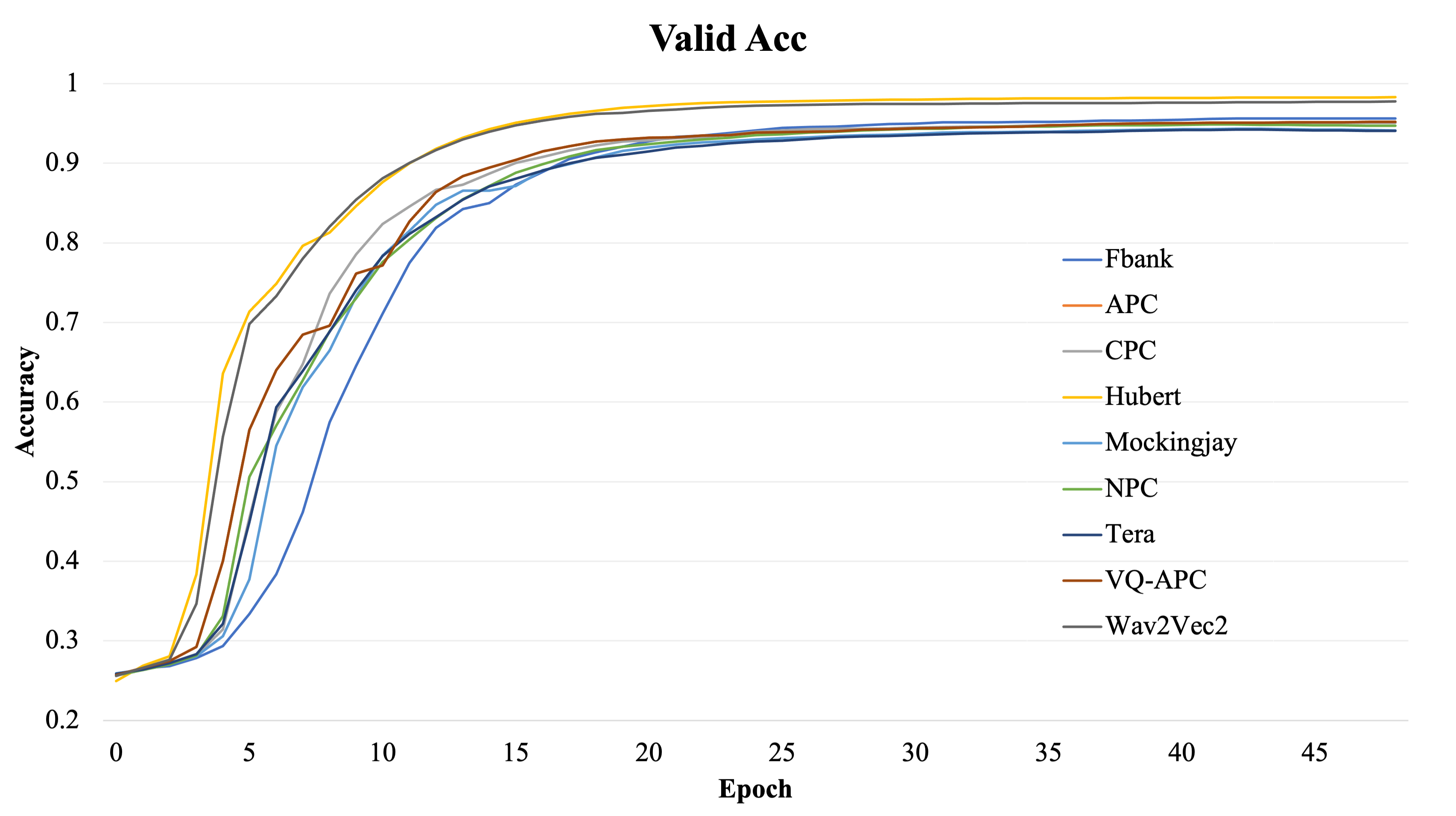
- 通过验证准确率曲线监控训练动态,评估SSLR特征的收敛性与鲁棒性。
实验结果
研究问题
- RQ1在多样化语料库中,自监督预训练表征与传统log-Mel FBANK特征相比,在E2E-ASR性能上表现如何?
- RQ2HuBERT和Wav2Vec2.0等SSLRs是否能超越LibriSpeech语料库,在其他开源ASR数据集上也实现SOTA性能?
- RQ3如何最优地利用SSLRs的多层表征——加权求和、最后一层,还是微调后的最后一层特征?
- RQ4在跨语言识别或重叠语音识别等挑战性场景下,SSLRs的表现如何?
主要发现
- HuBERT和Wav2Vec2.0表征显著优于log-Mel FBANK特征,在WSJ、LibriTTS和AISHELL等多个语料库上实现了SOTA或接近SOTA的结果。
- 在WSJ数据集上,采用加权求和特征的HuBERT将词错误率(WER)降至3.0%(使用语言模型)和4.9%(不使用语言模型),优于使用语言模型的FBANK基线(分别为5.3%和5.5%)。
- 使用加权求和特征的Wav2Vec2.0在WSJ上实现了3.7%的WER(使用语言模型),与之前SOTA系统相当或更优。
- SSLR-based模型的学习曲线显示其收敛速度快于FBANK,HuBERT和Wav2Vec2.0在训练初期即展现出更优的准确率。
- HuBERT特征在最后一层表现出强烈集中性,而Wav2Vec2.0则通过加权求和多层特征获益,表明其具有更丰富的中间表征。
- 预训练表征对学习率和批量大小等超参数变化具有鲁棒性,表明其在不同训练设置下均具备可靠性。
更好的研究,从现在开始
从阅读论文到最终审阅,大幅缩短您的研究时间。
无需绑定信用卡
本解读由 AI 生成,并经人工编辑审核。