
[论文解读] An FRB Sent Me a DM: Constraining the Electron Column of the Milky Way Halo with Fast Radio Burst Dispersion Measures from CHIME/FRB
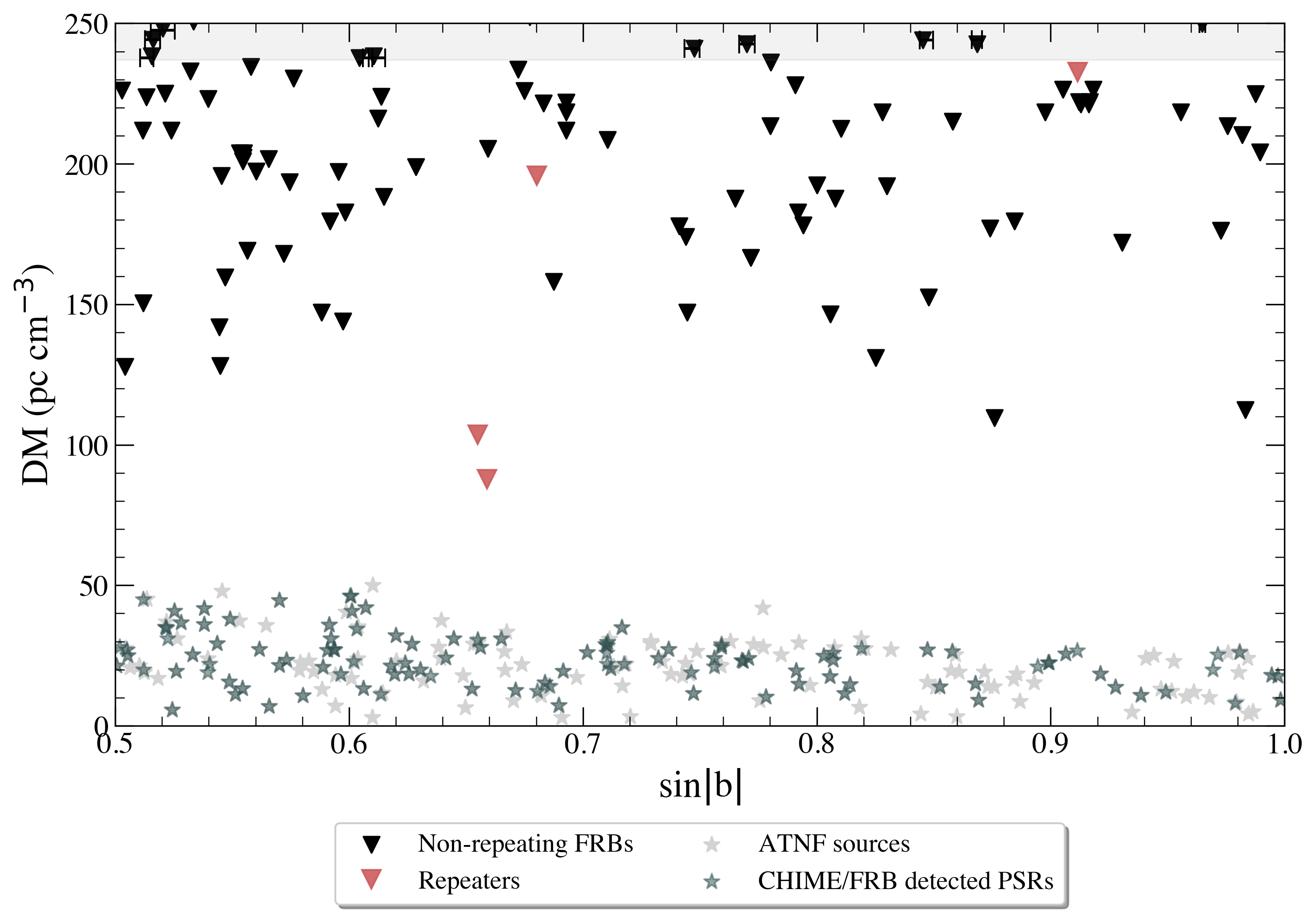
本研究利用 CHIME/FRB 的 83 个快速射电暴的色散量(DMs)约束银河系电离晕中的电子柱密度,发现 |b| ≥ 30° 时总贡献为 87.8–141 pc cm⁻³,上限为 52–111 pc cm⁻³。该分析考虑了调查选择效应,未发现银河系晕中存在 DM 缺失的显著证据,支持电子密度分布适中的模型。
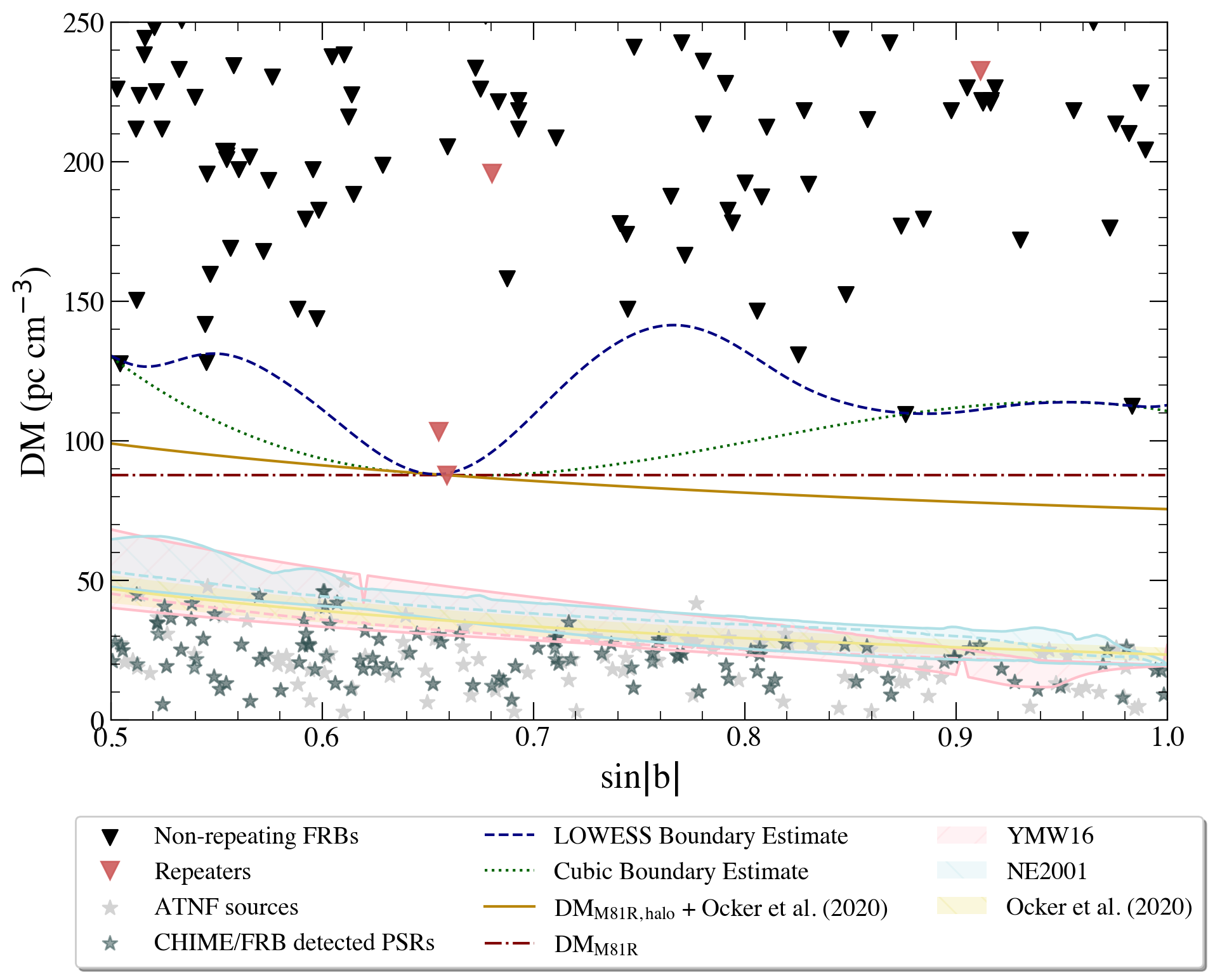
The CHIME/FRB project has detected hundreds of fast radio bursts (FRBs), providing an unparalleled population to probe statistically the foreground media that they illuminate. One such foreground medium is the ionized halo of the Milky Way (MW). We estimate the total Galactic electron column density from FRB dispersion measures (DMs) as a function of Galactic latitude using four different estimators, including ones that assume spherical symmetry of the ionized MW halo and ones that imply more latitudinal-variation in density. Our observation-based constraints of the total Galactic DM contribution for $|b|\geq 30^\circ$, depending on the Galactic latitude and selected model, span 87.8 - 141 pc cm^-3. This constraint implies upper limits on the MW halo DM contribution that range over 52-111 pc cm^-3. We discuss the viability of various gas density profiles for the MW halo that have been used to estimate the halo's contribution to DMs of extragalactic sources. Several models overestimate the DM contribution, especially when assuming higher halo gas masses (~ 3.5 x 10^12 solar masses). Some halo models predict a higher MW halo DM contribution than can be supported by our observations unless the effect of feedback is increased within them, highlighting the impact of feedback processes in galaxy formation.
研究动机与目标
- 利用 CHIME/FRB 检测到的快速射电暴(FRBs)的色散量(DMs)估算银河系晕的电子柱密度。
- 评估调查选择效应和光度函数偏差对基于 DM 的晕约束的影响。
- 检验多种电离晕密度分布模型与观测到的 FRB DM 分布的相容性。
- 确定当前数据是否支持银河系晕中存在 DM 缺失,同时考虑探测效率和红移相关的通量阈值。
提出的方法
- 利用 CHIME/FRB 检测到的 83 个具有已知红移和 DM 的 FRBs,估算银河系晕对总 DM 的贡献。
- 应用四种不同的估计器:两种假设晕具有球对称性,两种允许电子密度随纬度变化。
- 通过建模探测效率随通量和红移的变化来校正调查选择效应,使用泊松统计评估在低红移体积中零探测的可能性。
- 通过观测到的探测率(μ_v1 = 0.346,μ_v2 = 0.366)和光度函数(α = -1.0)校正两个红移体积(z₁ ≈ 0.1,z₂ ≈ 0.3)之间探测效率的非均匀性。
- 在无天体物理 DM 缺失的零假设下,使用探测效率比值和红移标度计算体积 1 中预期的探测数量。
- 使用泊松概率 P = exp(–N_det,v1) 计算在体积 1 中观测到零个 FRB 的可能性,得到 P = 0.24,表明与选择效应一致。
实验结果
研究问题
- RQ1在银河系纬度 |b| ≥ 30° 时,银河系晕对 FRB 色散量的总电子柱密度贡献是多少?
- RQ2关于晕几何结构(球对称 vs. 纬向变化)的不同假设如何影响推断的晕 DM 贡献?
- RQ3调查选择效应和 FRB 光度函数在多大程度上偏差了观测到的 DM 分布,并掩盖了潜在的 DM 缺失?
- RQ4当前电离晕电子密度分布模型是否与观测到的 CHIME/FRB DM 数据一致?
- RQ5在低红移体积(z₁ ≈ 0.1)中观测到 FRB 缺失是否在统计上与已知探测偏差一致,还是暗示 DM 分布中存在物理性缺失?
主要发现
- 对于 |b| ≥ 30°,银河系电子柱密度对 FRB DM 的总贡献被约束在 87.8–141 pc cm⁻³ 之间,具体取决于模型和纬度。
- 晕 DM 贡献的上限范围为 52 至 111 pc cm⁻³,具体取决于所假设的电子密度分布模型。
- 在无天体物理 DM 缺失的零假设下,观测到体积 1(z₁ ≈ 0.1)中零个 FRB 的概率为 24%,表明与选择效应和体积偏差一致。
- 分析表明,假设 FRB 为标准烛光会导致零探测可能性的保守高估,意味着体积 1 中的真实探测率可能高于估计值。
- 观测到的 DM 分布与现有晕模型一致,但多种常用密度分布模型高估了晕的贡献,提示需要修正密度分布模型。
- 本研究未发现银河系晕中存在 DM 缺失的统计显著证据,体积 1 中探测缺失的现象最合理的解释是调查灵敏度和体积效应,而非 FRB 的物理性缺失。
更好的研究,从现在开始
从阅读论文到最终审阅,大幅缩短您的研究时间。
无需绑定信用卡
本解读由 AI 生成,并经人工编辑审核。