
[论文解读] An HSC view of the CMASS galaxy sample. Halo mass as a function of stellar mass, size and Sérsic index
本研究利用深度HSC弱引力透镜和光度测量,研究CMASS星系的暗物质晕质量随恒星质量、大小和Sérsic指数的变化。结果发现,晕质量与恒星质量的关系为 $ M_{\text{halo}} \propto M_*^{1.7} $,在恒星质量固定时,晕质量对大小或Sérsic指数无显著依赖,这与高质晕中大小增长更高效的模型相矛盾。
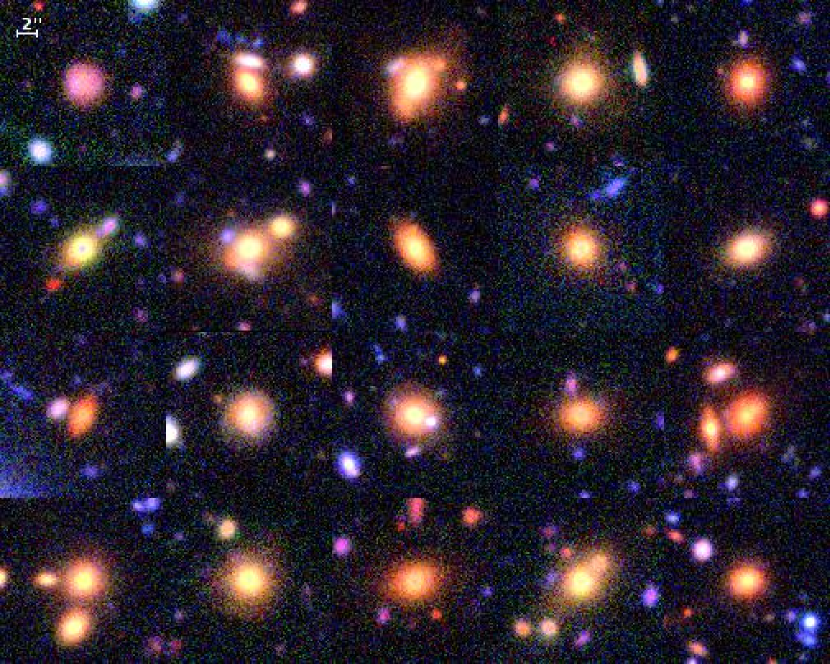
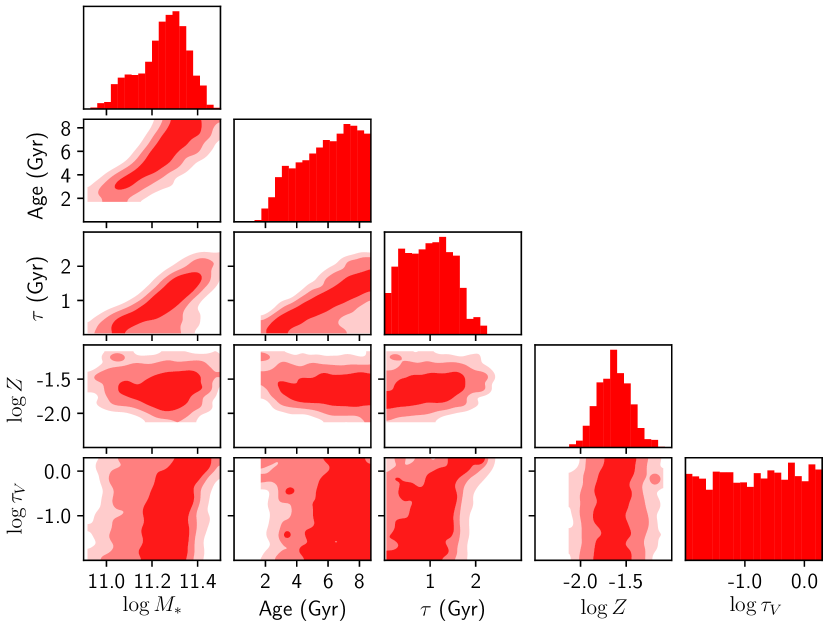
Aims. We wish to determine the distribution of dark matter halo masses as a function of the stellar mass and the stellar mass profile, for massive galaxies in the BOSS CMASS sample. Methods. We use grizy photometry from HSC to obtain Sérsic fits and stellar masses of CMASS galaxies for which HSC weak lensing data is available, visually selected to have spheroidal morphology. We apply a cut in stellar mass, $\log{M_*/M_\odot} > 11.0$,selecting $\sim$10, 000 objects. Using a Bayesian hierarchical inference method, we first investigate the distribution of Sérsic index and size as a function of stellar mass. Then, making use of shear measurements from HSC, we measure the distribution of halo mass as a function of stellar mass, size and Sérsic index. Results. Our data reveals a steep stellar mass-size relation $R_e \propto M_*^{β_R}$, with $β_R$ larger than unity, and a positive correlation between Sérsic index and stellar mass: $n \propto M_*^{0.46}$. Halo mass scales approximately with the 1.7 power of the stellar mass. We do not find evidence for an additional dependence of halo mass on size or Sérsic index at fixed stellar mass. Conclusions. Our results disfavour galaxy evolution models that predict significant differences in the size growth efficiency of galaxies living in low and high mass halos.
研究动机与目标
- 确定大质量CMASS星系中暗物质晕质量与恒星质量、大小和Sérsic指数的相关性。
- 检验预测低质量晕与高质晕中大小增长效率不同的星系演化模型。
- 通过在深度HSC光度和弱引力透镜数据上应用贝叶斯分层推断,提高晕质量测量的准确性。
- 研究约10,000个经人工选择的球状CMASS星系($ \log M_* / M_\odot > 11.0 $)的恒星质量-大小-Sérsic指数关系。
提出的方法
- 应用贝叶斯分层推断,从HSC $grizy$光度数据建模Sérsic指数、有效半径和恒星质量的联合分布。
- 采用Sérsic和Sersic-Exponential(SerExp)轮廓拟合来建模星系光度分布,并推导恒星质量和大小。
- 结合HSC的弱引力透镜剪切测量,推断CMASS星系周围暗物质晕质量的分布。
- 执行叠加弱引力透镜分析,测量晕质量随恒星质量、大小和Sérsic指数的变化,同时考虑测量不确定性。
- 比较不同表面亮度轮廓模型(Sérsic与SerExp)的结果,评估系统误差对晕质量推断的影响。
- 采用平坦的 $ \Lambda $CDM宇宙学模型,其中 $ \Omega_M = 0.3 $,$ H_0 = 70 \, \text{km} \, \text{s}^{-1} \, \text{Mpc}^{-1} $。
实验结果
研究问题
- RQ1CMASS星系的恒星质量-大小关系如何依赖于其Sérsic指数?
- RQ2在恒星质量固定时,晕质量与星系大小之间是否存在显著相关性?
- RQ3CMASS星系的Sérsic指数是否与恒星质量相关,这种关系如何影响晕质量标度?
- RQ4不同表面亮度轮廓模型(Sérsic与SerExp)在多大程度上影响推断的晕质量分布?
- RQ5基于弱引力透镜的晕质量估计与CMASS样本中星系聚类的估计相比如何?
主要发现
- CMASS星系的恒星质量-大小关系非常陡峭,满足 $ R_e \propto M_*^{\beta_R} $,其中 $ \beta_R > 1 $,表明质量越大,大小演化越显著。
- Sérsic指数随恒星质量增加而上升,关系为 $ n \propto M_*^{0.46} $,且在恒星质量固定时,大小与Sérsic指数正相关。
- 晕质量与恒星质量的关系为 $ M_{\text{halo}} \propto M_*^{1.7} $,表明存在强但次线性的标度关系。
- 在恒星质量固定时,未发现晕质量对大小或Sérsic指数的显著依赖,表明大小增长在高质晕中并不更高效。
- 弱引力透镜与聚类方法估计的晕质量之间存在0.2–0.3 dex的差异,可能源于光度建模和表面亮度轮廓假设的差异。
- 在大半径区域外推表面亮度轮廓时,尤其是Sérsic与SerExp模型之间的差异,构成了未来高精度测量的主要挑战。
更好的研究,从现在开始
从阅读论文到最终审阅,大幅缩短您的研究时间。
无需绑定信用卡
本解读由 AI 生成,并经人工编辑审核。