
[论文解读] Analysis and controller-design of time-delay systems using TDS-CONTROL. A tutorial and manual
本论文提出 TDS-CONTROL,一个用于分析和设计具有多个离散时滞的线性时不变时滞系统的 MATLAB 工具箱,支持滞后型、中性型及描述器形式。该工具箱可通过计算谱辐值、H-infinity 范数和伪谱辐值实现稳定性分析,并提供基于非光滑、非凸优化的控制器设计方法,以最小化谱辐值或 H-infinity 范数,支持结构化控制器如 PID 和分散化设计。
TDS-CONTROL is an integrated MATLAB package for the analysis and controller-design of linear time-invariant (LTI) dynamical systems with (multiple) discrete delays, supporting both systems of retarded and neutral type. TDS-CONTROL is based on a state-space representations for these TDSs, although functionality is provided to obtain such a formulation from a frequency-domain description of the system. Firstly, the package offers various functionality for analyzing such systems, like methods for computing the spectral abscissa, the H-infinity norm, the pseudospectral abscissa, and the distance to instability. Furthermore, as TDS-CONTROL is designed with neutral time-delay systems in mind, it has the appealing feature that the sensitivity of certain quantities (such as the spectral abscissa) with respect to infinitesimal delay perturbations can explicitly be taken into account. Secondly, TDS-CONTROL also allows to design fixed-order dynamic output feedback controllers. The corresponding controller-design algorithms are based on minimizing the spectral abscissa, the H-infinity norm, or a combination of both with respect to the free controller parameters by solving a non-smooth, non-convex optimization problem. As a strictly negative spectral abscissa is a necessary and sufficient condition for stability, the presented design methods are thus not conservative. It is also possible to impose structure on the controller, enabling the design of decentralized and proportional-integral-derivative (PID) controllers. Furthermore, by allowing the plant to be described in delay descriptor form (i.e., the system's dynamics are given in terms of delay differential algebraic equations), acceleration feedback and Pyragas-type and delay-based controllers can also be considered.
研究动机与目标
- 为具有多个离散时滞的线性时不变时滞系统提供一个全面、集成的 MATLAB 工具箱,用于分析与控制器设计。
- 支持滞后型与中性型系统,包括时滞微分代数方程(DDAEs),以拓展其在控制工程中的应用范围。
- 通过计算结构化不确定性下的不稳定距离与伪谱辐值,实现鲁棒性分析。
- 通过谱辐值与 H-infinity 范数的非光滑优化,实现固定阶动态输出反馈控制器设计。
- 在统一框架内支持结构化控制器(如 PID、比例-积分-时滞(PIR)及分散化控制器)的设计。
提出的方法
- 该工具箱采用基于谱的方法计算广义多项式的特征根,从而实现通过谱辐值与伪谱辐值进行稳定性分析。
- 通过数值积分与相关算子的特征值分析,计算时滞系统的 H-infinity 范数。
- 通过控制器参数的谱辐值或 H-infinity 范数的非光滑、非凸优化方法实现控制器设计。
- 该工具箱支持描述器形式建模,通过时滞描述器系统实现加速度反馈与 Pyragas 类型控制器的引入。
- 通过 tds_uncertain_matrix 与 tds_uncertain_delay 函数,采用结构化扰动(实数/复数、谱范数/弗罗贝尼乌斯范数)实现不确定性建模。
- 通过 tds_dins 函数计算 epsilon-伪谱辐值,实现参数不确定性下的不稳定距离计算,提供鲁棒性度量。
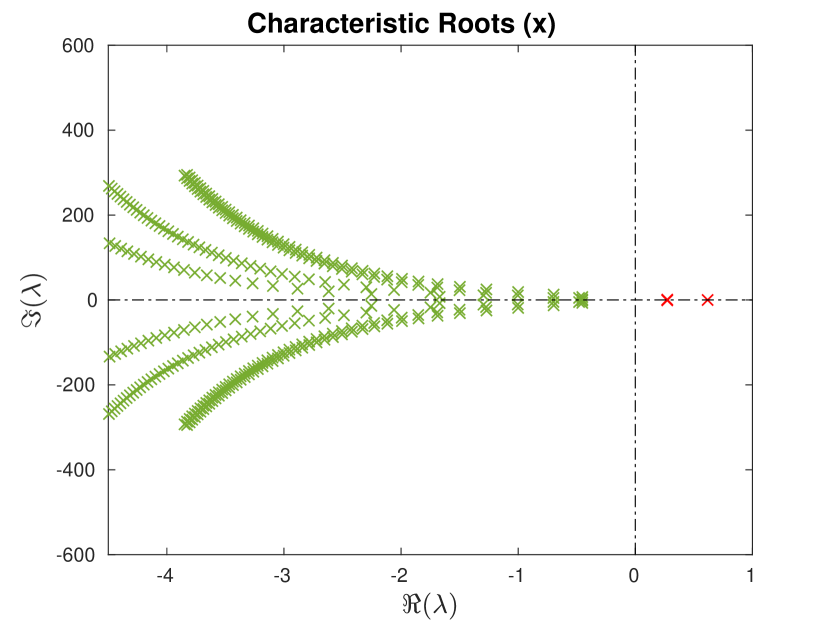
![Figure 2.1 : The characteristic roots of ( 2.8 ) in the region $[-1.5,1]\times\jmath[-40,40]$ .](https://ar5iv.labs.arxiv.org/html/2305.00341/assets/x1.png)
实验结果
研究问题
- RQ1如何高效且准确地分析具有多个离散时滞的线性时滞系统的稳定性?
- RQ2在中性型时滞系统中,无穷小时滞扰动对谱辐值有何影响?如何在分析中捕捉这一影响?
- RQ3如何设计固定阶动态输出反馈控制器,以最小化时滞系统中的谱辐值或 H-infinity 范数?
- RQ4在结构化参数不确定性下,时滞系统的鲁棒性裕度(不稳定距离)是多少?
- RQ5如何利用基于优化的方法为时滞系统设计结构化控制器(如 PID 或分散化控制器)?
主要发现
- 该工具箱成功计算了具有多个时滞的滞后型与中性型时滞系统的谱辐值、H-infinity 范数与伪谱辐值。
- 对于质量、阻尼与时滞均存在不确定性的系统,不稳定距离计算结果为 0.4125,表明在相对不确定性达 41.25% 的范围内系统保持鲁棒稳定。
- 对于不确定系统,epsilon-伪谱辐值计算结果为 20.7022,表明所有允许的不确定性值下系统均不稳定。
- 该方法通过在优化过程中施加控制器参数的结构约束,支持 PID 与分散化控制器的设计。
- HANSO(版本 3.0)的使用可可靠求解控制器设计中出现的非光滑、非凸优化问题。
- 该框架支持以时滞描述器形式建模系统,从而在设计过程中实现加速度反馈与基于时滞的控制器的集成。
更好的研究,从现在开始
从阅读论文到最终审阅,大幅缩短您的研究时间。
无需绑定信用卡
本解读由 AI 生成,并经人工编辑审核。