
[论文解读] Analysis of learning a flow-based generative model from limited sample complexity
本文针对高维高斯混合模型,在训练数据有限的条件下,对基于流的生成模型进行了严格的端到端分析,采用两层去噪自编码器(DAE)学习并采样。研究表明,尽管未使用跳跃连接,该模型估计的均值仍以贝叶斯最优速率 $\Theta_n(1/n)$ 收敛至真实混合均值,并通过闭式总结统计量刻画了生成流的均值与方差动态变化。
We study the problem of training a flow-based generative model, parametrized by a two-layer autoencoder, to sample from a high-dimensional Gaussian mixture. We provide a sharp end-to-end analysis of the problem. First, we provide a tight closed-form characterization of the learnt velocity field, when parametrized by a shallow denoising auto-encoder trained on a finite number $n$ of samples from the target distribution. Building on this analysis, we provide a sharp description of the corresponding generative flow, which pushes the base Gaussian density forward to an approximation of the target density. In particular, we provide closed-form formulae for the distance between the mean of the generated mixture and the mean of the target mixture, which we show decays as $Θ_n(\frac{1}{n})$. Finally, this rate is shown to be in fact Bayes-optimal.
研究动机与目标
- 为填补理解基于流的生成模型如何从有限训练样本泛化的问题中的理论空白,特别是在预期存在记忆化现象时。
- 分析通过浅层 DAE 学习速度场与其对生成流影响之间的相互作用。
- 刻画在有限样本上训练时生成密度的统计特性,特别是均值与方差。
- 确定在有限样本复杂度下,均值估计的泛化误差是否达到贝叶斯最优速率。
- 在高维设置下,对有限数据中的生成过程提供紧致且闭式的表征。
提出的方法
- 模型使用一个具有单个隐层单元的两层 DAE 来参数化随机插值流的速度场。
- 速度场基于来自高维高斯混合的 $n$ 个样本,通过经验风险最小化进行训练。
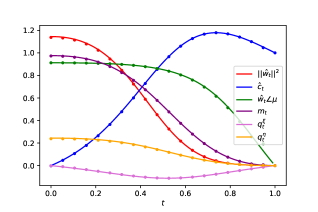
- 进行高维渐近分析,推导出在每个时间点 $t$ 处学习到的权重向量 $\hat{\bm{w}}_t$ 的闭式表达式。
- 推导出用于追踪样本从基高斯分布经由学习到的速度场传播过程的总结统计量 $M_t$ 与 $Q^\eta_t$。
- 证明这些统计量的动力学遵循一组对应于均值为 $\hat{\mu}$ 的奇异高斯混合的常微分方程组(ODEs)。
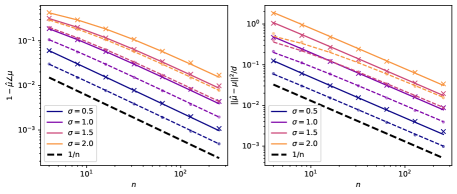
- 分析生成模型的均值估计误差,结果表明其衰减速率为 $\Theta_n(1/n)$。
实验结果
研究问题
- RQ1在从高维高斯混合中有限样本训练的基于流的生成模型是否会避免记忆训练数据?
- RQ2在有限样本复杂度下,浅层 DAE 学习到的速度场的渐近行为如何?
- RQ3当通过无跳跃连接的 DAE 参数化时,生成流在均值与方差估计方面的表现如何?
- RQ4估计混合均值收敛至真实均值的速率是多少?是否最优?
- RQ5均值估计的泛化误差能否被精确刻画?是否达到贝叶斯最优?
主要发现
- 在高维极限下,学习到的速度场收敛为与随机插值调度无关的时间不变向量。
- 生成流由总结统计量 $M_t$ 与 $Q^\eta_t$ 表征,其演化遵循一组具有闭式解的常微分方程组。
- 估计的混合均值 $\hat{\mu}$ 以平方距离衡量,收敛至真实均值 $\mu$ 的速率为 $\Theta_n(1/n)$。
- 均值估计误差达到贝叶斯最优速率,最小均方误差为 $\frac{\lambda^2 + n\sigma^2}{(\lambda + n)^2}$,在 $\lambda = \sigma^2$ 时最小化。
- 尽管实现了最优的均值估计,该模型未能恢复真实方差,生成的为具有在 $\pm \hat{\mu}$ 处的狄拉克函数分量的奇异高斯混合。
- 该模型隐式正则化了学习过程,避免了对训练样本的记忆化,且隐式正则化导致了最优的均值估计。
更好的研究,从现在开始
从阅读论文到最终审阅,大幅缩短您的研究时间。
无需绑定信用卡
本解读由 AI 生成,并经人工编辑审核。