
[论文解读] Angle Basis: a Generative Model and Decomposition for Functional Connectivity
本文提出 Angle Basis,一种新颖的 fMRI 功能连接(FC)生成模型与分解方法,将 FC 表征为正弦波基态与抖动成分的组合。仅使用 5–10 个基态,其预测性能即可与原始 FC 相当,且重建部分与残差部分对预测的贡献相当均衡;当二者集成时,AUC 最高超出原始 FC 5%,且残差部分可实现近乎完美的受试者特征识别(准确率达 97.3%)。
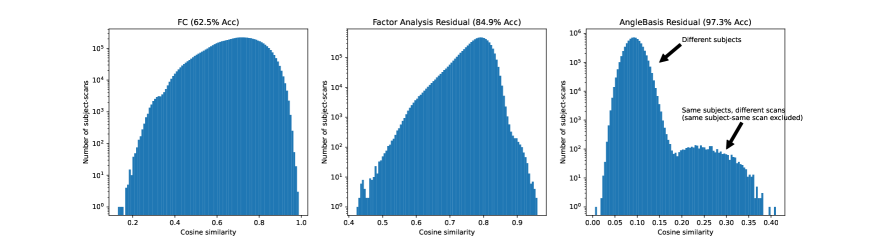
Functional connectivity (FC) is one of the most common inputs to fMRI-based predictive models, due to a combination of its simplicity and robustness. However, there may be a lack of theoretical models for the generation of FC. In this work, we present a straightforward decomposition of FC into a set of basis states of sine waves with an additional jitter component. We show that the decomposition matches the predictive ability of FC after including 5-10 bases. We also find that both the decomposition and its residual have approximately equal predictive value, and when combined into an ensemble, exceed the AUC of FC-based prediction by up to 5%. Additionally, we find the residual can be used for subject fingerprinting, with 97.3% same-subject, different-scan identifiability, compared to 62.5% for FC. Unlike PCA or Factor Analysis methods, our method does not require knowledge of a population to perform its decomposition; a single subject is enough. Our decomposition of FC into two equally-predictive components may lead to a novel appreciation of group differences in patient populations. Additionally, we generate synthetic patient FC based on user-specified characteristics such as age, sex, and disease diagnosis. By creating synthetic datasets or augmentations we may reduce the high financial burden associated with fMRI data acquisition.
研究动机与目标
- 开发一种理论基础扎实、适用于单受试者的功能连接(FC)分解方法,无需依赖群体水平统计量。
- 探究 FC 是否可被分解为可解释的、可生成的组成部分,同时保持其预测能力。
- 评估分解过程中重建部分与残差部分各自的预测效用。
- 基于表型特征(如年龄、性别、诊断)实现合成 FC 生成,以降低 fMRI 数据采集成本。
- 探索残差部分在高精度受试者识别(特征指纹识别)中的潜力。
提出的方法
- 该方法将 BOLD 信号建模为具有不同相位与振幅的正弦波之和,将功能连接表示为类似傅里叶的分解形式。
- 每个感兴趣区域(ROI)被赋予一个相位与振幅,形成一组基态,用于重建原始 FC 矩阵。
- 在每个 ROI 上增加一个抖动项,以反映相位的可变性,从而提升重建精度。
- 通过最小二乘法拟合优化分解过程,以最小化重建误差。
- 保留残差(原始 FC 与重建 FC 之间的差异),并将其用作互补的预测特征。
- 通过指定表型参数(如年龄、性别、诊断),利用训练好的模型预测基态参数,并重建 FC,从而生成合成 FC。
![Figure 1: Example of the angle basis reconstruction of one representative subject from the PNC dataset. The prominent block corresponds to the default mode network (DMN). The scan is probably of a female, due to the high within-DMN connectivity [ 11 ] . Here only one basis is used.](https://ar5iv.labs.arxiv.org/html/2305.10541/assets/x1.png)
实验结果
研究问题
- RQ1能否仅使用单个受试者的数据,有效将功能连接分解为一组可解释的、可生成的基态?
- RQ2重建的 FC 及其残差部分是否各自保有对年龄、性别、种族及诊断等表型特征的显著预测能力?
- RQ3重建部分与残差部分的集成模型是否能超越标准 FC 基础的预测模型?
- RQ4残差部分在同一个人不同扫描中的受试者特征指纹识别中是否具有高度判别性?
- RQ5能否可靠地生成基于表型信息的合成 FC,以减少对真实 fMRI 数据采集的依赖?
主要发现
- 仅使用 5–10 个角度基态,重建部分在年龄、性别、种族及精神分裂症诊断预测中的预测性能即可与原始 FC 相当。
- 残差部分本身即可实现与重建部分相当的预测准确率,在 PNC 数据集中,性别预测的 AUC 为 0.744 ± 0.065,种族预测的 AUC 为 0.812 ± 0.040。
- 重建部分与残差部分的集成模型在多个预测任务中,AUC 最高超出单独使用 FC 的结果 5%。
- 残差部分可实现极高精度的受试者特征指纹识别,同人不同扫描的识别准确率达 97.3%,而 FC 仅达 62.5%。
- 该模型可生成反映表型特征的合成 FC,例如在合成女性中表现出较强的内侧默认网络(DMN)连接性,而在合成男性中则呈现更平缓的连接模式。
- 该方法计算效率高,单个受试者仅需中端 GPU 上数秒时间,且分解过程无需群体水平数据。
更好的研究,从现在开始
从阅读论文到最终审阅,大幅缩短您的研究时间。
无需绑定信用卡
本解读由 AI 生成,并经人工编辑审核。