
[论文解读] AntiFold: Improved antibody structure-based design using inverse folding
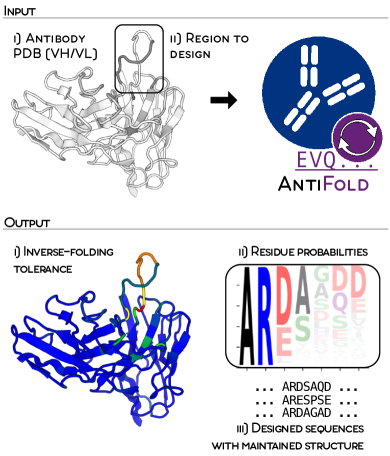
AntiFold 是一个抗体特异的逆向折叠模型,在从 ESM-IF1 微调而来,能够提高 CDR 序列恢复和零样本抗体-抗原亲和力预测,同时保持主链结构。
The design and optimization of antibodies requires an intricate balance across multiple properties. Protein inverse folding models, capable of generating diverse sequences folding into the same structure, are promising tools for maintaining structural integrity during antibody design. Here, we present AntiFold, an antibody-specific inverse folding model, fine-tuned from ESM-IF1 on solved and predicted antibody structures. AntiFold outperforms existing inverse folding tools on sequence recovery across complementarity-determining regions, with designed sequences showing high structural similarity to their solved counterpart. It additionally achieves stronger correlations when predicting antibody-antigen binding affinity in a zero-shot manner, while performance is augmented further when including antigen information. AntiFold assigns low probabilities to mutations that disrupt antigen binding, synergizing with protein language model residue probabilities, and demonstrates promise for guiding antibody optimization while retaining structure-related properties. AntiFold is freely available under the BSD 3-Clause as a web server at https://opig.stats.ox.ac.uk/webapps/antifold/ and and pip installable package at https://github.com/oxpig/AntiFold
研究动机与目标
- 通过在序列设计中保持主链结构来推动抗体设计的改进。
- 开发一个抗体特异的逆向折叠模型,基于大型预先训练的结构模型微调。
- 评估 CDR 区域在序列恢复和主链保持方面的性能。
- 评估零样本和抗原信息驱动的结合亲和力预测。
- 提供易于获取的实现,帮助研究人员进行抗体优化。
提出的方法
- 在已解决和预测的抗体结构上微调 ESM-IF1 以创建 AntiFold。
- 使用结构条件化逆向折叠输出每个位置的突变耐受性与氨基酸概率。
- 对指定区域采样设计序列,使用可控温度参数来实现多样性。
- 在用 ABodyBuilder2 重折叠后,评估设计的 CDR 的氨基酸恢复率(AAR)和主链 RMSD。
- 通过逆向折叠对数似然在有无抗原上下文的情况下评估抗体-抗原结合亲和力预测。
- 提供网页服务器和可通过 pip 安装的软件包以实现广泛可及。
实验结果
研究问题
- RQ1抗体特异的逆向折叠能否在保持主链结构的同时改善 CDR 序列恢复?
- RQ2 AntiFold 设计的序列在重新折叠时是否与原始结构相似?
- RQ3逆向折叠分数是否与抗体-抗原结合亲和力相关,并且包含抗原信息是否能改善这一相关性?
- RQ4在抗体设计任务中,AntiFold 相对于现有的逆向折叠工具表现如何?
- RQ5 AntiFold 是否可以通过优先考虑高适应度、结构受限的变体来辅助亲和力成熟策略?
主要发现
- AntiFold 相较于 AbMPNN 和基线模型提高了 CDRH3 的氨基酸恢复以及整体 AAR。
- 设计序列在重新折叠后保持主链结构,CDR 的平均 RMSD 约为 0.95 Å,表明几何结构保持。
- 逆向折叠分数与结合亲和力相关,在零样本测试中,AntiFold 的斯皮尔曼相关系数高于竞争者(0.418 对比 0.334–0.322)。
- 在结合位点附近的 CDR,尤其是 CDR2 和 CDR3,包含抗原信息能提升性能。
- 在亲和力成熟实验中, AntiFold 能更好地区分改进与非改进的变体(中位排名 80% 对比 其他 57–73%)。
- AntiFold 的分数对输入结构类型(已解决、预测、AlphaFold) 稳健,即使应用于预测结构也表现出强劲性能。
![Figure S1: Overview of the AntiFold training strategy. (A) AntiFold was trained and evaluated on solved antibody structures from SAbDab [Dunbar et al., 2014 , Schneider et al., 2021 ] and structures of antibody sequences from OAS [Kovaltsuk et al., 2018 , Olsen et al., 2022b ] modeled with ABodyBuil](https://ar5iv.labs.arxiv.org/html/2405.03370/assets/x2.png)
更好的研究,从现在开始
从阅读论文到最终审阅,大幅缩短您的研究时间。
无需绑定信用卡
本解读由 AI 生成,并经人工编辑审核。