
[论文解读] Atmospheric Chemistry of Secondary and Hybrid Atmospheres of Super Earths and Sub-Neptunes
本文提出了一套统一的理论框架,用于建模超级地球与亚海王星的次生及混合大气的化学过程,考虑了非理想气体行为和混合效应。结果表明,CO/CO₂ 比值是地幔氧逸度的稳健诊断指标,而甲烷主导的大气则需要表面压力超过10 bar、还原性地幔以及较低的岩浆温度。
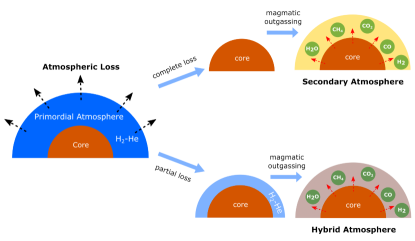
The atmospheres of small exoplanets likely derive from a combination of geochemical outgassing and primordial gases left over from formation. Secondary atmospheres, such as those of Earth, Mars and Venus, are sourced by outgassing. Persistent outgassing into long-lived, primordial, hydrogen-helium envelopes produces hybrid atmospheres of which there are no examples in the Solar System. We construct a unified theoretical framework for calculating the outgassing chemistry of both secondary and hybrid atmospheres, where the input parameters are the surface pressure, oxidation and sulfidation states of the mantle, as well as the primordial atmospheric hydrogen, helium and nitrogen content. Non-ideal gases (quantified by the fugacity coefficient) and non-ideal mixing of gaseous components (quantified by the activity coefficient) are considered. Both secondary and hybrid atmospheres exhibit a rich diversity of chemistries, including hydrogen-dominated atmospheres. The abundance ratio of carbon dioxide to carbon monoxide serves as a powerful diagnostic for the oxygen fugacity of the mantle, which may conceivably be constrained by James Webb Space Telescope spectra in the near future. Methane-dominated atmospheres are difficult to produce and require specific conditions: atmospheric surface pressures exceeding $\sim 10$ bar, a reduced (poorly oxidised) mantle and diminished magma temperatures (compared to modern Earth). Future work should include photochemistry in these calculations and clarify the general role of atmospheric escape. Exoplanet science should quantify the relationship between the mass and oxygen fugacity for a sample of super Earths and sub-Neptunes; such an empirical relationship already exists for Solar System bodies.
研究动机与目标
- 开发适用于超级地球与亚海王星次生及混合大气出气化学的统一理论框架。
- 解决当前缺乏能够覆盖次生与混合大气状态的、一致且基于第一性原理的模型的问题。
- 在多相平衡计算中引入非理想效应(逸度与活度系数),以提高计算精度。
- 识别在不同行星条件下,地幔氧化态与大气成分的关键化学诊断指标。
- 通过量化系外行星大气中的地球化学背景,为未来生物信号的解释提供支持。
提出的方法
- 基于矿物-熔体-气体体系的热力学约束,采用多相化学平衡计算的形式化方法。
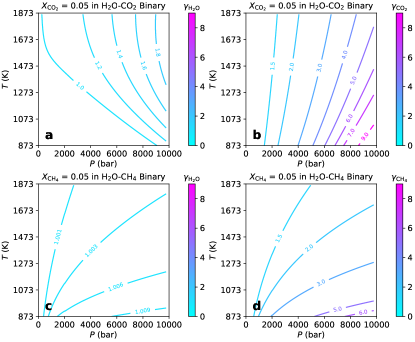
- 在气体混合物中引入非理想气体的逸度系数与非理想混合的活度系数。
- 以地幔的 fO₂(氧逸度)为核心控制参数,并在 IW(铁-瓦斯特莱特)缓冲尺度上系统变化。
- 系统研究大气成分随 H₂、N₂、CO、CO₂、CH₄、H₂O 和 H₂S 分压的变化关系。
- 对比理想与非理想气体假设在多个化学体系(H-O、C-H-O、C-H-O-N-S)中的表现,评估模型的鲁棒性。
- 分层建模方法:从无溶解的简化理想模型出发,逐步引入溶解效应。
实验结果
研究问题
- RQ1系外行星大气中 CO/CO₂ 浓度比如何依赖于地幔氧逸度?其能否作为内部氧化状态的诊断指标?
- RQ2在超级地球与亚海王星中,形成甲烷主导大气需要哪些大气条件?
- RQ3非理想气体与混合效应如何影响次生及混合大气中预测的大气成分?
- RQ4如模型所建议,H₂O 与 H₂ 混合比是否对气体在岩浆海洋中的溶解度不敏感?其程度如何?
- RQ5原始 H₂/He 含量在塑造混合大气化学演化过程中起什么作用?
主要发现
- CO/CO₂ 浓度比是地幔氧逸度的稳健诊断指标,且对气体溶解度或总氢储量的变化不敏感。
- 甲烷主导的大气需要表面压力超过约 10 bar、还原性地幔(逸度 < IW)以及低于现代地球的岩浆温度。
- H₂O 与 H₂ 混合比的交叉点出现在约 IW 氧逸度处,且与气体溶解度或体系复杂性(H-O、C-H-O、C-H-O-N-S)无关。
- 非理想效应(逸度与活度系数)仅在极端条件下(如 P_H₂ > 10³ bar 或 f_O₂ > IW+2)对总压预测产生显著影响。
- 模型表明,即使引入气体溶解度,H₂O 与 H₂ 混合比仍保持不变,这与热力学约束的分析预期一致。
- 该框架可一致预测次生与混合大气状态下的大气成分,对詹姆斯·韦布空间望远镜观测结果的解释具有重要意义。
更好的研究,从现在开始
从阅读论文到最终审阅,大幅缩短您的研究时间。
无需绑定信用卡
本解读由 AI 生成,并经人工编辑审核。