
[论文解读] Attention-aware Resource Allocation and QoE Analysis for Metaverse xURLLC Services
本文提出了一种基于契约理论的注意力感知资源分配框架,用于元宇宙xURLLC服务,旨在最大化用户体验质量(QoE)。通过引入结合客观KPI与主观注意力的新型Meta-Immersion指标,该方案在统一分配的常规URLLC基础上实现了20.1%的平均QoE提升。
Metaverse encapsulates our expectations of the next-generation Internet, while bringing new key performance indicators (KPIs). Although conventional ultra-reliable and low-latency communications (URLLC) can satisfy objective KPIs, it is difficult to provide a personalized immersive experience that is a distinctive feature of the Metaverse. Since the quality of experience (QoE) can be regarded as a comprehensive KPI, the URLLC is evolved towards the next generation URLLC (xURLLC) with a personalized resource allocation scheme to achieve higher QoE. To deploy Metaverse xURLLC services, we study the interaction between the Metaverse service provider (MSP) and the network infrastructure provider (InP), and provide an optimal contract design framework. Specifically, the utility of the MSP, defined as a function of Metaverse users' QoE, is to be maximized, while ensuring the incentives of the InP. To model the QoE mathematically, we propose a novel metric named Meta-Immersion that incorporates both the objective KPIs and subjective feelings of Metaverse users. Furthermore, we develop an attention-aware rendering capacity allocation scheme to improve QoE in xURLLC. Using a user-object-attention level dataset, we validate that the xURLLC can achieve an average of 20.1% QoE improvement compared to the conventional URLLC with a uniform resource allocation scheme. The code for this paper is available at https://github.com/HongyangDu/AttentionQoE
研究动机与目标
- 为弥合元宇宙xURLLC服务中个性化沉浸式体验的空白,该空白源于传统URLLC仅关注客观KPI而无法支持个性化需求。
- 建立一种能够同时捕捉技术性能与用户对虚拟对象主观注意力的体验质量(QoE)建模方法。
- 设计一种激励相容的契约机制,使元宇宙服务提供商(MSP)与基础设施提供商(InP)之间实现互惠,最大化MSP的效用并确保InP的参与。
- 开发一种注意力感知的渲染容量分配方案,优先为用户-对象注意力值更高的虚拟对象分配资源。
- 利用真实用户注意力数据验证所提框架,并展示其在QoE方面显著优于基线URLLC方案。
提出的方法
- 提出Meta-Immersion指标作为综合QoE度量,融合客观KPI(如时延、可靠性)与用户对虚拟对象的主观注意力。
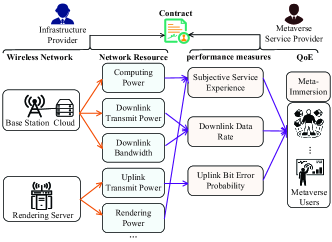
- 应用契约理论设计MSP与InP之间的最优激励机制,确保InP参与的同时最大化MSP的效用。
- 设计一种注意力感知的资源分配算法,动态为预测用户注意力值更高的虚拟对象分配更高的渲染容量。
- 使用用户-对象注意力等级数据集训练并验证注意力预测模型,以支持实时资源分配决策。
- 采用数学优化方法求解在功率与时延约束下的最优资源分配问题,通过凸性分析推导出闭式解。
- 利用真实世界注意力数据集验证框架性能,与均匀分配和随机分配方案进行对比。
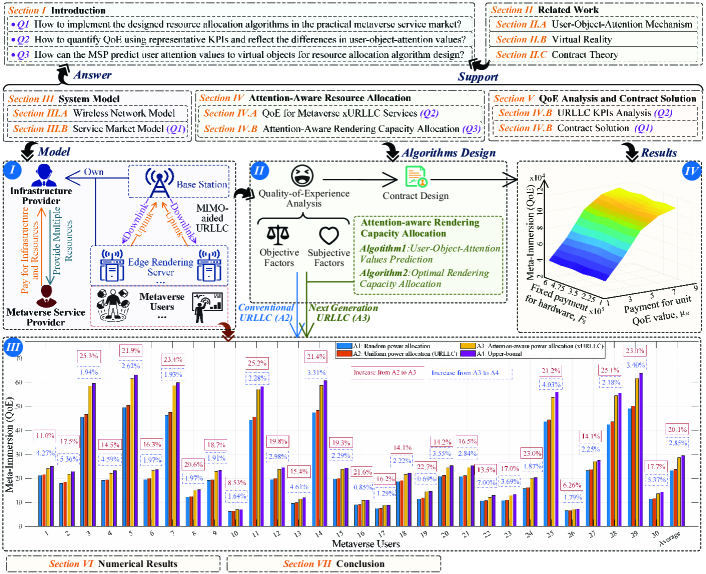
实验结果
研究问题
- RQ1如何在元宇宙xURLLC服务中建模QoE,以同时纳入客观KPI与用户主观注意力?
- RQ2何种契约设计可确保MSP与InP之间的相互激励,同时最大化MSP的效用?
- RQ3如何使资源分配具备注意力感知能力,以提升用户沉浸感与QoE?
- RQ4与采用均匀分配的常规URLLC相比,所提出的注意力感知方案在QoE方面实现了多大程度的量化提升?
- RQ5在真实用户注意力模式与网络约束条件下,所提框架的性能表现如何?
主要发现
- 所提出的Meta-Immersion指标成功将客观KPI与用户主观注意力整合为统一的QoE度量。
- 注意力感知的资源分配方案相比采用均匀分配的常规URLLC,平均QoE提升了20.1%。
- 基于契约的框架通过将InP的激励与MSP最大化QoE的目标对齐,确保了InP的参与。
- 优化问题被证明为拟凹函数,可通过凸优化技术高效求解并获得全局最优解。
- 推导出的最优资源分配闭式解确保了低计算开销,适用于实时部署。
- 基于真实用户注意力数据的实证验证证实,所提方案在多样化用户行为下具有鲁棒性与有效性。
更好的研究,从现在开始
从阅读论文到最终审阅,大幅缩短您的研究时间。
无需绑定信用卡
本解读由 AI 生成,并经人工编辑审核。