
[论文解读] Automatic Identification of Crystal Structures and Interfaces via Artificial-Intelligence-based Electron Microscopy
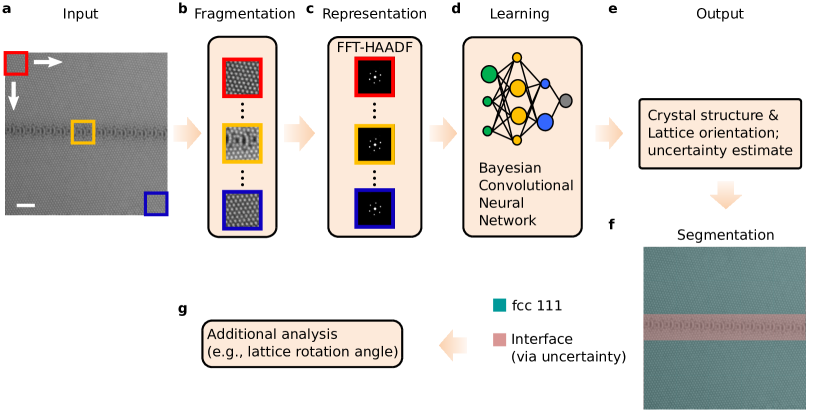
该论文提出AI-STEM,一种基于贝叶斯卷积神经网络(BNN)的方法,仅使用模拟训练数据即可自动识别原子分辨率HAADF-STEM图像中的晶体结构、晶格取向及晶界界面。该方法在分类立方晶系和六方晶系时表现出高精度,并且在训练过程中未显式包含界面数据的情况下仍能检测界面,从而实现对合成图像和实验图像的鲁棒、具备不确定性感知的分析。
Characterizing crystal structures and interfaces down to the atomic level is an important step for designing advanced materials. Modern electron microscopy routinely achieves atomic resolution and is capable to resolve complex arrangements of atoms with picometer precision. Here, we present AI-STEM, an automatic, artificial-intelligence based method, for accurately identifying key characteristics from atomic-resolution scanning transmission electron microscopy (STEM) images of polycrystalline materials. The method is based on a Bayesian convolutional neural network (BNN) that is trained only on simulated images. AI-STEM automatically and accurately identifies crystal structure, lattice orientation, and location of interface regions in synthetic and experimental images. The model is trained on cubic and hexagonal crystal structures, yielding classifications and uncertainty estimates, while no explicit information on structural patterns at the interfaces is included during training. This work combines principles from probabilistic modeling, deep learning, and information theory, enabling automatic analysis of experimental, atomic-resolution images.
研究动机与目标
- 开发一种全自动、基于人工智能的方法,用于在无需对实验数据进行人工标注的情况下,识别原子分辨率STEM图像中的晶体结构和界面。
- 仅使用模拟的HAADF-STEM图像作为训练数据,实现多晶材料中晶体对称性和晶格取向的准确分类。
- 在模型训练过程中不显式包含界面图案的情况下,检测STEM图像中的晶界和缺陷区域。
- 利用贝叶斯深度学习在预测结果中提供不确定性估计,提升材料表征的可靠性。
- 构建一个可泛化、可扩展的框架,用于先进材料中原子尺度显微结构的高通量分析。
提出的方法
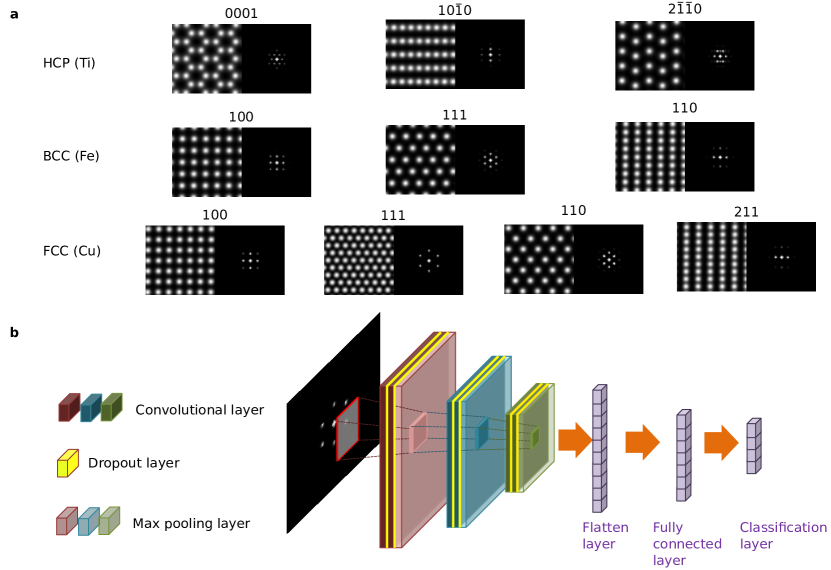
- 使用仅包含立方晶系(fcc、bcc)和六方晶系(hcp)晶体结构的模拟HAADF-STEM图像,对贝叶斯卷积神经网络(BNN)进行训练。
- 模型的输入为基于STEM图像快速傅里叶变换生成的傅里叶空间描述符——FFT-HAADF,用于编码周期性晶格信息。
- 通过贝叶斯推断,模型在分类晶体结构和取向的同时估计预测不确定性。
- 通过识别预测图中不确定性较高或结构不连续的区域来实现界面检测,而无需显式接口标注。
- 使用abTEM生成图像模拟,采用包括热漫散射在内的真实参数,如通过冻结声子构型,以确保物理保真度。
- 采用计算高效的基于卷积的方法加速模拟生成,从而实现快速训练数据创建。
实验结果
研究问题
- RQ1仅在模拟STEM图像上进行训练的深度学习模型,能否在实验图像中准确分类晶体结构和取向?
- RQ2该模型是否能在未显式训练于界面图案的情况下检测晶界界面?
- RQ3来自贝叶斯神经网络的不确定性估计与STEM图像中实际的结构不连续性之间的相关性如何?
- RQ4FFT-HAADF描述符在跨不同结晶学取向和材料时,对泛化性能的提升程度如何?
- RQ5该方法是否能在无需微调或人工特征工程的情况下,在真实实验STEM数据中实现高精度?
主要发现
- AI-STEM模型在合成和实验的HAADF-STEM图像中对晶体结构(如fcc、bcc、hcp)的分类均表现出高精度,即使在测试未见材料时亦表现良好。
- 该模型在未见训练集中包含任何显式界面数据的情况下,成功检测出Cu、Fe和Ti等实验图像中的晶界界面。
- 贝叶斯网络的不确定性估计与实际界面位置高度相关,从而实现可靠的缺陷检测。
- 该方法在不同材料和结晶学取向间具有良好的泛化能力,对晶格间距和取向变化表现出鲁棒性。
- 使用FFT-HAADF作为输入可有效编码周期性晶格信息,显著提升模型性能,即使在存在噪声和实验伪影的情况下亦然。
- 该模型仅依赖模拟数据即实现优异性能,显著降低了对昂贵且耗时的实验标注的依赖。
更好的研究,从现在开始
从阅读论文到最终审阅,大幅缩短您的研究时间。
无需绑定信用卡
本解读由 AI 生成,并经人工编辑审核。