
[论文解读] Automatic Segmentation of Organs-at-Risk from Head-and-Neck CT using Separable Convolutional Neural Network with Hard-Region-Weighted Loss
该论文提出了一种3D-SepNet框架,结合可分离卷积与硬区域加权损失,实现了头颈部CT扫描中危及器官(OARs)的精确、不确定性感知分割。通过集成用于多器官可视化的分段线性函数(SLF)与用于不确定性估计的集成学习方法,该方法在加权平均Dice分数上达到80.52%,95% Hausdorff距离为3.043毫米,性能优于3D UNet,且参数量仅为后者的1/3。
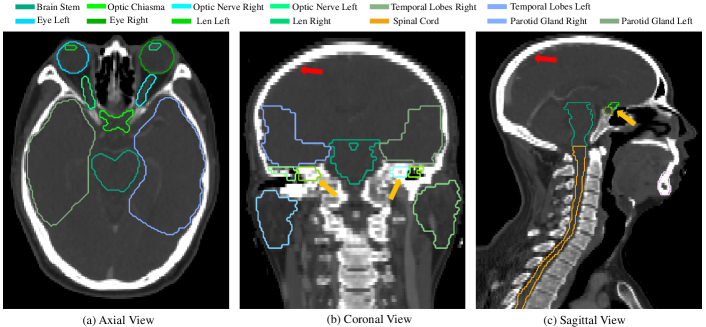
Nasopharyngeal Carcinoma (NPC) is a leading form of Head-and-Neck (HAN) cancer in the Arctic, China, Southeast Asia, and the Middle East/North Africa. Accurate segmentation of Organs-at-Risk (OAR) from Computed Tomography (CT) images with uncertainty information is critical for effective planning of radiation therapy for NPC treatment. Despite the stateof-the-art performance achieved by Convolutional Neural Networks (CNNs) for automatic segmentation of OARs, existing methods do not provide uncertainty estimation of the segmentation results for treatment planning, and their accuracy is still limited by several factors, including the low contrast of soft tissues in CT, highly imbalanced sizes of OARs and large inter-slice spacing. To address these problems, we propose a novel framework for accurate OAR segmentation with reliable uncertainty estimation. First, we propose a Segmental Linear Function (SLF) to transform the intensity of CT images to make multiple organs more distinguishable than existing methods based on a simple window width/level that often gives a better visibility of one organ while hiding the others. Second, to deal with the large inter-slice spacing, we introduce a novel 2.5D network (named as 3D-SepNet) specially designed for dealing with clinic HAN CT scans with anisotropic spacing. Thirdly, existing hardness-aware loss function often deal with class-level hardness, but our proposed attention to hard voxels (ATH) uses a voxel-level hardness strategy, which is more suitable to dealing with some hard regions despite that its corresponding class may be easy. Our code is now available at https://github.com/HiLab-git/SepNet.
研究动机与目标
- 解决放射治疗计划中头颈部CT扫描中低对比度软组织及OAR尺寸高度不平衡的挑战。
- 提升对小、扁平及边界模糊OAR(如晶状体和视神经)的分割精度。
- 为放射治疗中的临床决策支持提供可靠的不确定性估计。
- 在各向异性CT扫描(具有高层间间距)中降低模型复杂度,同时保持或提升性能。
- 开发一种整合强度变换、对困难体素的关注以及基于集成的不确定性量化框架。
提出的方法
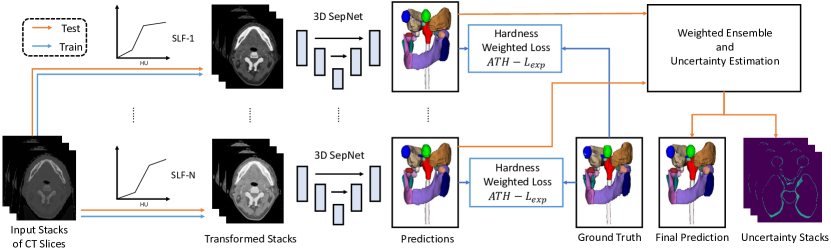
- 提出一种分段线性函数(SLF),通过在不同组织类型上应用非均匀强度变换,同时增强多个OAR的可视性。
- 设计一种使用空间可分离3D卷积的3D-SepNet架构,以高效处理具有高平面内分辨率和低层面内分辨率的各向异性CT扫描。
- 设计一种硬度感知损失函数(ATH-LExp),结合指数损失与对难分体素的关注,提升在困难区域的性能。
- 通过结合使用不同SLF强度变换和损失函数训练的模型进行集成学习,生成鲁棒的分割输出及内在的不确定性估计。
- 使用集成预测结果之间的方差作为不确定性的代理指标,该指标与误分割区域具有强相关性。
- 采用加权平均集成策略,以提升在OAR数据集不平衡情况下的泛化能力并减少过拟合。
实验结果
研究问题
- RQ1与标准窗位调整相比,可学习的强度变换(如SLF)是否能提升头颈部CT中多器官的可视性与分割精度?
- RQ2在具有高层间间距的各向异性CT扫描中,与标准3D UNet相比,可分离3D卷积网络(3D-SepNet)在OAR分割中的表现如何?
- RQ3一种强调困难体素的硬度感知损失函数是否能提升分割精度,特别是对小尺寸或低对比度的OAR?
- RQ4基于集成的模型输出能否提供与临床环境中分割错误相关联的可靠不确定性估计?
- RQ5不确定性图在多大程度上可指导放射科医生聚焦于高风险区域进行手动修正,以优化放射治疗计划?
主要发现
- 所提出的3D-SepNet在StructSeg 2019 HAN OAR挑战赛中,加权平均Dice分数达到80.52%,95% Hausdorff距离为3.043毫米,获得第三名。
- 仅使用3D UNet 1/3的参数量,3D-SepNet在大多数OAR的分割精度上表现更优,尤其在视神经和晶状体等扁平或纤细结构上优势明显。
- 基于SLF的强度变换显著提升了多OAR的同步可视性,从而提高了分割精度,优于标准线性窗位调整。
- ATH-LExp损失函数通过强调困难体素,相比标准DSC或单独使用指数损失,显著提升了Dice分数,尤其在小尺寸和边界模糊的OAR上表现更优。
- 基于集成方差生成的不确定性图与误分割区域高度相关,显示出在临床修正中作为指导工具的强潜力。
- 该方法在多样化数据集上表现出鲁棒性,并在无需额外训练或推理成本的情况下提供了可操作的不确定性信息。
更好的研究,从现在开始
从阅读论文到最终审阅,大幅缩短您的研究时间。
无需绑定信用卡
本解读由 AI 生成,并经人工编辑审核。