
[论文解读] Bar formation and evolution in the cosmological context: Inputs from the Auriga simulations
本文在Auriga宇宙学缩放再现模拟中分析棒形星系,以刻画棒结构的形成、增长与演化跨越宇宙时间的变化,并将棒的性质与全球星系/晕参数联系起来。
Galactic bars drive the internal evolution of spiral galaxies, while their formation is tightly coupled to the properties of their host galaxy and dark matter halo. To explore what drives bar formation in the cosmological context and how these structures evolve throughout cosmic history, we use the Auriga suite of magneto-hydrodynamical cosmological zoom-in simulations. We find that bars are robust and long-lived structures, and we recover a decreasing bar fraction with increasing redshift which plateaus around $\sim20\%$ at $z\sim3$. We find that bars which form at low and intermediate redshifts grow longer with time, while bars that form at high redshifts are born `saturated' in length, likely due to their merger-induced formation pathway. This leads to a larger bar-to-disc size ratio at high redshifts as compared to the local Universe. We subsequently examine the multi-dimensional parameter space thought to drive bar formation. We find that barred galaxies tend to have lower Toomre $Q$ values at the time of their formation, while we do not find a difference in the gas fraction of barred and unbarred populations when controlling for stellar mass. Barred galaxies tend to be more baryon-dominated at all redshifts, assembling their stellar mass earlier, while galaxies that are baryon-dominated but that do not host a bar, have a higher ex-situ bulge fraction. We explore the implications of the baryon-dominance of barred galaxies on the Tully-Fisher relation, finding an offset from the unbarred relation; confirming this in observations would serve as additional evidence for dark matter, as this behaviour is not readily explained in modified gravity scenarios.
研究动机与目标
- 研究Auriga模拟中棒形成如何依赖宇宙学背景及宿主星系性质。
- 量化棒的性质(强度、长度)及其从高红移到现在的演化。
- 评估棒形成与重子支配、圆盘稳定性及质量组装历史之间的相关性。
- 在宇宙学框架下探索对Tully-Fisher关系及高红移棒的影响。
提出的方法
- 使用Auriga磁流体宇宙学缩放再现模拟,晕质量范围为0.5到2×10^12 Msun。
- 通过A2(A2>=0.25),由恒星表面密度的m=2傅里叶模计算,在z=0时识别棒形星系。
- 将棒形成时间t_bf定义为A2首次超过0.25且持续高于该值的回看时间。
- 将棒长R_bar测量为在0–10 kpc内A2降至最大值的70%的半径。
- 将圆盘尺寸R_d定义为恒星表面密度降至1 Msun/pc^2的半径。
- 将重子支配时间t_gal,bd定义为在5 kpc内恒星贡献的质量≥80%的时刻。
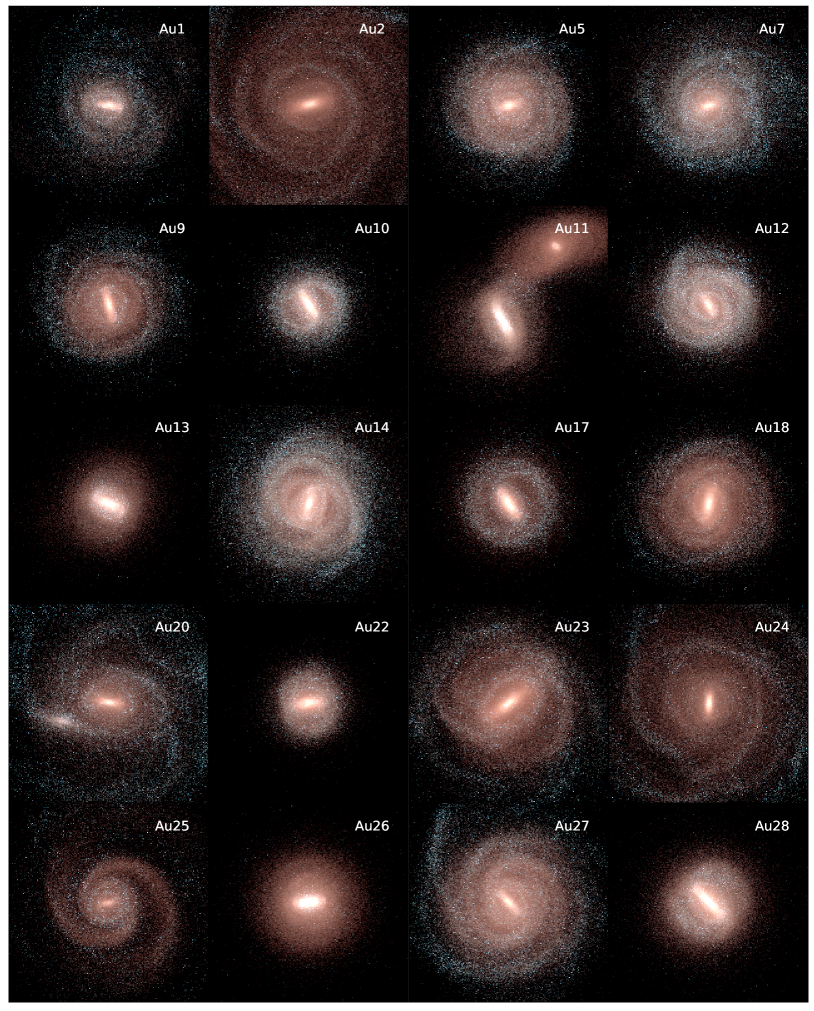
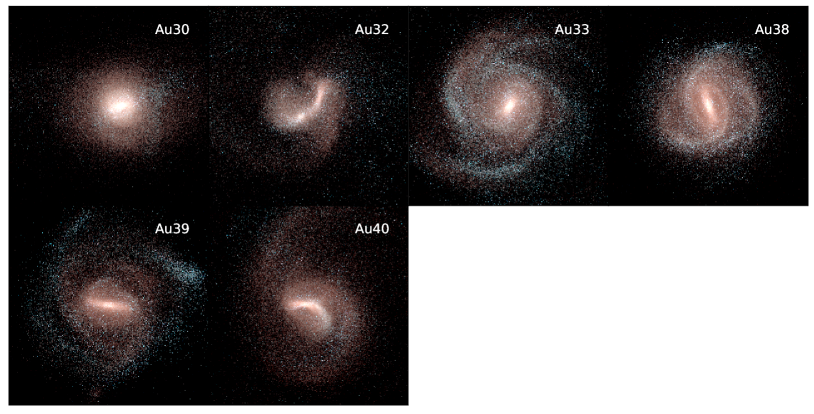
实验结果
研究问题
- RQ1Auriga星系的棒分数随红移和恒星质量的变化是多少?
- RQ2棒的强度、长度与形成时间如何与宿主星系属性(重子支配、圆盘尺寸、恒星质量)在整个宇宙时间中的关系?
- RQ3在控制恒星质量时,棒形与非棒形星系在气体分数上是否存在差异,以及这对棒形成有何影响?
- RQ4在宇宙学背景下,棒形成对Tully-Fisher关系的含意,尤其在高红移阶段?
主要发现
- 在Auriga星系中,棒结构坚固且寿命较长,棒分数随红移降低,约在z~3时稳定在约20%。
- 在低至中等红移形成的棒会随时间变长,而早期形成的棒出生时就很长,长度变化不大。
- 棒形星系在所有红移上往往更具重子支配,棒形成与更早的重子支配起始相关。
- 在z=0时,棒强度与棒年龄之间存在温和的相关性;棒形成时间与内层恒星对暗物质质量比之间存在相关性,但与当前的恒星质量关系不强。
更好的研究,从现在开始
从论文设计到论文写作,大幅缩短您的研究时间。
无需绑定信用卡
本解读由 AI 生成,并经人工编辑审核。