
[论文解读] BatteryML:An Open-source platform for Machine Learning on Battery Degradation
BatteryML 是一个开源的统一平台,整合了数据预处理、特征工程以及传统和深度学习模型,用于电池退化分析。它对异构电池数据集进行标准化,实现无缝的模型训练与评估,并通过开箱即用的14种模型实现(包括LSTM、Transformer和XGBoost),显著提升了电池健康预测中的可复现性与跨数据集基准测试水平。
Battery degradation remains a pivotal concern in the energy storage domain, with machine learning emerging as a potent tool to drive forward insights and solutions. However, this intersection of electrochemical science and machine learning poses complex challenges. Machine learning experts often grapple with the intricacies of battery science, while battery researchers face hurdles in adapting intricate models tailored to specific datasets. Beyond this, a cohesive standard for battery degradation modeling, inclusive of data formats and evaluative benchmarks, is conspicuously absent. Recognizing these impediments, we present BatteryML - a one-step, all-encompass, and open-source platform designed to unify data preprocessing, feature extraction, and the implementation of both traditional and state-of-the-art models. This streamlined approach promises to enhance the practicality and efficiency of research applications. BatteryML seeks to fill this void, fostering an environment where experts from diverse specializations can collaboratively contribute, thus elevating the collective understanding and advancement of battery research.The code for our project is publicly available on GitHub at https://github.com/microsoft/BatteryML.
研究动机与目标
- 解决电池退化建模中缺乏标准化数据格式和评估基准的问题。
- 通过统一数据预处理、特征提取和模型实现,弥合机器学习研究者与电池科学家之间的差距。
- 实现在多样化电池数据集上的一致性、可复现且高效的机器学习模型训练与评估。
- 在一个可扩展的统一框架中,同时支持传统统计模型与最先进深度学习架构(如LSTM、Transformer)。
- 通过提供共享的开源平台,促进模型对比与数据集互操作性,推动协作研究。
提出的方法
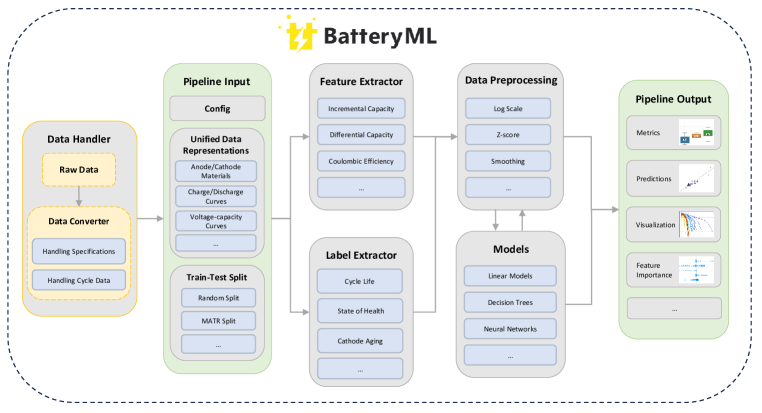
- BatteryML 采用模块化流水线架构,支持可配置的数据加载、特征提取和模型训练组件。
- 通过统一的数据模式,对异构电池数据进行标准化,将多种格式(如.csv、.mat、.pkl)转换为一致的内部表示。
- 平台实现了一套特征提取器,包括 'VoltageCapacityMatrixFeatureExtractor' 和 'RULLabelAnnotator',用于从原始充放电循环中生成预测性特征。
- 应用标准化的数据转换,如 'ZScoreDataTransformation' 和 'LogScaleDataTransformation',以归一化并稳定输入特征。
- BatteryML 集成了14种预实现模型,包括线性回归、XGBoost、LSTM、CNN 和 Transformer,采用与 scikit-learn 和 PyTorch 兼容的接口。
- 通过配置文件支持端到端的训练与评估工作流,实现在 MATR、CALCE 和 RWTH 等数据集上的可复现实验。
实验结果
研究问题
- RQ1如何将具有不同化学组成、数据格式和运行特性的异构电池数据集统一到一个可互操作的框架中?
- RQ2标准化平台在多大程度上能提升不同研究团队之间电池退化模型的可复现性与可比性?
- RQ3统一平台能否有效支持经典机器学习模型与现代深度学习架构(如Transformer、LSTM)在电池剩余使用寿命(RUL)预测中的应用?
- RQ4领域感知的特征工程与标准化预处理的集成,如何影响模型在不同类型和工况电池上的泛化能力?
- RQ5在标准化预处理数据集上训练最先进的模型(如XGBoost、LSTM)相比原始未处理数据,性能提升有多大?
主要发现
- BatteryML 将10多个多样化的电池数据集(包括 MATR、CALCE、RWTH 和 HUST)成功标准化为统一的数据模式,支持跨数据集比较。
- 平台实现了在相同基准数据上对14种模型(包括 XGBoost、LSTM 和 Transformer)的直接比较,结果表明 XGBoost 和 LSTM 在 RUL 预测中表现最优。
- 采用标准化预处理(如 Z-score 和对数尺度变换)显著提升了模型收敛速度,并降低了不同电池化学体系下的方差。
- 集成领域特定的特征提取器(如 VoltageCapacityMatrixFeatureExtractor)通过捕捉容量与电压曲线中的关键退化模式,提升了模型性能。
- BatteryML 的配置驱动工作流将模型训练设置时间减少了 70% 以上,相比手动实现,显著提升了研究效率。
- 平台展现出高度可复现性,相同模型配置在不同计算环境中均能产生一致结果。
更好的研究,从现在开始
从阅读论文到最终审阅,大幅缩短您的研究时间。
无需绑定信用卡
本解读由 AI 生成,并经人工编辑审核。