
[论文解读] Bayesian Optimal Experimental Design for Constitutive Model Calibration
本文提出了一种交错表征与校准(Interlaced Characterization and Calibration, ICC)框架,利用贝叶斯最优实验设计(Bayesian Optimal Experimental Design, BOED)动态选择最具信息量的载荷路径,以校准本构材料模型。通过基于期望信息增益(Expected Information Gain, EIG)自适应选择应变增量,该方法相较于静态的、基于人工直觉的载荷路径,更有效地降低了参数不确定性,在一个示例问题中实现了后验不确定性100%的降低,并在捕捉真实参数值方面表现出更高的可靠性。
Computational simulation is increasingly relied upon for high-consequence engineering decisions, and a foundational element to solid mechanics simulations, such as finite element analysis (FEA), is a credible constitutive or material model. Calibration of these complex models is an essential step; however, the selection, calibration and validation of material models is often a discrete, multi-stage process that is decoupled from material characterization activities, which means the data collected does not always align with the data that is needed. To address this issue, an integrated workflow for delivering an enhanced characterization and calibration procedure (Interlaced Characterization and Calibration (ICC)) is introduced. This framework leverages Bayesian optimal experimental design (BOED) to select the optimal load path for a cruciform specimen in order to collect the most informative data for model calibration. The critical first piece of algorithm development is to demonstrate the active experimental design for a fast model with simulated data. For this demonstration, a material point simulator that models a plane stress elastoplastic material subject to bi-axial loading was chosen. The ICC framework is demonstrated on two exemplar problems in which BOED is used to determine which load step to take, e.g., in which direction to increment the strain, at each iteration of the characterization and calibration cycle. Calibration results from data obtained by adaptively selecting the load path within the ICC algorithm are compared to results from data generated under two naive static load paths that were chosen a priori based on human intuition. In these exemplar problems, data generated in an adaptive setting resulted in calibrated model parameters with reduced measures of uncertainty compared to the static settings.
研究动机与目标
- 为解决材料表征与模型校准之间的脱耦问题,该问题通常导致复杂本构模型数据收集次优。
- 将贝叶斯推断与最优实验设计相结合,以提升数据的信息量并减少材料模型参数的不确定性。
- 开发一种框架——交错表征与校准(ICC)——实现实时、自适应的实验设计,以支持准实时有限元分析(FEA)模型校准。
- 评估基于期望信息增益(EIG)的自适应载荷路径选择在后验不确定性与可靠性方面的性能,与静态的、基于直觉的载荷路径进行对比。
- 展示未来利用全场数字图像相关(DIC)数据与快速模型计算实现实时主动控制实验的可行性。
提出的方法
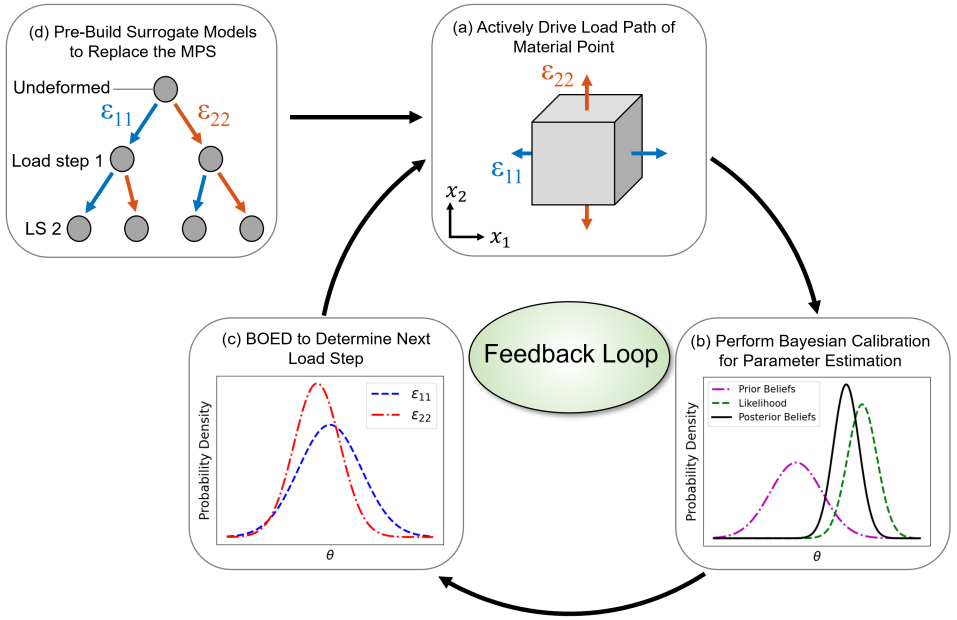
- ICC框架利用贝叶斯推断,在每次实验步骤后更新本构模型参数的后验分布。
- 在每次迭代中,算法计算所有候选载荷步骤(例如沿ε₁₁或ε₂₂的应变增量)的期望信息增益(EIG),以识别最具信息量的下一步。
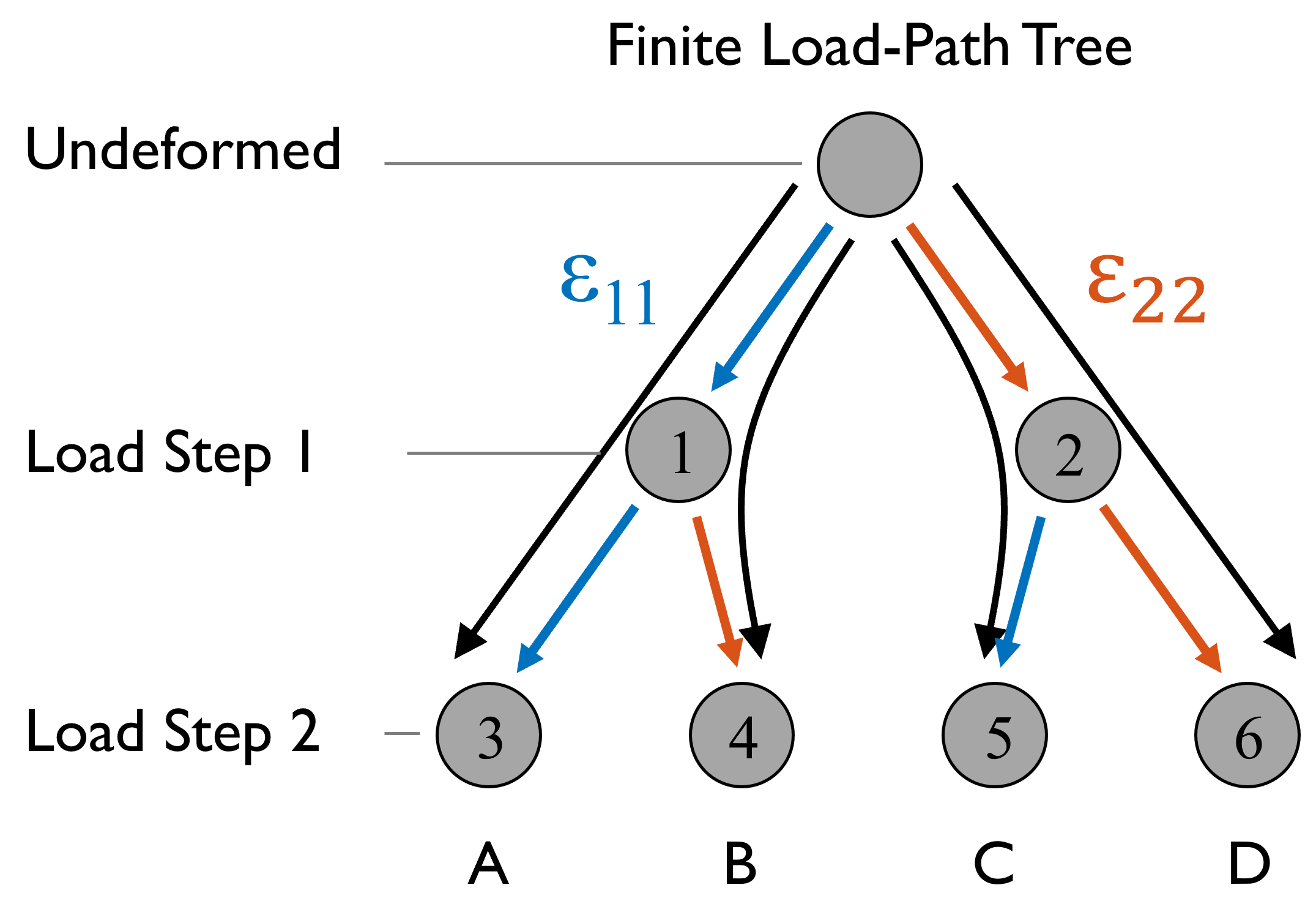
- 使用二叉树结构建模载荷路径决策空间,其中每个节点代表一个应变增量选择,EIG在每个子节点上进行计算。
- EIG通过一个快速材料点模拟器计算,该模拟器用于模拟双轴加载下平面应力弹塑性行为。
- 框架将基于EIG最大化选择的自适应设计,与两种基于人工直觉的静态预设载荷路径进行对比。
- 在更复杂的示例中,每步运行时间少于3分钟,表明其适用于准实时实现。
实验结果
研究问题
- RQ1通过贝叶斯最优实验设计(BOED)的自适应载荷路径选择,是否能比静态的、基于直觉的载荷路径更有效地降低本构模型校准中的参数不确定性?
- RQ2期望信息增益(EIG)准则如何指导双轴加载场景下最优应变增量方向的选择?
- RQ3交替载荷路径对各向异性塑性模型参数估计精度与不确定性降低有何影响?
- RQ4自适应与静态实验设计在后验分布可靠性方面如何比较——以与真实参数值的距离衡量?
- RQ5ICC框架能否高效地实现实时运行,以支持基于全场数据的主动控制实验?
主要发现
- 通过BOED实现的自适应载荷路径选择,在一个示例问题中相较静态的、基于直觉的载荷路径,将后验参数不确定性降低了最多100%。
- 自适应设计产生的后验分布具有更低的总方差与广义方差,表明对模型参数的估计更加精确。
- 自适应设计在捕捉真实参数值方面更具可靠性,表现为与真实参数的平均距离(MD)更低。
- 交替载荷路径(例如在ε₁₁与ε₂₂之间切换)始终被算法优先选择,可能是因为需要探测各向异性屈服行为。
- 在更复杂的示例中,算法每步运行时间少于3分钟,包括EIG计算与推断,证明了其在准实时应用中的可行性。
- ICC框架可扩展至非二叉树结构,例如包含压缩或同时应变增量的结构,而无需改变核心算法逻辑。
更好的研究,从现在开始
从阅读论文到最终审阅,大幅缩短您的研究时间。
无需绑定信用卡
本解读由 AI 生成,并经人工编辑审核。