
[论文解读] Benchmarking Generated Poses: How Rational is Structure-based Drug Design with Generative Models?
这篇论文提出 PoseCheck,一个用于评估结构基于药物设计中生成结合位点的生物物理基准套件,显示生成的位点常常存在物理违规,并且重新对接可以掩盖这些问题。
Deep generative models for structure-based drug design (SBDD), where molecule generation is conditioned on a 3D protein pocket, have received considerable interest in recent years. These methods offer the promise of higher-quality molecule generation by explicitly modelling the 3D interaction between a potential drug and a protein receptor. However, previous work has primarily focused on the quality of the generated molecules themselves, with limited evaluation of the 3D molecule \emph{poses} that these methods produce, with most work simply discarding the generated pose and only reporting a "corrected" pose after redocking with traditional methods. Little is known about whether generated molecules satisfy known physical constraints for binding and the extent to which redocking alters the generated interactions. We introduce PoseCheck, an extensive analysis of multiple state-of-the-art methods and find that generated molecules have significantly more physical violations and fewer key interactions compared to baselines, calling into question the implicit assumption that providing rich 3D structure information improves molecule complementarity. We make recommendations for future research tackling identified failure modes and hope our benchmark can serve as a springboard for future SBDD generative modelling work to have a real-world impact.
研究动机与目标
- 在 SBDD 中评估超越二维分子指标的生成结合位点质量。
- 评估三维生成模型在结合过程是否符合已知的生物物理约束。
- 表征重新对接对构象质量与相互作用准确性的影响。
- 识别失效模式并提出改进 SBDD 生成方法的建议。
提出的方法
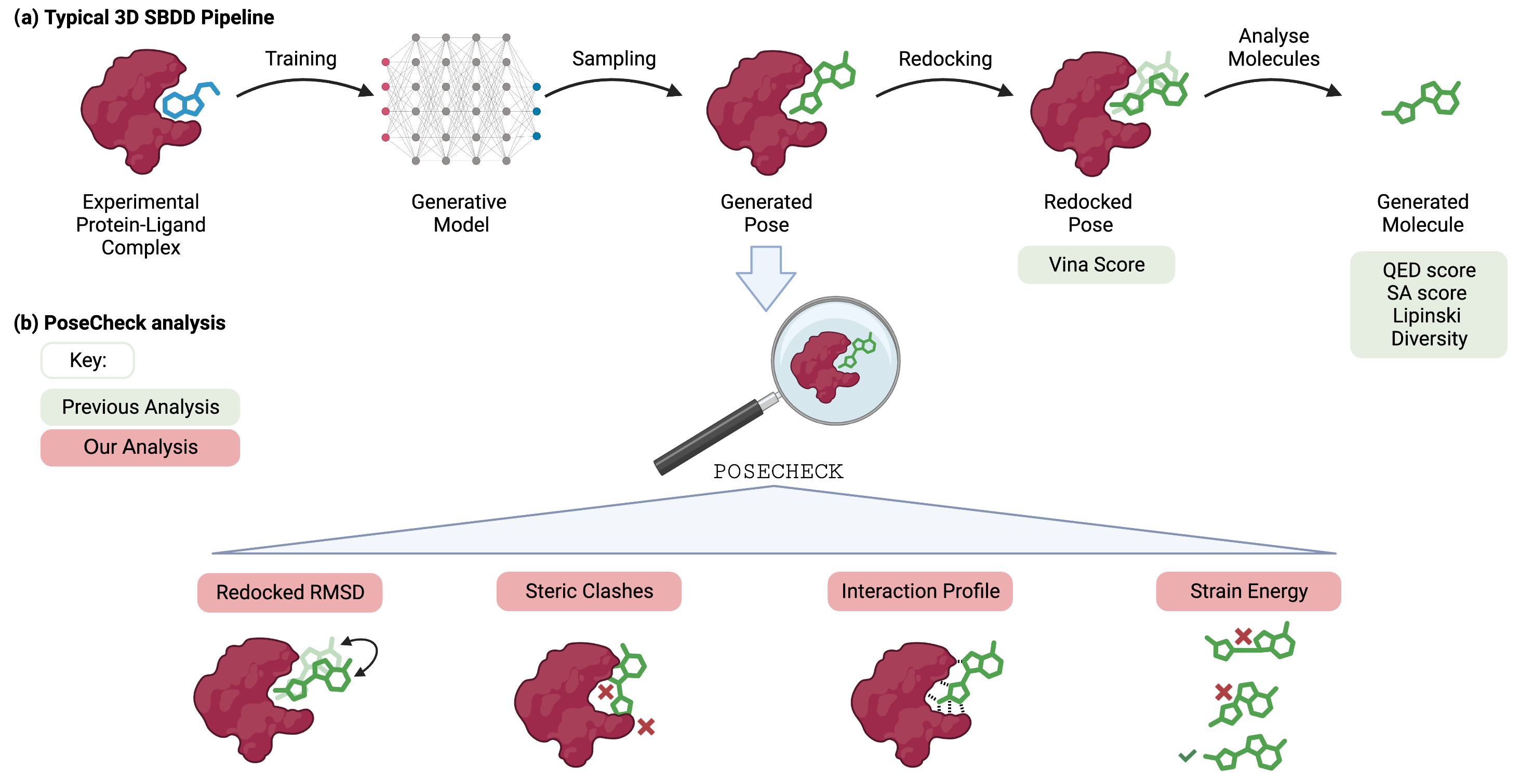
- 引入 PoseCheck,包含面向生成和重新对接位点的整个流程及各组件的度量。
- 使用相互作用指纹(ProLIF)比较氢键、范德瓦尔斯接触和疏水相互作用。
- 基于范德瓦尔斯半径,使用 0.5 Å 容忍度量化立体拥挤冲突。
- 通过 RDKit 的 UFF,利用放松位姿与生成位姿之差计算应变能。
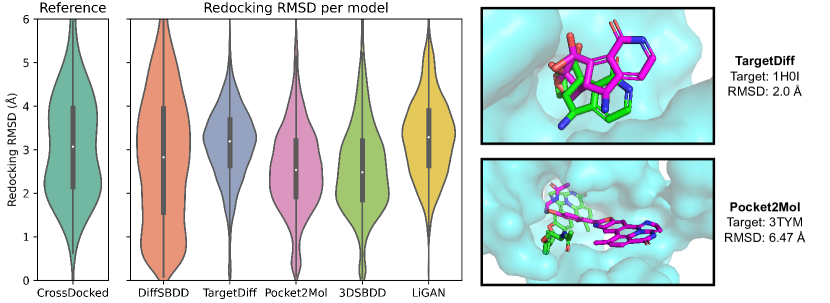
- 在 CrossDocked2020 测试集上,使用 QuickVina2 对五种方法评估生成位姿与重新对接位姿之间的 RMSD。
- 分析氢键及其他相互作用,将生成位姿与 CrossDocked 参考进行比较。
实验结果
研究问题
- RQ1生成的位姿是否像 CrossDocked 参考那样经常满足生物物理约束(氢键、立体兼容性)?
- RQ2重新对接如何影响生成分子的构象质量与相互作用模式?
- RQ3哪些 SBDD 生成方法能产生物理上合理的位姿,具有更少的冲突和更低的应变能?
- RQ4当前三维生成 SBDD 模型的主要失效模式是什么?
主要发现
- 所有方法在生成位姿与重新对接位姿之间的 RMSD 均较高(中位数不低于 2 Å)。
- 生成位姿的氢键供体/受体数量显著少于基线,表明氢键网络较弱。
- 扩散式方法中立体拥挤冲突更为严重,重新对接减少了但未消除严重冲突。
- 生成位姿的应变能通常明显高于 CrossDocked 基线,尤其是对扩散模型和 LiGAN。
- 在许多情况下,重新对接可能掩盖基本的位姿不合理性,而非纠正它们。
- 在重新对接前 LiGAN 显示出相对更好的相互作用相似性,但在重新对接后退化。
更好的研究,从现在开始
从阅读论文到最终审阅,大幅缩短您的研究时间。
无需绑定信用卡
本解读由 AI 生成,并经人工编辑审核。