
[论文解读] Beyond Clicks: Modeling Multi-Relational Item Graph for Session-Based Target Behavior Prediction
本文提出 MGNN-SPred,一种多关系图神经网络,通过建模多种行为类型(如点击、购买)之间的全局物品-物品关系,以提升基于会话的目标行为预测性能。通过构建多关系物品图(MRIG)并使用门控机制融合目标行为与辅助行为的表征,MGNN-SPred 在两个真实世界数据集上实现了最先进性能,证明了利用稀疏但关键的行为(如购买)的价值。
Session-based target behavior prediction aims to predict the next item to be interacted with specific behavior types (e.g., clicking). Although existing methods for session-based behavior prediction leverage powerful representation learning approaches to encode items' sequential relevance in a low-dimensional space, they suffer from several limitations. Firstly, they focus on only utilizing the same type of user behavior for prediction, but ignore the potential of taking other behavior data as auxiliary information. This is particularly crucial when the target behavior is sparse but important (e.g., buying or sharing an item). Secondly, item-to-item relations are modeled separately and locally in one behavior sequence, and they lack a principled way to globally encode these relations more effectively. To overcome these limitations, we propose a novel Multi-relational Graph Neural Network model for Session-based target behavior Prediction, namely MGNN-SPred for short. Specifically, we build a Multi-Relational Item Graph (MRIG) based on all behavior sequences from all sessions, involving target and auxiliary behavior types. Based on MRIG, MGNN-SPred learns global item-to-item relations and further obtains user preferences w.r.t. current target and auxiliary behavior sequences, respectively. In the end, MGNN-SPred leverages a gating mechanism to adaptively fuse user representations for predicting next item interacted with target behavior. The extensive experiments on two real-world datasets demonstrate the superiority of MGNN-SPred by comparing with state-of-the-art session-based prediction methods, validating the benefits of leveraging auxiliary behavior and learning item-to-item relations over MRIG.
研究动机与目标
- 解决现有基于会话的推荐模型仅依赖目标行为序列、忽略辅助行为数据的局限性。
- 克服缺乏一种全局、系统化的方法来编码多种行为类型下的物品-物品关系的问题。
- 通过利用更丰富的行为信号,提升稀疏但重要的目标行为(如购买、分享)的预测准确性。
- 开发一个统一框架,利用图神经网络联合建模用户在目标行为与辅助行为序列中的偏好。
提出的方法
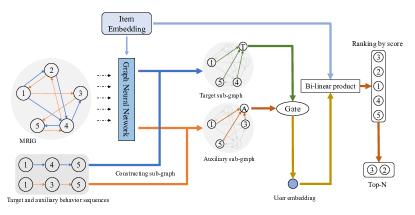
- 从所有用户行为序列构建多关系物品图(MRIG),其中节点代表物品,边代表不同行为类型(如点击、购买)。
- 使用图神经网络(GNN)在 MRIG 上传播表征,以全局方式捕捉高阶物品-物品关系。
- 在 MRIG 内部的独立子图中,分别为目标行为与辅助行为序列学习用户偏好表征。
- 应用可学习的门控机制,自适应地融合目标行为与辅助行为的表征,生成统一的用户偏好向量。
- 端到端训练模型,使用交叉熵损失预测目标行为序列中的下一个物品。
实验结果
研究问题
- RQ1将辅助行为序列(如点击)纳入是否能提升稀疏目标行为(如购买)的预测性能?
- RQ2在多种行为类型上建模全局物品-物品关系,是否能优于局部、行为序列特定的建模方式,从而提升基于会话的推荐性能?
- RQ3所提出的门控机制在融合目标行为与辅助行为序列表征方面有多有效?
- RQ4GNN 深度与序列长度对所提框架中模型性能有何影响?
主要发现
- MGNN-SPred 在 WeChat 与 YooChoose 数据集上均达到最先进性能,在 H@100、M@100 与 N@100 指标上优于现有 SOTA 方法。
- 消融实验表明,移除辅助行为边(w/o ae)会导致性能下降,验证了辅助数据的有效性。
- 移除辅助子图建模(w/o asg)导致性能显著下降,表明独立建模辅助序列的重要性。
- 将门控机制替换为简单求和(w/o g)会降低性能,证明了自适应融合的有效性。
- 模型性能随 GNN 深度增加至 2 时提升,但在深度超过 3 后下降,表明存在最优的表征传播深度。
- WeChat 与 YooChoose 数据集的性能峰值出现在不同序列长度,反映出两数据集平均会话长度的差异。
更好的研究,从现在开始
从阅读论文到最终审阅,大幅缩短您的研究时间。
无需绑定信用卡
本解读由 AI 生成,并经人工编辑审核。