
[论文解读] Binary vision: The merging black hole binary mass distribution via iterative density estimation
本文提出一种基于自适应带宽核密度估计(awKDE)的迭代密度估计方法,无需假设质量比的参数形式(如幂律),从引力波数据中重建并合双黑洞的完整二维质量分布。该方法降低了测量不确定性带来的偏差,并揭示了次级质量分布中具有明显谱线样特征的结构,以及在约10 M⊙附近与主星质量的反相关性,挑战了以往对普遍质量比分布的假设。
Binary black hole (BBH) systems detected via gravitational-wave (GW) emission are a recently opened astrophysical frontier with many unknowns and uncertainties. Accurate reconstruction of the binary distribution with as few assumptions as possible is desirable for inference on formation channels and environments. Most population analyses have, though, assumed a power law in binary mass ratio $q$, and/or assumed a universal $q$ distribution regardless of primary mass. Kernel density estimation (KDE)-based methods allow us to dispense with such assumptions and directly estimate the joint binary mass distribution. We deploy a self-consistent iterative method to estimate this full BBH mass distribution, finding local maxima in primary mass consistent with previous investigations and a secondary mass distribution with a partly independent structure, inconsistent with both power laws and with a constant function of $q$. We find a weaker preference for near-equal mass binaries than in most previous investigations; instead, the secondary mass has its own "spectral lines" at slightly lower values than the primary, and we observe an anti-correlation between primary and secondary masses around the ~$10M_\odot$ peak.
研究动机与目标
- 在不假设质量比q的参数形式(如幂律)的前提下,重建并合双黑洞的完整二维质量分布。
- 通过基于awKDE密度估计的迭代重加权方案,减少单个事件参数测量不确定性带来的偏差。
- 探究次级质量分布是否独立于主星质量,或表现出与恒定或幂律q分布不一致的结构。
- 利用数据驱动方法检验群体推断中常见假设的有效性,如普遍q分布或q ∝ m₁^β。
- 为引力波天文学中的群体推断提供一种非参数化、自洽的框架,最大限度减少模型依赖性。
提出的方法
- 该方法采用自适应带宽核密度估计(awKDE)对引力波探测结果中主星与次星黑洞质量的联合概率密度进行非参数估计。
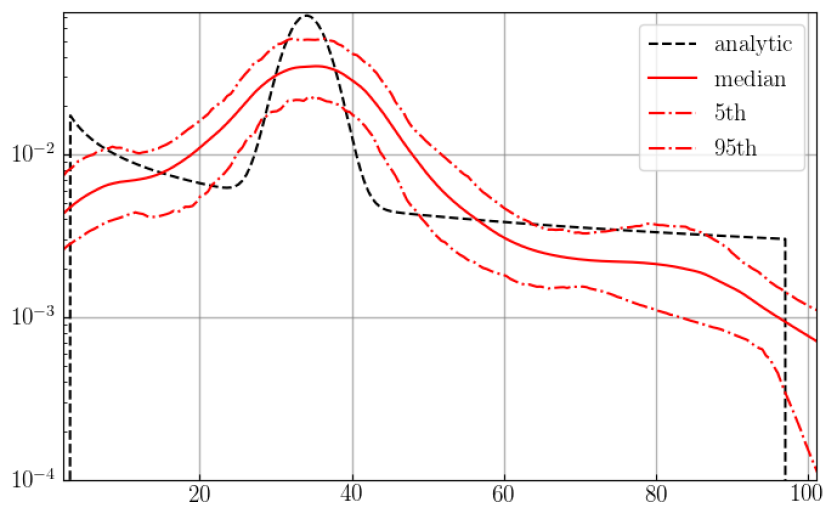
- 应用一种受期望最大化算法启发的迭代重加权方案,通过将当前密度估计作为提议分布来重新加权后验样本,以优化密度估计。
- 算法在当前样本上交替执行密度估计与样本权重更新,以更好地反映真实底层分布,从而降低由噪声较大的单个事件测量带来的偏差。
- 采用高斯核进行密度估计,带宽根据局部数据密度自适应调整,以提高稀疏区域的估计精度。
- 该方法应用于GWTC-1至GWTC-3引力波事件星表,聚焦于双黑洞并合事件。
- 该方法避免对质量比分布形式的假设,能够检测到如局部极大值和反相关性等复杂非均匀结构。
实验结果
研究问题
- RQ1次级黑洞质量分布是否表现出与主星质量无关的结构,且与恒定或幂律质量比分布不一致?
- RQ2在约10 M⊙峰值区域是否存在主星与次星质量之间的反相关性,如数据所示?
- RQ3与标准KDE相比,迭代重加权方案在群体质量分布重建中的准确性如何提升?
- RQ4当前关于q的假设(如幂律或恒定)在双黑洞研究中在多大程度上导致群体推断的偏差?
- RQ5非参数化、数据驱动的方法能否揭示参数模型所遗漏的质量分布特征?
主要发现
- 该方法揭示了次级质量分布中存在明显局部极大值,其位置略低于主星质量,表明该分布非均匀且结构复杂,与恒定或幂律q函数不一致。
- 在约10 M⊙峰值区域观察到主星与次星质量之间的反相关性,暗示其形成或演化过程中存在物理关联。
- 对近似等质量双黑洞的偏好弱于大多数先前研究,挑战了普遍认为q ≈ 1偏好强烈的假设。
- 迭代重加权方案有效降低了单个事件参数测量不确定性带来的偏差,提升了重建群体分布的真实性。
- 联合质量分布明显偏离幂律和恒定q模型,表明普遍q假设无法被数据支持。
- 该方法成功识别出次级质量分布中的“谱线样”特征,提示双黑洞形成过程中存在复杂的天体物理机制。
更好的研究,从现在开始
从阅读论文到最终审阅,大幅缩短您的研究时间。
无需绑定信用卡
本解读由 AI 生成,并经人工编辑审核。