
[论文解读] Birth of Rapidly Spinning, Overmassive Black Holes in the Early Universe
本文提出,尘埃丰富的早期宇宙类星体,即‘小红点’(LRDs),由于在致密环境中持续且相干的吸积,其核心存在快速旋转、超质量的黑洞(BHs)。对 z ≈ 4–5 时黑洞质量增长速率与质量密度的分析表明,辐射效率超过20%,对应黑洞自旋接近最大极限的96%,这挑战了传统的混沌吸积模型,暗示对早期黑洞增长起主导作用的是对齐的气体流入。
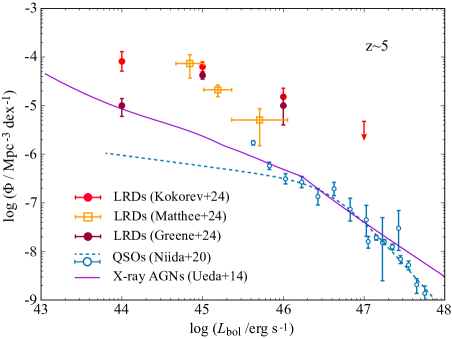
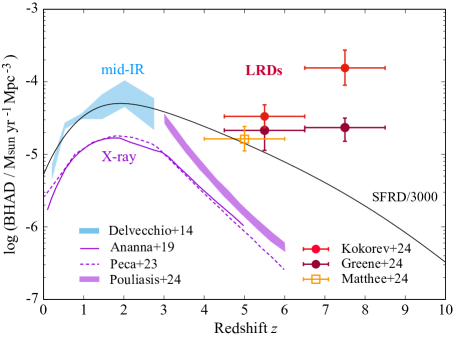
The James Webb Space Telescope (JWST) has unveiled numerous massive black holes (BHs) in faint, broad-line active galactic nuclei (AGNs). The discovery highlights the presence of dust-reddened AGN populations, referred to as "little red dots (LRDs)", more abundant than X-ray selected AGNs, which are less influenced by obscuration. This finding indicates that the cosmic growth rate of BHs within this population does not decrease but rather increases at higher redshifts beyond $z\sim 6$. The BH accretion rate density deduced from their luminosity function is remarkably higher than that from other AGN surveys in X-ray and infrared bands. To align the cumulative mass density accreted to BHs with the observed BH mass density at $z\simeq 4-5$, as derived from the integration of the BH mass function, the radiative efficiency must be doubled from the canonical 10% value, achieving significance beyond the $>3σ$ confidence level. This suggests the presence of rapid spins with 96% of the maximum limit among these BHs, maintained by prolonged mass accretion instead of chaotic accretion with randomly oriented inflows. Moreover, we derive an upper bound for the stellar mass of galaxies hosting these LRDs, ensuring consistency with galaxy formation in the standard cosmological model, where the host stellar mass is limited by the available baryonic reservoir. Our analysis gives a lower bound for the BH-to-galaxy mass ratio that exceeds the typical value known in the nearby universe and aligns with that for JWST-detected unobscured AGNs. Accordingly, we propose a hypothesis that the dense, dust-rich environments within LRDs facilitate the emergence of rapidly spinning and overmassive BH populations during the epoch of reionization. This scenario predicts a potential association between relativistic jets and other high-energy phenomena with overmassive BHs in the early universe.
研究动机与目标
- 将 z ≈ 4–5 时观测到的黑洞质量密度与从高红移 AGN 光度函数推导出的累积质量吸积相协调。
- 确定‘小红点’(LRDs)中黑洞的辐射效率,LRDs 是由 JWST 新发现的尘埃消光、具有宽线的 AGN 群体。
- 通过将吸积速率与观测到的质量函数进行比较,约束早期宇宙黑洞的自旋,检验相干吸积与混沌吸积的主导性。
- 建立与标准宇宙学一致的宿主星系恒星质量上限,并推导 LRD 中 BH 与星系质量比的下限。
- 提出一种物理解释,将 LRD 中尘埃丰富的环境与快速旋转、超质量黑洞的形成联系起来,发生在再电离时期。
提出的方法
- 在 z ≈ 4–5 时应用 Soltan-Paczyński 论证,将观测到的黑洞质量函数与从 LRD 的总光度函数推导出的积分吸积速率进行比较。
- 利用 JWST 对 Hα 和连续谱光度的观测,估算 LRD 的总光度,从而实现吸积速率的计算。
- 通过假设一系列与自旋相关的效率,计算使观测到的 BH 质量密度与吸积质量一致所需的辐射效率。
- 通过要求与标准宇宙学模型中重子物质储库限制一致,推导出宿主星系恒星质量的最大上限。
- 通过结合观测到的 BH 质量与推导出的宿主恒星质量上限,估算 BH 与星系质量比的下限。
- 提出一种物理情景:LRD 中致密且富含尘埃的环境促进持续且对齐的吸积,导致高自旋与超质量黑洞的形成。
实验结果
研究问题
- RQ1为使 z ≈ 4–5 时观测到的黑洞质量密度与从 LRD 光度函数推导出的吸积速率相一致,所需的辐射效率是多少?
- RQ2推导出的辐射效率所暗示的自旋参数为何?与经典值和理论极限相比如何?
- RQ3在已知观测到的 BH 质量下,标准宇宙学模型对 LRD 宿主星系恒星质量施加了何种限制?
- RQ4LRD 中 BH 与星系质量比与本地值相比如何?这对早期黑洞增长机制有何启示?
- RQ5LRD 的观测特性能否由持续的相干吸积而非混沌吸积来解释?这对喷流产生与多信使信号有何影响?
主要发现
- 为使吸积质量与观测到的黑洞质量密度一致,所需的辐射效率超过20%,显著高于经典的10%,显著性水平 >2σ。
- 此高辐射效率意味着黑洞自旋接近最大 Kerr 极限的96%,对应无量纲自旋参数 a₆ ≈ 0.96。
- 分析表明,LRD 中黑洞增长主要由持续的、相干的吸积主导,其角动量方向对齐,而非由随机取向的混沌吸积主导。
- 宿主星系恒星质量的上限被约束,以确保与标准宇宙学模型中重子物质储库限制一致。
- LRD 中 BH 与星系质量比的下限超过典型的本地值,并与未遮蔽的 JWST AGN 中观测到的值一致,表明在高红移时黑洞相对于其宿主星系更为质量超大。
- 本研究提出,LRD 中富含尘埃的致密环境有助于形成快速旋转、超质量的黑洞,可能与相对论喷流及高能暂现现象有关。
更好的研究,从现在开始
从阅读论文到最终审阅,大幅缩短您的研究时间。
无需绑定信用卡
本解读由 AI 生成,并经人工编辑审核。