
[论文解读] Blockchain for Data Sharing at the Network Edge: Trade-Off Between Capability and Security
本文使用马尔可夫链在区块链网络边缘建模区块传播,以分析交易吞吐量(能力)与故障容错性、恶意修改概率等安全指标之间的权衡。结果表明,提高区块生成速度或大小可将吞吐量提升至数千 TPS,但会降低容错能力;而提高确认阈值可恢复安全性,代价是更高的确认延迟。
Blokchain is a promising technology to enable distributed and reliable data sharing at the network edge. The high security in blockchain is undoubtedly a critical factor for the network to handle important data item. On the other hand, according to the dilemma in blockchain, an overemphasis on distributed security will lead to poor transaction-processing capability, which limits the application of blockchain in data sharing scenarios with high-throughput and low-latency requirements. To enable demand-oriented distributed services, this paper investigates the relationship between capability and security in blockchain from the perspective of block propagation and forking problem. First, a Markov chain is introduced to analyze the gossiping-based block propagation among edge servers, which aims to derive block propagation delay and forking probability. Then, we study the impact of forking on blockchain capability and security metrics, in terms of transaction throughput, confirmation delay, fault tolerance, and the probability of malicious modification. The analytical results show that with the adjustment of block generation time or block size, transaction throughput improves at the sacrifice of fault tolerance, and vice versa. Meanwhile, the decline in security can be offset by adjusting confirmation threshold, at the cost of increasing confirmation delay. The analysis of capability-security trade-off can provide a theoretical guideline to manage blockchain performance based on the requirements of data sharing scenarios.
研究动机与目标
- 分析边缘网络中基于区块链的数据共享的性能-安全权衡。
- 利用马尔可夫链对边缘服务器之间的区块传播进行建模,以量化传播延迟和分叉概率。
- 推导关键性能指标的闭式表达式:交易吞吐量、确认延迟、容错能力以及篡改概率。
- 提供理论边界和设计指南,以根据边缘计算中特定应用的需求调整区块链参数。
提出的方法
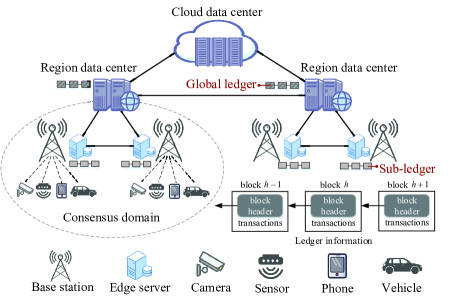
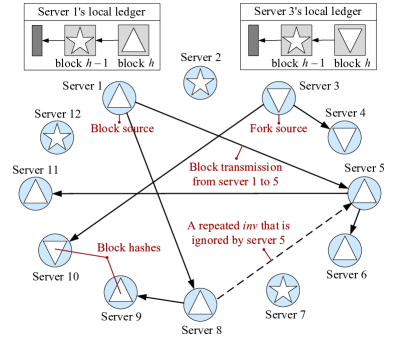
- 构建连续时间马尔可夫链,以模拟新区块在边缘服务器间的动态传播过程,跟踪随时间推移的已知服务器数量。
- 模型考虑异步区块传输,并纳入总服务器数、选中服务器数和数据速率等网络参数。
- 利用马尔可夫链推导区块传播延迟和故障状态转移概率,从而分析传播可靠性。
- 基于传播不完全性计算分叉概率,该概率直接影响区块链的安全性和能力指标。
- 从传播模型中推导出交易吞吐量、确认延迟、容错能力以及恶意篡改概率的数学表达式。
- 分析可调参数(区块生成时间、区块大小和确认阈值)的影响,揭示其中的权衡关系。
实验结果
研究问题
- RQ1在边缘区块链系统中,区块传播延迟和分叉概率如何随服务器数量和传输速率等网络参数变化?
- RQ2边缘区块链的交易吞吐量理论上限是多少?其受网络和系统参数的何种约束?
- RQ3分叉如何影响区块链数据共享中的容错能力和恶意数据篡改概率?
- RQ4提高确认阈值在多大程度上可弥补因高分叉概率导致的安全性下降?
- RQ5当存在分叉时,确认延迟与安全等级之间存在何种权衡?
主要发现
- 通过缩短区块生成时间或增大区块大小,交易吞吐量可从 7 TPS 提升至 1,000 TPS 以上,但容错能力会下降 10% 至 40%,具体取决于分叉概率。
- 交易吞吐量的理论上限对网络参数高度敏感,包括边缘服务器总数、每次传输中选中的服务器数以及网络数据速率。
- 当分叉概率较高时,恶意数据篡改概率上升,但可通过提高确认阈值 $ m $ 来缓解,该方法可对数级降低风险。
- 为实现比特币的安全等级 1(攻击者算力占比 10%),确认阈值需从 $ m=6 $ 提高至 $ m=16 $;对于安全等级 2(20% 攻击者算力),需 $ m=28 $。
- 由于分叉的存在,确认延迟随区块大小呈指数增长;更高的安全等级(通过增大 $ m $ 实现)会带来额外延迟,清晰展示了安全与延迟之间的权衡。
- 退出故障状态(如传播不完全)的期望时间在很大程度上依赖于选择参数 $ k $,较小的 $ k $ 可通过提高选择未知服务器的概率,实现更快恢复。
更好的研究,从现在开始
从阅读论文到最终审阅,大幅缩短您的研究时间。
无需绑定信用卡
本解读由 AI 生成,并经人工编辑审核。