
[论文解读] Breast Cancer Segmentation using Attention-based Convolutional Network and Explainable AI
该论文提出了一种基于注意力的 UNet 架构,用于超声图像中的乳腺癌分割,通过 CLAHE 预处理和可解释 AI(Grad-CAM)分析模型聚焦,具有竞争力的准确率和 IoU。
Breast cancer (BC) remains a significant health threat, with no long-term cure currently available. Early detection is crucial, yet mammography interpretation is hindered by high false positives and negatives. With BC incidence projected to surpass lung cancer, improving early detection methods is vital. Thermography, using high-resolution infrared cameras, offers promise, especially when combined with artificial intelligence (AI). This work presents an attention-based convolutional neural network for segmentation, providing increased speed and precision in BC detection and classification. The system enhances images and performs cancer segmentation with explainable AI. We propose a transformer-attention-based convolutional architecture (UNet) for fault identification and employ Gradient-weighted Class Activation Mapping (Grad-CAM) to analyze areas of bias and weakness in the UNet architecture with IRT images. The superiority of our proposed framework is confirmed when compared with existing deep learning frameworks.
研究动机与目标
- 推动自动化乳腺癌检测与分割,降低乳腺摄影和超声成像中的误判。
- 开发将注意力机制的 CNN 与图像增强相结合的分割框架,以提高感兴趣区域(ROI)提取。
- 引入可解释 AI,直观展示并理解超声基础的 BC 分割中的模型决策。
提出的方法
- 通过 CLAHE 的直方图均衡化来增强超声图像并提取感兴趣区域。
- 采用基于 UNet 的编码-解码结构并加入注意力机制(注意力门控,Attention Gate)以提升分割质量。
- 在分割框架中融入 Vision Transformer(ViT)元素以提升性能。
- 使用 IoU、Loss、Accuracy、Precision、Recall、F1-Score 等标准指标进行分割评估,并用于 XAI 分析的 Grad-CAM。
- 将所提的 AttentionUNet 与现有最先进的深度学习框架在乳腺癌数据集上进行对比。
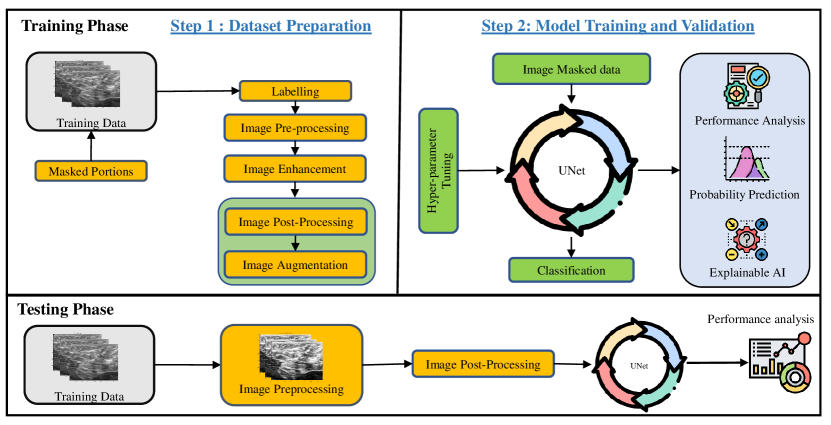
实验结果
研究问题
- RQ1基于注意力增强的 UNet 能否在超声图像上相比标准架构改善乳腺癌分割?
- RQ2基于 CLAHE 的预处理是否改善在有噪声的超声数据中的 ROI 提取和分割性能?
- RQ3Grad-CAM 是否能为模型聚焦区域提供有意义的解释,以支持对 AI 基于分割的临床信任?
主要发现
- 最大训练准确率为 95%,最大验证准确率为 99%。
- 模型在 12 轮训练后显示出强分割性能,具有较高的 IoU 和稳健的学习曲线。
- 使用 Grad-CAM 分析来检查模型区域,支持分割决策的可解释性。
- 所提架构据称在乳腺癌超声数据集上比某些现有深度学习框架更快且更精确。
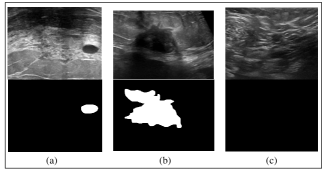
- 定性结果显示模型能有效检测出暗区,但对不规则形状可能存在困难,建议调整训练策略(如更长训练、分段轮次)。
更好的研究,从现在开始
从阅读论文到最终审阅,大幅缩短您的研究时间。
无需绑定信用卡
本解读由 AI 生成,并经人工编辑审核。