
[论文解读] Bridging Systems: Open Problems for Countering Destructive Divisiveness across Ranking, Recommenders, and Governance
本文阐述 Bridging Systems(桥接系统)及一个跨 ranking、集体响应与治理的注意力分配框架,强调解决分裂的开放问题。
Divisiveness appears to be increasing in much of the world, leading to concern about political violence and a decreasing capacity to collaboratively address large-scale societal challenges. In this working paper we aim to articulate an interdisciplinary research and practice area focused on what we call bridging systems: systems which increase mutual understanding and trust across divides, creating space for productive conflict, deliberation, or cooperation. We give examples of bridging systems across three domains: recommender systems on social media, collective response systems, and human-facilitated group deliberation. We argue that these examples can be more meaningfully understood as processes for attention-allocation (as opposed to "content distribution" or "amplification") and develop a corresponding framework to explore similarities - and opportunities for bridging - across these seemingly disparate domains. We focus particularly on the potential of bridging-based ranking to bring the benefits of offline bridging into spaces which are already governed by algorithms. Throughout, we suggest research directions that could improve our capacity to incorporate bridging into a world increasingly mediated by algorithms and artificial intelligence.
研究动机与目标
- 将 bridging 定义为注意力分配器的一个属性,并阐明其社会目标,即在分歧之间提升相互理解。
- 提出一个跨学科框架,将推荐系统、集体响应工具与人类促成联系起来。
- 提出信号、指标和数据建模方法,以在算法系统和人类系统中实现桥接。
- 识别桥接系统的评估挑战、风险及实施局限。
- 提出具体的开放研究问题,以促进跨领域协作与负责任部署。
提出的方法
- 开发一个适用于三个领域的注意力分配框架:推荐系统、集体响应系统,以及人类促进的讨论。
- 形式化分配与学习过程,包括状态与预测模型,以及引导分配的价值模型。
- 引入可用于在优化栈中优化桥接的信号与指标。
- 讨论评估方法并概述桥接系统的实际评估注意事项。
- 提供实际案例的分类,以及可执行的研究方向,突出对从业者和研究人员的绿色框和蓝色框指引。

实验结果
研究问题
- RQ1在不同领域(排名、集体响应、讨论)中,奖励桥接的系统应具备何种样貌,以及如何设计?
- RQ2如何将桥接作为注意力分配器的一个属性进行操作化,并整合到它们的优化框架中?
- RQ3哪些信号、指标和数据模型可以可靠地实现并衡量桥接结果?
- RQ4实施桥接系统时的评估挑战、局限性与风险是什么,如何加以缓解?
- RQ5哪些开放问题可以加速跨域研究与桥接系统的安全部署?
主要发现
- 点子:桥接系统的目标是增加跨分歧的相互理解和信任,而不是消除冲突或强制同质化。
- 框架:引入注意力分配作为统一视角,用以比较推荐系统、集体响应和促成系统。
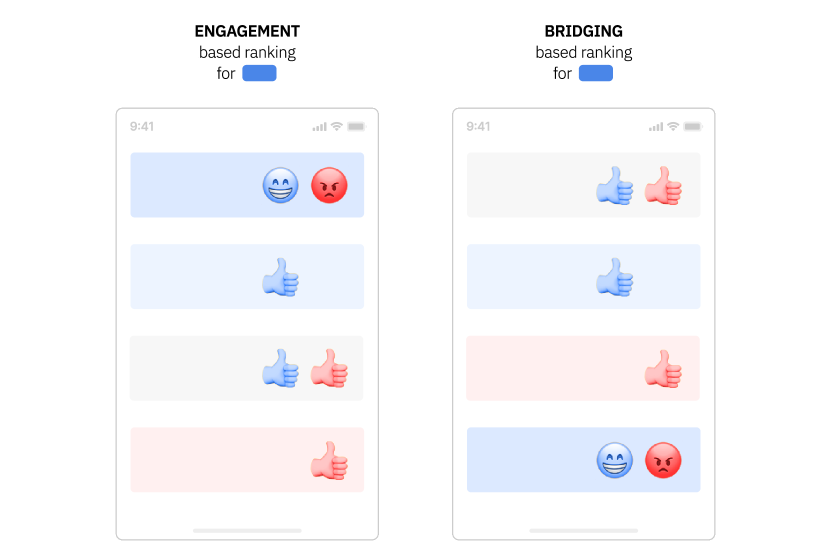
- 概念:通过重新设计排序和分配目标以奖励跨分歧对齐来实现桥梁(例如,多样化的批准模式)。
- 工具:提出信号、指标和优化栈,以指导在真实系统中桥接的开发与评估。
- 范围:强调跨学科研究方向,并指出桥接实现的挑战、局限性与风险。
更好的研究,从现在开始
从阅读论文到最终审阅,大幅缩短您的研究时间。
无需绑定信用卡
本解读由 AI 生成,并经人工编辑审核。