
[论文解读] Bright and pure single-photon source in a silicon chip by nanoscale positioning of a color center in a microcavity
本论文通过在 SOI 上在圆形 Bragg 谱线腔内确定性放置 W 中心,实现全硅芯片上的单光子源,在 CW 和脉冲激发下获得高 Purcell 增强的 ZPL 发射和极高的单光子纯度。
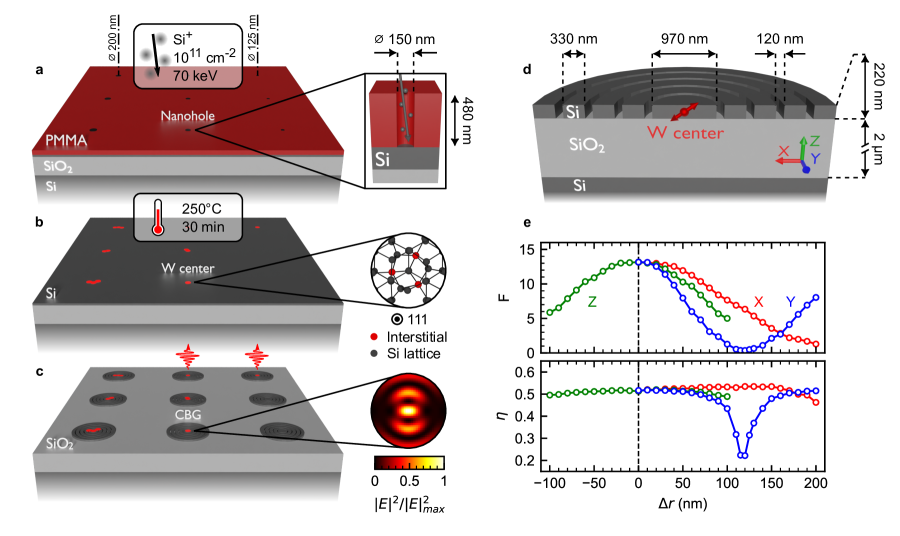
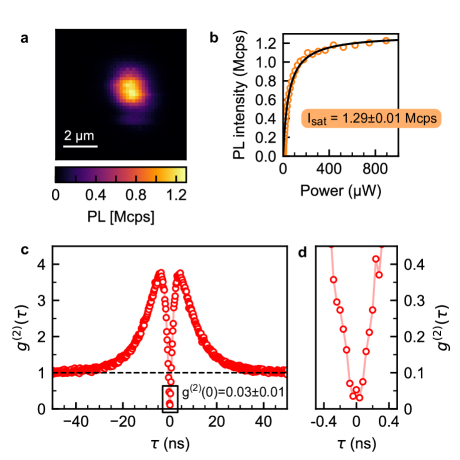
We present an all-silicon source of near-infrared linearly-polarized single photons, fabricated by nanoscale positioning of a color center in a silicon-on-insulator microcavity. The color center consists of a single W center, created at a well-defined position by Si$^{+}$ ion implantation through a 150 nm-diameter nanohole in a mask. A circular Bragg grating cavity resonant with the W's zero-phonon line at 1217 nm is fabricated at the same location as the nanohole. By Purcell enhancement of zero-phonon emission, we obtain a photon count rate of $1.29 \pm 0.01$ Mcounts/s at saturation under above-gap continuous-wave excitation with a Debye-Waller factor of $98.6\pm1.4 \%$. A clean photon antibunching behavior is observed up to pump powers ensuring saturation of the W's emission ($g^{(2)}(0)=0.06\pm0.02$ at $P=9.2P_{sat}$), evidencing that the density of additional parasitic fluorescent defects is very low. We also demonstrate the triggered emission of single photons with $93\pm2 \%$ purity under weak pulsed laser excitation. At high pulsed laser power, we reveal a detrimental effect of repumping processes, that could be mitigated using selective pumping schemes in the future. These results represent a major step towards on-demand sources of indistinguishable near-infrared single photons within silicon photonics chips.
研究动机与目标
- 在硅中通过纳米尺度发射体定位实现确定性地片上生成明亮、纯净的单光子
- 实现圆形布拉格格栅腔中 W 中心的零声子线(ZPL)发射的强 Purcell 增强
- 在 CW 和脉冲激发下评估单光子纯度、亮度和偏振特性
- 评估在硅光子学中可扩展、不可区分的片上光子源的潜力与局限性
提出的方法
- 通过在 SOI 上用 PMMA 掩模在 150 nm 纳孔处进行 Si+ 离子植入来制备 W 中心阵列
- 在纳孔位置处创建圆形布拉格谱腔(CBG),腔模与 W 的 ZPL 1217–1218 nm 共振
- 通过光致发光光谱和二阶相关函数 g(2)(τ) 在超带隙 CW 和脉冲激发下表征发射
- 通过反射谱分析腔-发射体耦合,提取腔模 Q 因子和 Purcell 增强
- 通过脉冲泵浦下的寿命测量估算 ZPL 分量及 Purcell 增强的辐射寿命
实验结果
研究问题
- RQ1一个单个 W 中心是否可以在腔驻波节点处实现确定性放置,以最大化片上硅光子结构中的 Purcell 增强?
- RQ2在 CW 与脉冲激发下,SOI CBG 腔中 W 中心的亮度、纯度 (g(2)(0)) 及 ZPL 比例可达到何种水平?
- RQ3发射体-腔耦合失谐和定位公差如何影响该系统的收集效率与 Purcell 因子?
- RQ4主要局限性(闪烁、非辐射通道)及改进硅色中心片上不可区分单光子发射的前景是什么?
主要发现
- 在腔驻波对齐的位置确定性地创建了 W 中心,实现了 ZPL 发射的强 Purcell 增强。
- 在 CW 饱和计数率约为 1.29 Mcps,g(2)(0) ≈ 0.03–0.06,覆盖全功率范围,显示极低的寄生发射。
- 零声子发射占比约为 PL 的 98.6%,表明由于腔 Purcell 增强而实现高效 ZPL 发射。
- 在弱脉冲泵浦下实现极高纯度的偏振单光子源,触发发射纯度达到 93%。
- 腔道反射测得模 Q ≈ 158(Δλ ≈ 7.7 nm),与仿真高度吻合,表明 ZPL 与腔模的光谱对准有效。
- 脉冲激发下的触发发射呈现反聚束(antibunching),其中心峰面积对应单光子发射,同时观察并分析了闪烁(亚稳态动力学)。
- 展示了与未刻画的 SOI W 中心相比显著的增强(在饱和时 PL 计数率的增强因子约为 400),凸显腔在亮度中的作用。
更好的研究,从现在开始
从阅读论文到最终审阅,大幅缩短您的研究时间。
无需绑定信用卡
本解读由 AI 生成,并经人工编辑审核。